
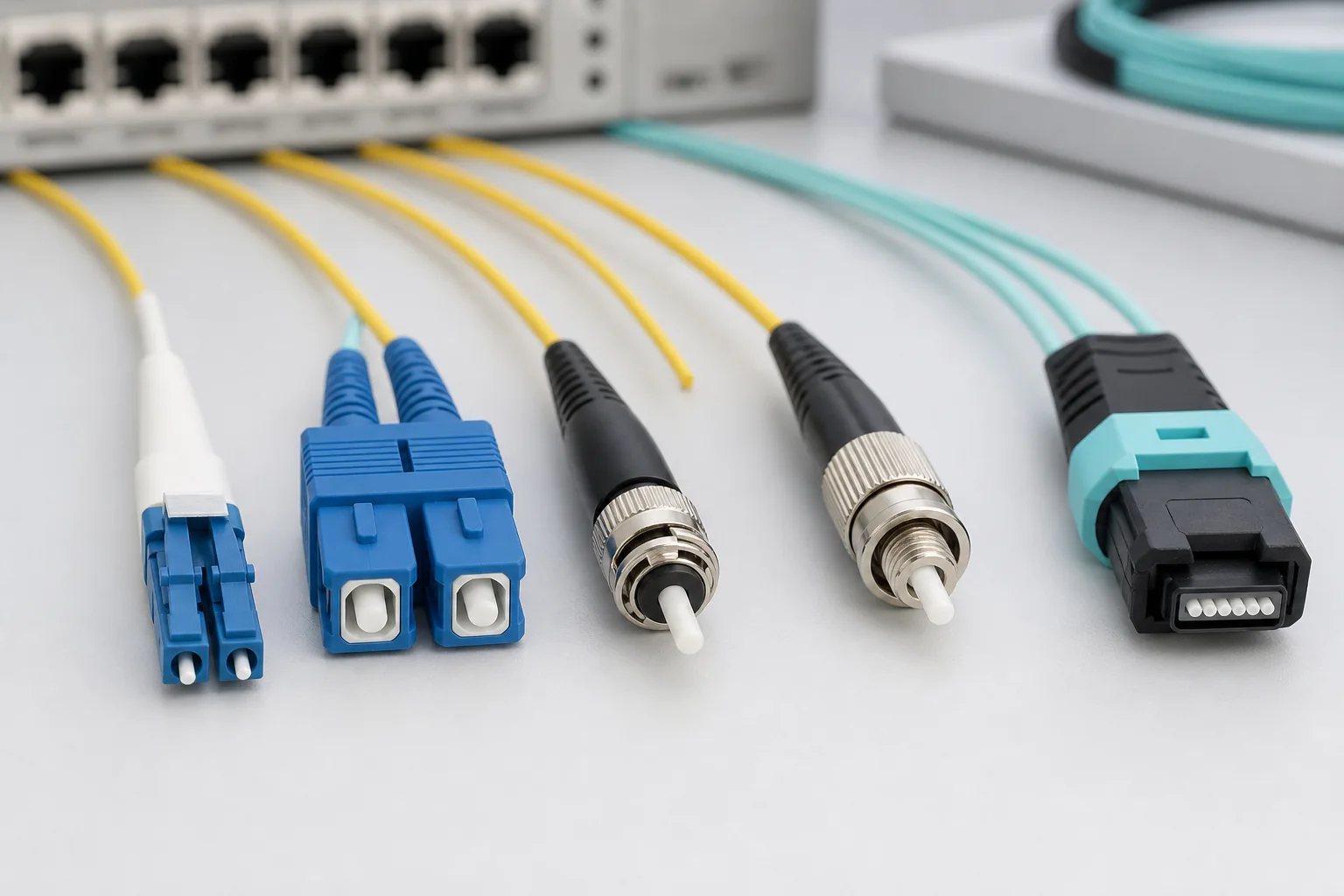
What a fiber optic adapter does
A fiber optic adapter—often called a mating adapter or coupler—aligns two connector ferrules so their fibers can form a repeatable optical connection. The housing controls mechanical engagement and panel mounting; the internal alignment sleeve controls ferrule concentricity. Adapter quality is therefore more than housing color or connector fit.
The complete selection identifies connector interface, simplex/duplex/quad density, UPC or APC compatibility, sleeve material, flange or snap-in mounting, shutter or dust protection, panel cutout, operating environment and required optical/mechanical evidence.
Adapter family comparison
| Adapter type | Typical configuration | Selection notes |
|---|---|---|
| LC | Simplex, duplex or quad; standard or shuttered | High-density panels; verify clip spacing, flange and port access |
| SC | Simplex or duplex; UPC or APC-compatible interface | Common in telecom, enterprise and PON distribution |
| FC | Threaded single-port design | Keying, panel thread and polish compatibility must match |
| ST | Bayonet-style single-port design | Often used in installed, campus or industrial systems |
| Hybrid | Different connector families on each side | Useful for controlled transitions; label both faces clearly |
| Metal adapter | Application-specific housing and mounting | Evaluate material, grounding context, durability and environment |
Zirconia ceramic and phosphor-bronze sleeves
Zirconia ceramic split sleeves are widely used for precision alignment, especially in single-mode applications. Phosphor-bronze sleeves may be used in suitable multimode or application-specific products. Sleeve material should be selected with ferrule type, alignment performance, mating cycles, temperature and project requirements in mind—not used as the only quality claim.
As one public benchmark, a current SENKO LC adapter data sheet identifies zirconia sleeve material and publishes insertion-loss, durability and environmental fields. A buyer can use the same field structure when comparing suppliers, while requiring the actual limits offered for the LIQIBA quotation.
UPC and APC compatibility
An adapter does not convert one polish into another. SC/APC connectors must mate with SC/APC connectors, and UPC connectors must mate with matching UPC interfaces. Housing color is a convention rather than a substitute for the part number and drawing. A hybrid adapter changes connector family, not the optical end-face geometry.
Before approving a bill of materials, map every equipment port, patch cord and adapter. The guides to LC vs SC connectors and UPC vs APC provide additional interface context.
Mechanical and panel-selection checklist
| Field | Buyer decision |
|---|---|
| Port count | Simplex, duplex, quad or another defined channel count |
| Mounting | Flanged, reduced-flange, flange-less snap-in, threaded or custom plate |
| Panel geometry | Cutout dimensions, panel thickness, pitch, orientation and fastener access |
| Dust protection | Removable caps or integrated shutters suited to both sides of the panel |
| Housing | Material, color/marking, keying and environmental requirement |
| Serviceability | Front/rear access, replacement method and cleaning-tool clearance |
A dense panel should be reviewed as an assembly. Port pitch that looks acceptable in a drawing can still restrict fingers, inspection probes or one-click cleaners. Shutters can improve dust and laser-safety control but must remain compatible with the intended connector and cleaning process.
Optical and durability acceptance
Insertion loss is measured through a mated connection, so the test method, reference cords, connector grade and cleanliness affect the result. State whether the limit applies to each random-mated pair, a sampled population or a complete adapter assembly. For reflection-sensitive links, also specify return loss or reflectance requirements at the connection level.
Mechanical evidence can include connector retention, mating durability, sleeve retention and panel-mount integrity. Environmental evidence may address temperature cycling, humidity, vibration or other project conditions. Do not assume a generic “telecom grade” claim defines these limits.
Inspection and cleaning before mating
Both connector end faces and the adapter path must be protected from contamination. The IEC 61300-3-35 inspection standard provides quantitative end-face assessment methods. Fluke Networks notes that end faces and ports should be inspected before connection, including both sides of an adapter.
Keep unused ports capped or shuttered, but inspect after removing the protection. Use the correct probe tip and cleaning tool for the adapter format. Never look directly into a fiber port, and follow the network owner’s laser-safety procedure.
How to specify adapters for procurement
- Connector family and polish compatibility on side A and side B.
- Port count, sleeve material, housing, flange and panel cutout.
- Color, marking, shutter or cap requirement and packaging quantity.
- Insertion-loss method and limit, durability and environmental requirements.
- Applicable drawing, sample approval, compliance documents and lot traceability.
Adapters are normally sourced together with fiber optic patch cords, panels or custom assemblies. Coordinating the interfaces in one schedule reduces mismatch risk.
Frequently asked questions
Is a fiber adapter an optical splitter?
No. An adapter aligns two connectors to continue one path. A PLC splitter intentionally divides optical power among multiple output paths.
Can the same adapter be used for single-mode and multimode?
Some mechanical formats are similar, but sleeve, color, connector and performance requirements may differ. Order the adapter for the declared application rather than relying on physical fit.
Does a green SC adapter convert UPC to APC?
No. Green commonly identifies an APC interface, but conversion requires a designed optical component, not a passive alignment sleeve. Mated connector polishes must match.
What is needed for a quotation?
Send the interface, port count, sleeve, panel drawing or cutout, mounting, color, limits, quantity and destination through the contact page.