OM3 vs OM4 vs OM5 Fiber: The Short Answer
Choose OM3, OM4 or OM5 together with the exact optical interface. For 100GBASE-SR4, the cited Cisco module supports 70 m on OM3 and 100 m on OM4/OM5; 100GBASE-SR10 has different reach and connector requirements. OM5 does not by itself guarantee a 150 m 200G or 400G link. Match the module specification, channel loss and measured route length before comparing cost.

What Are OM3, OM4, and OM5?
OM3, OM4, and OM5 are designations for laser-optimized multimode fiber (MMF) defined by international standards. They specify the fiber’s core size, bandwidth, and the distances it can support at various Ethernet speeds. The ‘OM’ stands for optical multimode, and the number indicates a performance tier—higher numbers generally mean higher bandwidth and longer reach.
Core and Cladding
All three fiber types share the same physical dimensions: a 50/125 micrometer core and cladding. This is a key difference from OM1 fiber, which has a 62.5/125 micrometer core; OM2 uses a 50/125 micrometer core. The 50-micron core is optimized for laser sources used in modern high-speed transceivers, reducing modal dispersion and enabling longer links.
Bandwidth Specifications
The main differentiator is the modal bandwidth, measured in MHz·km. This value indicates how much data can be transmitted over a given distance before the signal degrades. Standards define minimum bandwidths at specific wavelengths (850 nm and 953 nm for OM5). Typical values are:
- OM3: 2000 MHz·km at 850 nm.
- OM4: 4700 MHz·km at 850 nm.
- OM5: 4700 MHz·km at 850 nm, plus a specification at 953 nm for SWDM.
These are minimum values set by standards; actual fiber may have higher performance, but the standard guarantees the minimum.
When Does the OM3 vs OM4 vs OM5 Choice Matter?
The choice becomes critical when you are designing a network that must support high speeds over longer distances. For example, in a data center, the distance between switches in different racks or rows can vary from a few meters to hundreds of meters. If you underestimate the required reach, you may need to use more expensive single-mode fiber or add active equipment.
Typical Applications
- OM3: Suitable for 10GBASE-SR up to 300 m or standard 25GBASE-SR up to 70 m, subject to the module and channel specifications.
- OM4: Supports the cited 100GBASE-SR4 module up to 100 m; a 150 m claim must identify a different optical interface.
- OM5: Wideband multimode fiber for compatible multiwavelength optics, with OM4-level bandwidth at 850 nm; supported speed and reach depend on the module.
When to Choose Each
For standard 25GBASE-SR or 100GBASE-SR4, use 70 m on OM3 and 100 m on OM4 as the cited module limits. For longer routes or higher speeds, select a qualified optical interface first; neither OM4 nor OM5 alone guarantees the required reach.
Core Technical Differences
Beyond bandwidth, the key technical differences are in the wavelength support and the transceiver technology they are designed for.
Wavelength and Transceiver Compatibility
Standard SR optics commonly operate at 850 nm. OM5 specifies wideband performance to support compatible multiwavelength modules, including an EMB minimum of 2470 MHz·km at 953 nm. SWDM is not exclusive to OM5: compatible modules can also operate on OM3 or OM4 with their specified reach.
Distance at Common Speeds
The following table summarizes typical maximum distances (per standards) for each fiber type at popular Ethernet speeds. Note that these are ‘typical’ values based on standards; actual equipment may vary.
| Speed | OM3 | OM4 | OM5 |
|---|---|---|---|
| 10GBASE-SR | 300 m | 400 m | Confirm module qualification; no automatic extension beyond OM4 |
| 25GBASE-SR | 70 m | 100 m | Confirm module qualification |
| 100GBASE-SR4 | 70 m | 100 m | 100 m (cited Cisco module) |
| 200 Gbps | No universal reach from fiber grade alone; specify the exact PMD/module and cable assembly. | ||
| 400 Gbps | No universal 150 m guarantee; use the selected module specification. | ||
The rows above identify specific interfaces rather than a universal speed-to-fiber rule. Vendor extended-reach modules may have different limits; record the exact part number and channel conditions.
Cost Considerations
Cost is a major factor. OM3 is the least expensive, OM4 is moderately more expensive, and OM5 is the most costly due to its enhanced specifications. However, the price difference per meter is often small, and the larger cost is in transceivers. OM5 transceivers (SWDM) are newer and may be more expensive than standard 850 nm ones. For many projects, the total cost of ownership, including installation and future upgrades, should be evaluated.
In summary, the choice between OM3, OM4, and OM5 is a balance of distance, speed, and budget. By understanding the technical differences, you can make an informed decision that meets your current needs and prepares for future growth.
OM3 vs OM4 vs OM5 Fiber: Side-by-Side Comparison
When you need to compare OM3 vs OM4 vs OM5 fiber at a glance, a table helps. The values below are typical engineering figures for laser-optimized multimode fiber (LOMMF) as commonly deployed. They are not normative limits unless noted; always verify with the manufacturer’s datasheet and the relevant standard (e.g., ISO/IEC 11801 or TIA-492).
| Parameter | OM3 | OM4 | OM5 |
|---|---|---|---|
| Core diameter (µm) | 50 | 50 | 50 |
| Cladding diameter (µm) | 125 | 125 | 125 |
| Effective modal bandwidth (EMB) at 850 nm (MHz·km) | 2000 | 4700 | 4700 (minimum) |
| EMB at 953 nm (MHz·km) | Not specified | Not specified | ≥2470 |
| 10GBASE-SR reach (m) | 300 | 400 | Verify selected module support |
| 100GBASE-SR4 reach (m) | 70 | 100 | 100 (cited module) |
| 100G SWDM4 support | Module-specific | Module-specific | Module-specific; wideband fiber may extend reach |
| Relative cost per meter | Lowest | Moderate | Highest |
Note: The cited Cisco 10GBASE-SR module specifies 300 m on OM3 and 400 m on OM4. Longer vendor-specific reaches must not be presented as the baseline SR limit.
Decision Criteria: How to Choose
Your choice depends on three factors: current speed needs, future upgrade plans, and budget. Here is a practical decision framework.
Current Speed and Distance
- 10 GbE up to 300 m: OM3 is sufficient and cost-effective.
- 10GBASE-SR beyond 300 m and up to 400 m: use qualified OM4 cabling and verify the module specification.
- 100GBASE-SR4: 70 m on OM3 and 100 m on OM4/OM5 for the cited module; do not reuse 40G or SR10 reach values.
- 100G SWDM4: compare the selected module specifications on OM3, OM4 and OM5; OM5 is not the only compatible fiber grade.
Future-Proofing
If you anticipate moving to 400 GbE or beyond within the next 5–7 years, OM5 offers the most headroom because it is designed for wavelength-division multiplexing (WDM) over multimode fiber. However, many data centers still choose OM4 because it is well-proven and cheaper, and they plan to use single-mode fiber for very high speeds.
Cost vs. Performance
Compare current quotations for the complete link: cable, modules, patching, installation and testing. No fixed OM5 price premium is established by the evidence cited here.
Worked Example: Data Center Upgrade
Suppose an existing OM3 route is 100 m long. It exceeds the 70 m limit of the cited 100GBASE-SR4 module, so it must not be approved merely because it is OM3. Compare recabling with a different qualified optical interface. Treat any planned 400G upgrade as a separate reach and loss-budget decision.
- Option A: Replace with qualified OM4. For the cited 100GBASE-SR4 module this supports a 100 m channel, subject to loss and connectivity requirements. A future 400G design needs a separate module-specific check.
- Option B: Evaluate OM5 with a named multiwavelength module. Compare its supported reach against the actual route; OM5 alone does not guarantee 150 m at 400G.
Choose between these options using qualified module reach, measured channel loss and total installed cost. Do not select OM5 solely on an assumed future 150 m capability.
Selection Guidance
To summarize, here is a simple rule of thumb:
- Choose OM3 for short 10 GbE runs (≤300 m) or when budget is the primary constraint.
- Choose OM4 where the chosen module supports the route: examples are 400 m for the cited 10GBASE-SR module and 100 m for 100GBASE-SR4.
- Choose OM5 when a qualified multiwavelength module provides a useful reach or fiber-count benefit for your actual route.
Remember that the fiber is a small part of the total link cost; transceivers often dominate. OM5’s higher fiber cost may be offset by using fewer fibers and cheaper SWDM4 optics in some cases. Always model your actual link lengths, speeds, and transceiver costs before deciding.
Installation and Testing Implications
Choosing between OM3, OM4, and OM5 affects more than the bill of materials. Installation practices and testing procedures differ subtly, and mistakes here can turn a well-specified link into a chronic trouble ticket.
Connector and Polarity Checks
All three fiber types use standard LC or MPO connectors, but the transceiver type dictates the connector count. OM5 is often deployed with wideband transceivers using duplex LC or MPO-12. Before pulling cable, verify that the connector polish (UPC or APC) matches the transceiver and that polarity is correct for the planned link. A mismatched polarity is one of the most common causes of link failure during turn-up.
Testing to the Correct Standard
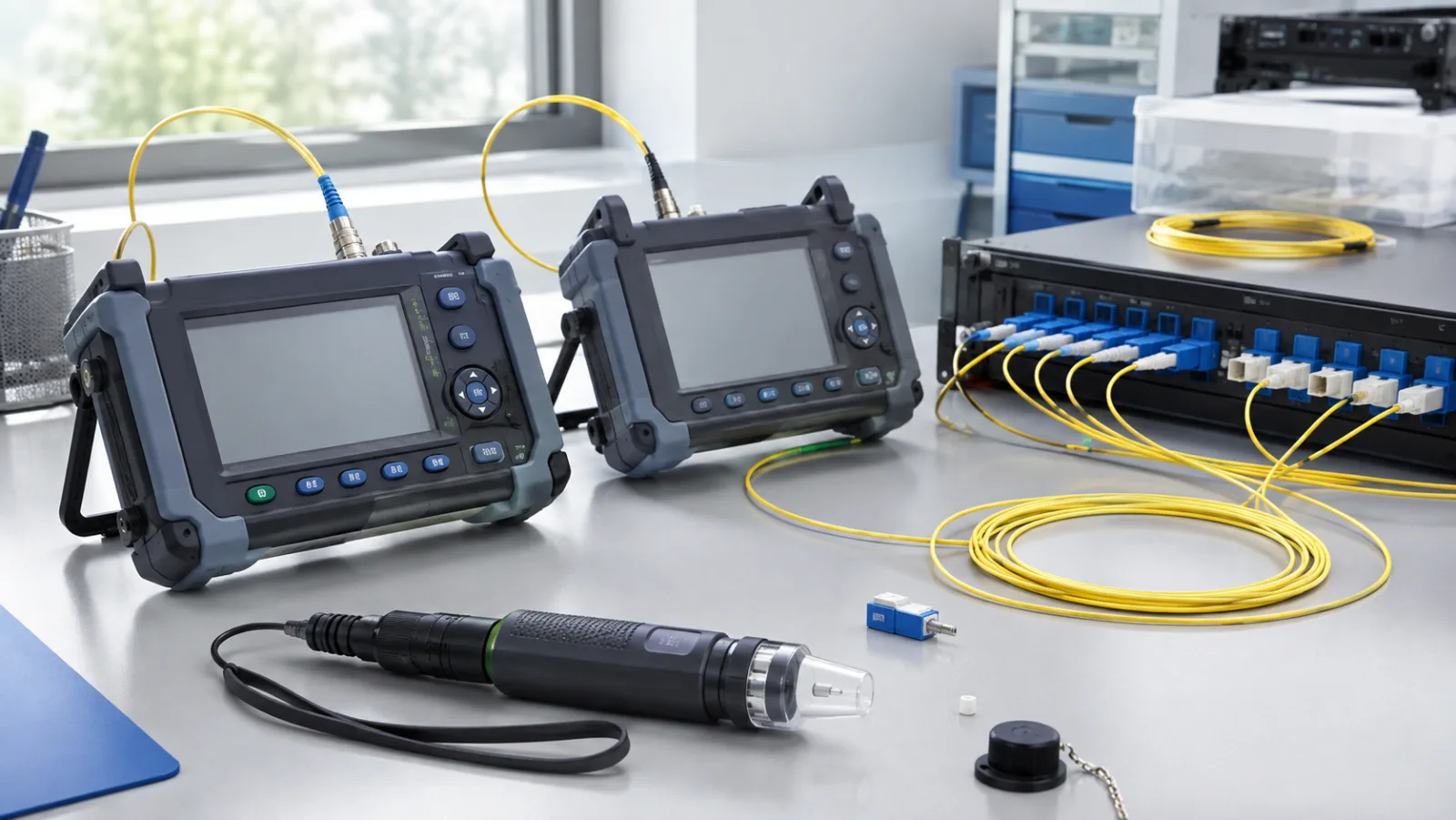
Field testing should follow the TIA-568.3-D standard, which defines insertion loss and return loss limits for OM3, OM4, and OM5. However, the standard does not specify a unique test for OM5; you test it like OM4 for loss, but you must also verify that the link supports the intended wavelengths. If you plan to use 850 nm and 910 nm, your test source and meter must cover both. Many basic OLTS sets only test at 850 nm and 1300 nm, so you may need a tunable source or a wideband meter.
Cleaning and Inspection
Fiber end-face contamination is the leading cause of insertion loss and back reflection. This is true for all multimode fibers, but contamination can affect every fiber grade; OM2, OM3, OM4 and OM5 all have a nominal 50 µm core. Always inspect both ends of every patch cord and bulkhead before mating. Use a one-click cleaner or dry cleaning method; avoid alcohol unless it is the specified optical-grade solvent.
Common Mistakes in OM3 vs OM4 vs OM5 Deployments
Even experienced installers can stumble on a few points. Here are the pitfalls we see most often.
Mixing Fiber Types in a Single Link
It is tempting to use a short OM3 patch cord to connect an OM4 trunk to a switch. However, the link performance is limited by the lowest-grade segment. If the OM3 patch is long enough, it can reduce the effective distance. Always match the fiber grade throughout the channel, or at least ensure the lowest grade still meets your distance requirement.
Ignoring Bend Radius and Pull Tension
OM4 and OM5 have the same 50 µm core as OM3, but the cable construction may differ. Always follow the manufacturer’s recommended bend radius and maximum pull tension. Exceeding these can cause micro-bends that increase attenuation, especially at longer wavelengths like 910 nm.
Assuming OM5 Is Backward Compatible with All OM4 Transceivers
OM5 is designed to be compatible with OM4 transceivers at 850 nm, but not all OM4 transceivers will work on OM5 at 910 nm. The transceiver must explicitly support the wideband (SWDM) wavelengths. Check the datasheet before mixing.
Overlooking the Need for Mode Conditioning
Mode-conditioning patch cords are not required for 1000BASE-SX multimode links. Some LX/LH applications on legacy multimode fiber have different requirements; follow the exact module guidance.
Buyer Checklist for OM3 vs OM4 vs OM5 Fiber
Use this checklist to keep your project on track.
- Define your speed and distance requirements for at least the next five years. Do not rely on vague “future-proofing” claims.
- Check transceiver availability for the speeds you plan to run. OM5 only helps if you can source SWDM4 optics.
- Verify cable manufacturer specifications for attenuation at 850 nm and 953 nm (if using OM5). Typical values are 3.0 dB/km at 850 nm and 2.3 dB/km at 953 nm, but always use the manufacturer’s data.
- Plan for testing – ensure your test equipment covers the wavelengths you will use.
- Compare total cost – include transceivers, patch cords, and testing, not just the cable price.
- Consider the physical path – if you have tight bends, choose a bend-insensitive variant (e.g., OM4 BI) rather than assuming all OM4 is the same.
Practical Recommendation and Conclusion
OM4 is a useful candidate for new installations, but its advantage depends on the interface: the cited 100GBASE-SR4 reach is 100 m on OM4 versus 70 m on OM3, not a twofold increase. Obtain current project quotations rather than assuming a fixed price premium.
OM5 is worth considering only if you have a specific need for SWDM4 transceivers – for example, to run 100G over two fibers when you cannot pull new cable. In new builds, the cost of OM5 cable is only slightly higher than OM4, but the transceivers are still niche and often more expensive. Unless you have a clear plan to use them, the extra cost does not buy you much.
Finally, remember that the fiber is just one part of the link. The transceiver, connectors, and installation quality matter just as much. A well-installed OM3 link will outperform a poorly installed OM5 link. So, focus on good engineering practices, test thoroughly, and choose the fiber that meets your real distance and speed needs without overpaying for features you will not use.
In summary: OM3 for legacy or short links, OM4 for most new data center and enterprise backbones, and OM5 only when you need wideband capability. That is the practical answer to the OM3 vs OM4 vs OM5 fiber question.
Frequently Asked Questions
What are the maximum distances for 10G, 40G, and 100G over OM3, OM4, and OM5 fiber?
For the cited modules, 10GBASE-SR reaches 300 m on OM3 and 400 m on OM4, while 100GBASE-SR4 reaches 70 m on OM3 and 100 m on OM4/OM5. SR10 and SWDM are different interfaces with separate specifications.
Can I mix OM3, OM4, and OM5 fiber in the same network?
Yes, they are all 50/125µm multimode fibers with the same connector types (LC, MPO). Mixing is physically possible, but the link distance is limited by the lowest-performing segment. For example, using OM3 patch cords with OM4 cabling reduces the maximum distance to OM3 ratings. For best performance, use the same grade throughout the channel.
How do I choose between OM3, OM4, and OM5 for a new data center?
Start with the exact interface, measured route length and channel loss. OM4 and OM5 have the same baseline bandwidth at 850 nm; consider OM5 when a qualified multiwavelength module offers a useful route-specific benefit.
What are the cost differences between OM3, OM4, and OM5 fiber?
OM3 is the least expensive, OM4 costs about 20-30% more than OM3, and OM5 can be 30-50% more than OM4. However, prices vary by manufacturer and volume. The total cost also includes transceivers: OM5 enables using fewer fibers with SWDM optics, which may offset cable costs. For short links, OM3 may be sufficient, but for high-speed and future-proofing, OM4 or OM5 may be more economical in the long run.
Is OM5 backward compatible with OM3 and OM4 transceivers?
Yes, OM5 is backward compatible with OM3 and OM4 transceivers because it meets or exceeds their performance specifications. OM5 has the same core size (50µm) and is designed to support legacy applications. However, to achieve the extended distances of OM5 with SWDM, you need SWDM transceivers. Standard VCSEL-based optics (e.g., 10G-SR, 100G-SR4) will work but will not provide the extended reach.
What special installation or testing considerations apply to OM5 fiber?
OM5 has the same physical installation requirements as OM3/OM4 (bend radius, pulling tension). However, OM5 is designed for wideband operation (850-950nm), so testing requires a light source and power meter that can test at multiple wavelengths, including 850nm and 910nm, to verify SWDM performance. Standard OLTS testing at 850nm alone is insufficient. Ensure your test equipment supports the required wavelengths and that all components (connectors, patch panels) are rated for wideband.
Complete topic guide: Single Mode vs Multimode Fiber: Complete Guide.
Fact-check references (4 September 2026): SR4 source; SR10 source; SR25 source; SR10G source; OM5 source; MODE source; OM2 source.