If you are choosing between LC and SC fiber connectors, the short answer is: LC connectors are half the size of SC connectors, making them the default choice for high-density data centers and modern transceivers, while SC connectors offer a larger, more robust interface that is still widely used in enterprise networks and legacy installations. Both are duplex-capable, ceramic-ferrule connectors with typical insertion loss under 0.3 dB, but their physical dimensions and locking mechanisms drive different application fit.
What Are LC and SC Connectors?
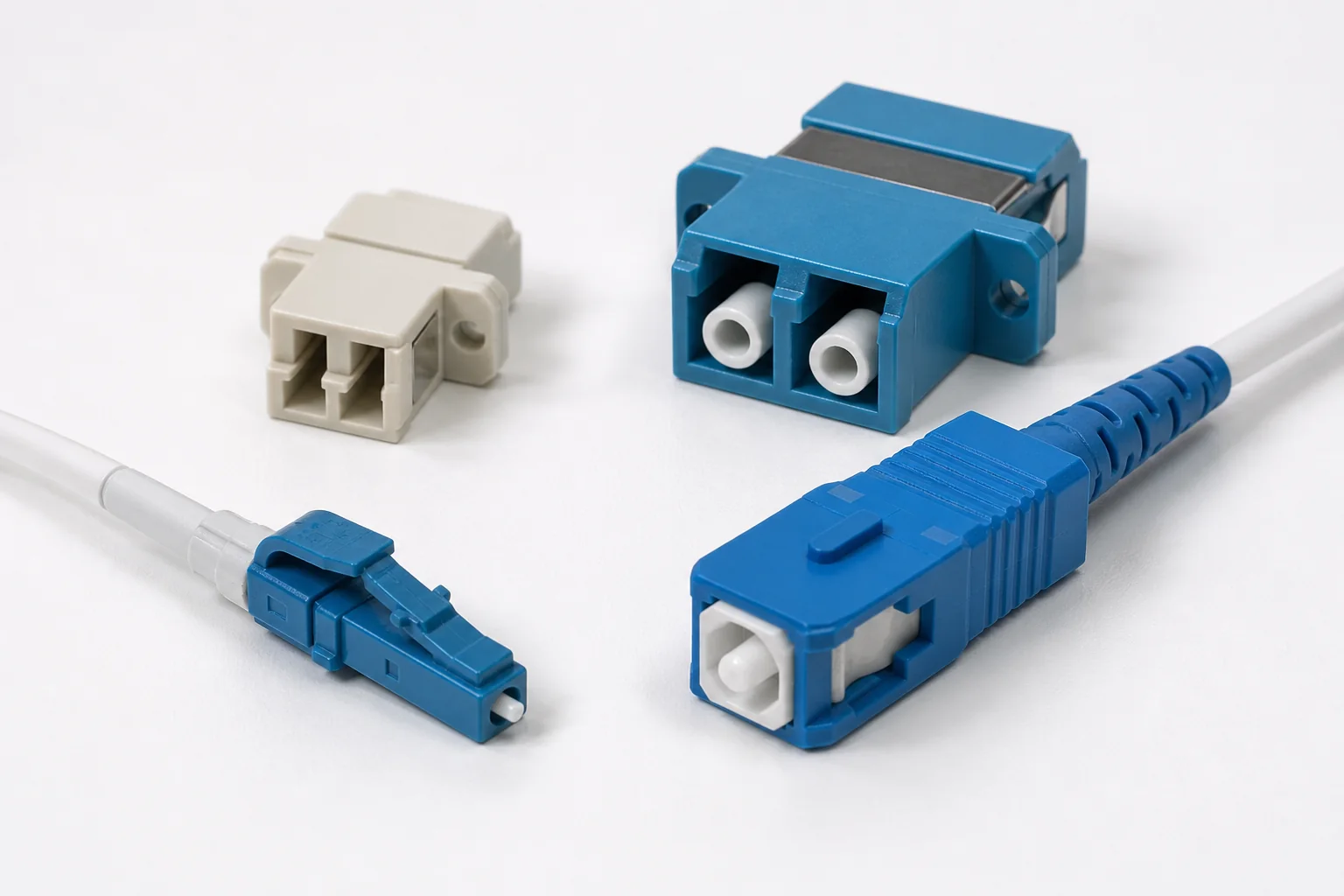
LC (Lucent Connector) and SC (Subscriber Connector) are both standard fiber optic connector types defined by IEC 61754-20 (LC) and IEC 61754-4 (SC). They use a 1.25 mm or 2.5 mm zirconia ferrule, respectively, to align the fiber core. The ferrule is the precision ceramic tip that holds the fiber; its diameter is the primary physical difference.
LC Connector: The Small-Form-Factor Standard
Introduced by Lucent Technologies in the 1990s, the LC connector features a 1.25 mm ferrule—half the diameter of SC’s. Its latch mechanism is a small push-pull tab similar to an RJ45 jack. Because of its compact size, LC is the dominant interface on SFP, SFP+, and QSFP transceivers, and it is the de facto standard for high-density patching in data centers.
SC Connector: The Push-Pull Workhorse
SC connectors, developed by NTT in the 1980s, use a 2.5 mm ferrule and a push-pull snap-in coupling mechanism. The larger ferrule provides a more forgiving alignment tolerance, making SC easier to terminate in the field. SC is common in premises cabling, CATV, and single-mode applications where density is less critical.
When Does the LC vs SC Choice Matter?
The decision between LC and SC is not merely cosmetic; it affects hardware compatibility, cable management, and future scalability. You should evaluate this choice in the following scenarios:
- Upgrading network equipment: Most modern active equipment (switches, routers, media converters) ships with LC ports. If your patch panel is SC, you will need hybrid patch cords or adapter plates.
- Designing a new data center: High-density racks demand LC to maximize port count per rack unit. SC would require more space and limit airflow.
- Maintaining legacy infrastructure: SC is prevalent in older building backbones and some telecom networks. Reusing existing SC cabling can reduce cost, but you must ensure adapter compatibility.
- Field termination: SC’s larger ferrule is easier to polish and inspect, which is why it is often preferred for on-site splicing or connectorization.
Core Technical Differences: Size, Loss, and Performance
Physical Dimensions and Density
The most obvious difference is size. An LC connector is roughly half the length and width of an SC connector. This translates directly to port density: a 1U patch panel can hold 24 LC duplex ports versus 12 SC duplex ports. In a 48-port panel, LC is the only practical option. The smaller footprint also reduces cable congestion and improves airflow in enclosed racks.
Insertion Loss and Return Loss
Both connector types are designed to meet the same performance grades, but typical values differ slightly due to ferrule geometry. For single-mode (OS2) and multimode (OM3/OM4) fibers, standard LC and SC connectors typically exhibit insertion loss below 0.3 dB, with premium grades achieving 0.15 dB or less. Return loss is more dependent on polish type (UPC vs APC) than on connector family. For single-mode APC, return loss is typically greater than 50 dB for both LC and SC. There is no normative difference in loss between LC and SC; both must meet IEC 61753-1 performance requirements, but real-world measurements often show LC with marginally lower loss due to tighter ferrule tolerances.
Durability and Mechanical Performance
SC’s larger ferrule provides a more robust mechanical interface, making it less susceptible to misalignment from cable strain. However, LC’s smaller ferrule is more prone to damage if mishandled, but its latching mechanism is generally considered more secure. Both are rated for hundreds of mating cycles, but SC’s push-pull design is easier to operate in tight spaces without special tools.
Standards and Compatibility
Both LC and SC are standardized under IEC and TIA. The TIA-568.3-D standard permits both, but for new installations, LC is recommended for data center environments due to density. SC remains acceptable for horizontal cabling in enterprise networks. Adapters exist to convert between LC and SC, but they add a connection point and potential loss, so they should be used sparingly.
In summary, choose LC when density, speed, and modern transceiver compatibility are priorities; choose SC when you need a rugged, field-friendly connector for lower-density or legacy applications. The rest of this guide will explore specific use cases and installation best practices.
LC vs SC Fiber Connector: Side-by-Side Comparison Table
When engineers evaluate LC vs SC fiber connector options, the decision often comes down to a handful of measurable parameters. The table below summarizes the key differences in a format suitable for quick reference during design reviews or procurement discussions. Values marked as “typical” are based on common industry practice, not mandatory limits.
| Parameter | LC Connector | SC Connector |
|---|---|---|
| Ferrule diameter | 1.25 mm | 2.5 mm |
| Typical insertion loss (single-mode, PC) | ≤ 0.15 dB (typical) | ≤ 0.20 dB (typical) |
| Typical return loss (single-mode, APC) | ≥ 50 dB (typical) | ≥ 50 dB (typical) |
| Mating mechanism | Latch (push-pull with tab) | Push-pull (snap) |
| Density (ports per 1U patch panel) | Up to 48 (typical) | Up to 24 (typical) |
| Typical durability (mating cycles) | 500–1000 (typical) | 500–1000 (typical) |
| Common applications | Data centers, high-density patching, SFP/SFP+ transceivers | Telecom networks, CATV, premises wiring, patch panels |
Note that insertion loss and return loss values are not standardized as maximums for all grades; they depend on polish type (PC, UPC, APC) and manufacturing quality. Always consult the relevant component specifications for your project.
Decision Criteria: Choosing Between LC and SC
Selecting the right connector is not about which is “better” in absolute terms—it’s about aligning connector characteristics with your network’s physical constraints and operational needs. Use the following criteria as a checklist.
Density and Space Constraints
If your rack or patch panel space is limited, LC’s smaller ferrule (1.25 mm vs 2.5 mm) allows more ports per unit area. For example, a 1U patch panel can typically house 48 LC duplex ports versus 24 SC ports. This density advantage is critical in data centers and high-density fiber distribution areas. If space is not a constraint, SC’s larger size may be perfectly acceptable.
Compatibility with Active Equipment
Most modern SFP, SFP+, and QSFP transceivers use LC connectors because of their small footprint. If your network relies on these pluggable optics, LC is almost mandatory for direct connection. SC is more common in legacy telecom environments and some enterprise switches that use SC-style GBIC modules. Check the port type on your equipment before deciding.
Ease of Handling and Installation
SC’s larger body and push-pull design make it easier to grip and insert, especially for technicians wearing gloves or working in tight spaces. LC’s latch mechanism is also push-pull, but the smaller size can be trickier for some users. For applications where frequent reconfiguration occurs and ease of use is a priority, SC may be more ergonomic.
Performance Requirements
Both LC and SC can achieve excellent optical performance. In practice, insertion loss differences are minimal—typically within 0.05 dB. For high-power or high-reflection-sensitive systems (e.g., analog RFoG), APC polish is often required, and both connectors are available in APC versions. The choice rarely hinges on loss alone; instead, consider the overall link budget and the quality of the connectors you purchase.
Worked Example: Choosing a Connector for a Data Center Upgrade
Let’s apply the decision criteria to a realistic scenario.
Scenario: You are upgrading a data center’s backbone to 40G/100G Ethernet. The existing patch panels are 1U high and currently use SC connectors. You need to increase port density without expanding the rack footprint. The active equipment (switches and transceivers) will use LC interfaces.
Analysis:
- Density: To double the number of fiber connections in the same 1U space, you would need to switch to LC connectors. SC would require additional racks, which is not feasible.
- Compatibility: The new transceivers have LC ports. Using SC would require hybrid patch cords or adapters, adding cost and potential failure points.
- Performance: Both LC and SC can handle 40G/100G single-mode links with proper insertion loss. However, the LC connectors you plan to use have typical insertion loss of 0.1 dB, while the old SC connectors average 0.2 dB. Over a 10 km link, this difference is negligible, but it helps with margin.
- Ease of handling: The installation team is experienced with both, but they prefer LC for high-density patching because it allows more room for fingers.
Decision: Migrate to LC connectors for all new patch panels and patch cords. Use LC-to-LC connections throughout, and replace SC patch panels only where density is critical. For legacy equipment that still has SC ports, use hybrid LC-SC patch cords temporarily.
Selection Guidance and Best Practices
To summarize, here are actionable guidelines for your LC vs SC fiber connector decision:
- Default to LC for new data center and high-density installations, especially when using SFP/SFP+ optics.
- Choose SC for telecom central offices, CATV headends, and environments where technicians prefer a larger connector and density is not a priority.
- Standardize on one connector type per network segment to minimize adapter and hybrid cable inventory.
- Verify polish type (PC, UPC, APC) matches your system requirements—do not mix APC and PC connectors.
- Always test insertion loss and return loss after installation to ensure compliance with your link budget.
Remember that the connector is only one part of the link. The quality of the fiber, splices, and terminations also affects overall performance. By considering density, compatibility, and handling, you can make an informed choice that balances cost, performance, and operational efficiency.
Installation and Testing Implications
Choosing between LC and SC affects more than the patch panel—it influences how technicians terminate, test, and maintain the link. The physical differences translate into distinct handling procedures and testing challenges.
Termination and Splicing
Both LC and SC connectors are available in field-installable and factory-polished variants. Field termination requires precision polishing and cleaving, but the smaller LC ferrule demands more care to avoid epoxy overflow or fiber protrusion issues. In contrast, SC’s larger ferrule is slightly more forgiving for novice technicians. Fusion splicing with pigtails is common for both, but LC pigtails are more delicate due to their smaller size.
Testing with Light Sources and Power Meters
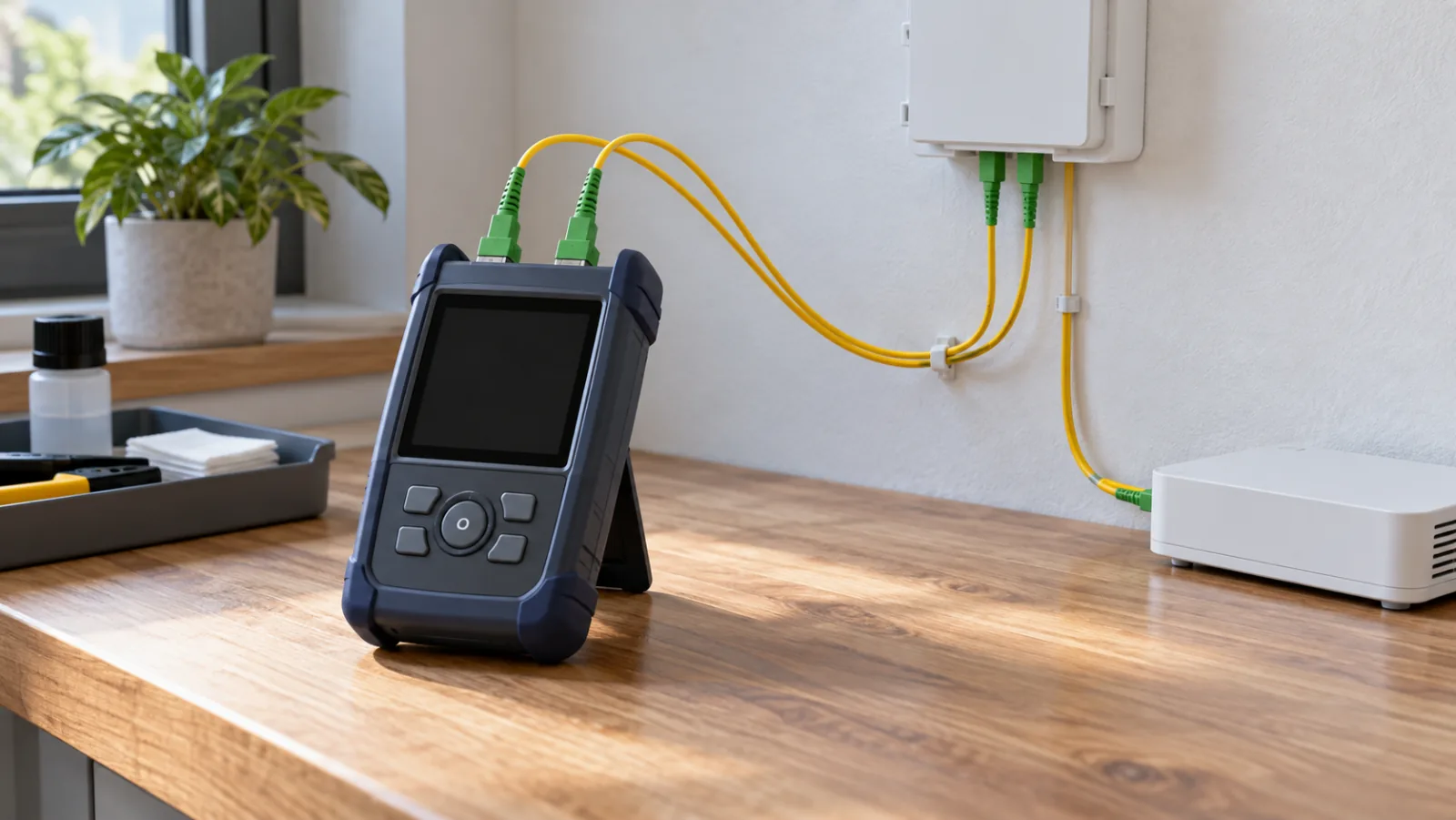
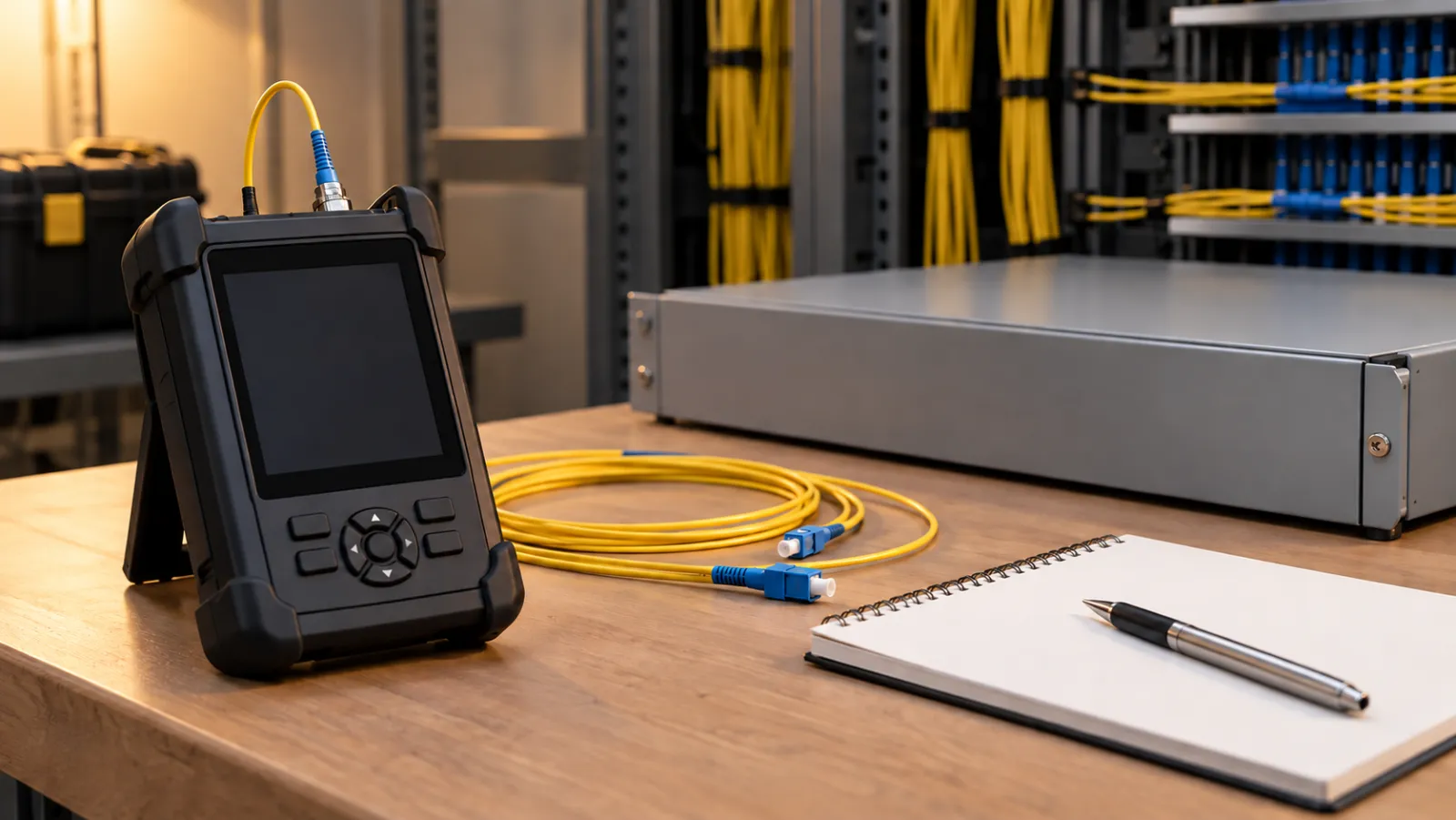
Testing insertion loss typically involves a light source and power meter. The test jumper must match the connector type of the link under test. For LC, use LC test jumpers; for SC, use SC jumpers. Mixing them requires a hybrid adapter, which adds an extra connection point and potential loss. Always calibrate the test setup with a reference jumper of the same type.
Return loss testing (using an OTDR or dedicated meter) is more sensitive to connector cleanliness and end-face geometry. The smaller LC ferrule can be harder to clean and inspect, as contaminants are less visible to the naked eye. Use a scope with appropriate magnification (e.g., 200x or 400x) for both types, but pay extra attention to LC end-faces.
Cleaning and Inspection
Both connectors require clean, dust-free end-faces. However, LC’s compact design makes it easier to accidentally touch the ferrule when plugging or unplugging. Use one-click cleaners or lint-free wipes designed for small ferrules. For SC, the push-pull design reduces touch risk, but the larger surface area can accumulate more dust. Regular inspection with a video scope is recommended for both.
Common Mistakes and How to Avoid Them
Even experienced engineers make errors when dealing with LC vs SC fiber connector choices. Here are the most frequent pitfalls:
- Mismatched Connectors in Existing Infrastructure: Assuming all patch panels use the same type. Always verify with a physical inspection or labeling.
- Improper Cleaning: Using dry wipes or compressed air can push debris into the ferrule. Use proper wet-to-dry cleaning.
- Over-Tightening SC Connectors: The push-pull mechanism should click into place; forcing it can damage the ferrule.
- Bending the LC Boot Excessively: The smaller boot provides less strain relief; sharp bends can cause micro-cracks.
- Ignoring Polarity in Duplex Systems: LC and SC duplex connectors have keying; flipping the polarity can cause link failure.
- Using the Wrong Adapter: LC and SC are not interchangeable; never force an LC into an SC port.
- Skipping End-Face Inspection: Even new connectors can have defects. Always inspect before installation.
To avoid these, establish a checklist for every installation: verify connector type, inspect end-faces, clean before mating, and test after termination.
Buyer Checklist and Practical Recommendation
When purchasing connectors or pre-terminated assemblies, use this checklist to ensure you select the right type and quality.
Buyer Checklist
- Connector Type: Confirm whether your equipment and patch panels use LC or SC. Check datasheets and physical ports.
- Ferrule Material: Ceramic (zirconia) is standard for both; avoid plastic ferrules for permanent installations.
- Polish Type: UPC (ultra-polished) is typical for most applications; APC (angled) is required for RF video or some GPON systems. Ensure consistency.
- Insertion Loss Rating: Look for connectors rated for low loss (typical values are ≤0.3 dB for LC and SC, but always verify with the manufacturer’s spec).
- Durability: Check the number of mating cycles (e.g., 500 or 1000) and the operating temperature range.
- Compatibility: Ensure the connector meets relevant standards (e.g., IEC 61754-20 for LC, IEC 61754-4 for SC).
- Color Coding: Beige for multimode, blue for single-mode UPC, green for APC. Match your system.
- Strain Relief and Boot: For patch cords, check the boot length and flexibility, especially in tight spaces.
Practical Recommendation
For most modern data center and high-density applications, LC is the recommended choice due to its small size and widespread adoption in transceivers. However, for industrial environments where robustness and ease of handling are paramount, SC may be more practical. If you are upgrading an existing system, match the existing connector type to avoid unnecessary adapter conversions. For new installations, choose LC if you anticipate high-density patching or future 40G/100G upgrades; choose SC for simplicity in low-density, harsh environments.
Conclusion: Making the Right Call in the LC vs SC Debate
The LC vs SC fiber connector decision is not about which is universally better—it’s about which fits your specific application. LC offers density and speed, while SC offers simplicity and ruggedness. By understanding the installation and testing nuances, avoiding common mistakes, and following a structured checklist, you can select the connector that ensures reliable performance and long-term maintainability. Always prioritize cleanliness, proper termination, and compatibility with your existing infrastructure. With these considerations, you’ll make a choice that serves your network well for years to come.
Frequently Asked Questions
What are the main differences between LC and SC fiber connectors in terms of size and insertion loss?
LC connectors have a 1.25 mm ferrule, half the size of SC's 2.5 mm, enabling higher density. Typical insertion loss is similar: ≤0.3 dB for single-mode, ≤0.5 dB for multimode, but actual values depend on quality. LC is preferred for data centers and high-density panels; SC for simpler installations and legacy networks.
Can LC and SC fiber connectors be used interchangeably or adapted?
No, they are not directly compatible due to different ferrule sizes. However, hybrid patch cords with LC on one end and SC on the other are available to connect devices or panels with different connector types. Adapters (like SC-to-LC) exist but are not recommended as they introduce additional loss and mechanical stress.
Which connector should I choose for a new fiber optic installation: LC or SC?
Choose LC for high-density environments like data centers and enterprise networks where space is limited. Choose SC for industrial settings, FTTH, or when simpler handling and larger connectors are preferred. Also consider existing infrastructure and device ports. For new high-speed networks, LC is increasingly standard.
How do I properly install and terminate LC and SC connectors?
Both require clean fiber ends, precise cleaving, and proper epoxy or mechanical splicing. LC's smaller ferrule demands more precision. Use a quality cleaver and polishing film. For field termination, consider pre-polished connectors. Always inspect with a scope and test with an OTDR or power meter to ensure low loss.
What are the typical insertion loss and return loss specifications for LC and SC connectors?
Typical insertion loss for both is ≤0.3 dB (single-mode) and ≤0.5 dB (multimode), with premium versions ≤0.15 dB. Return loss for single-mode is usually ≥50 dB (PC) or ≥60 dB (APC). These are typical values, not mandatory; always check manufacturer datasheets and applicable standards like IEC 61753.
Are LC and SC connectors compatible with single-mode and multimode fibers?
Yes, both LC and SC are available for single-mode (9/125 µm) and multimode (50/125 µm or 62.5/125 µm) fibers. Ensure the connector's ferrule bore size matches the fiber cladding. Also, polish types (PC, UPC, APC) must match to avoid reflections. Always verify compatibility before installation.
Complete topic guide: Fiber Optic Connector Types: Complete Guide.