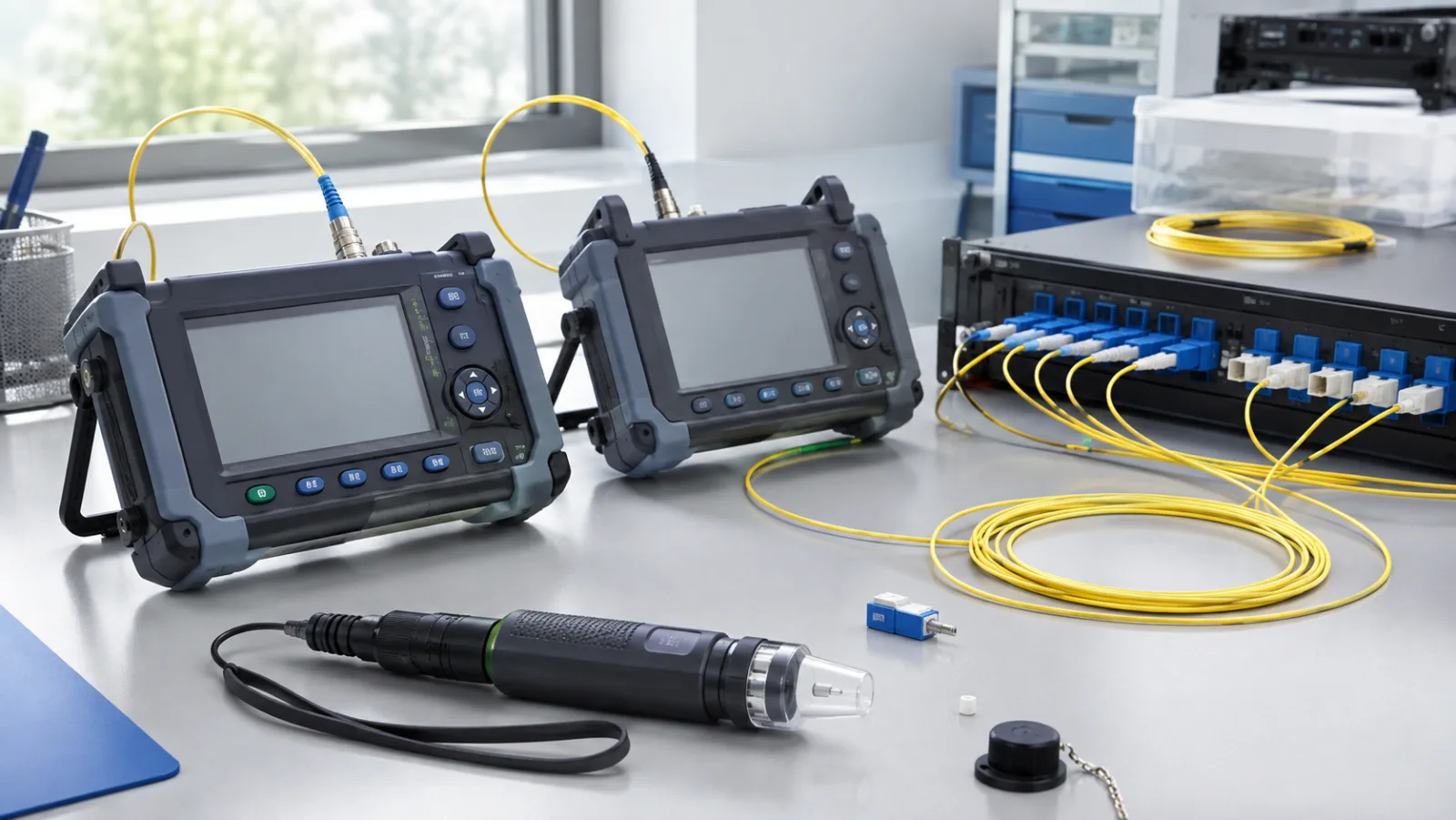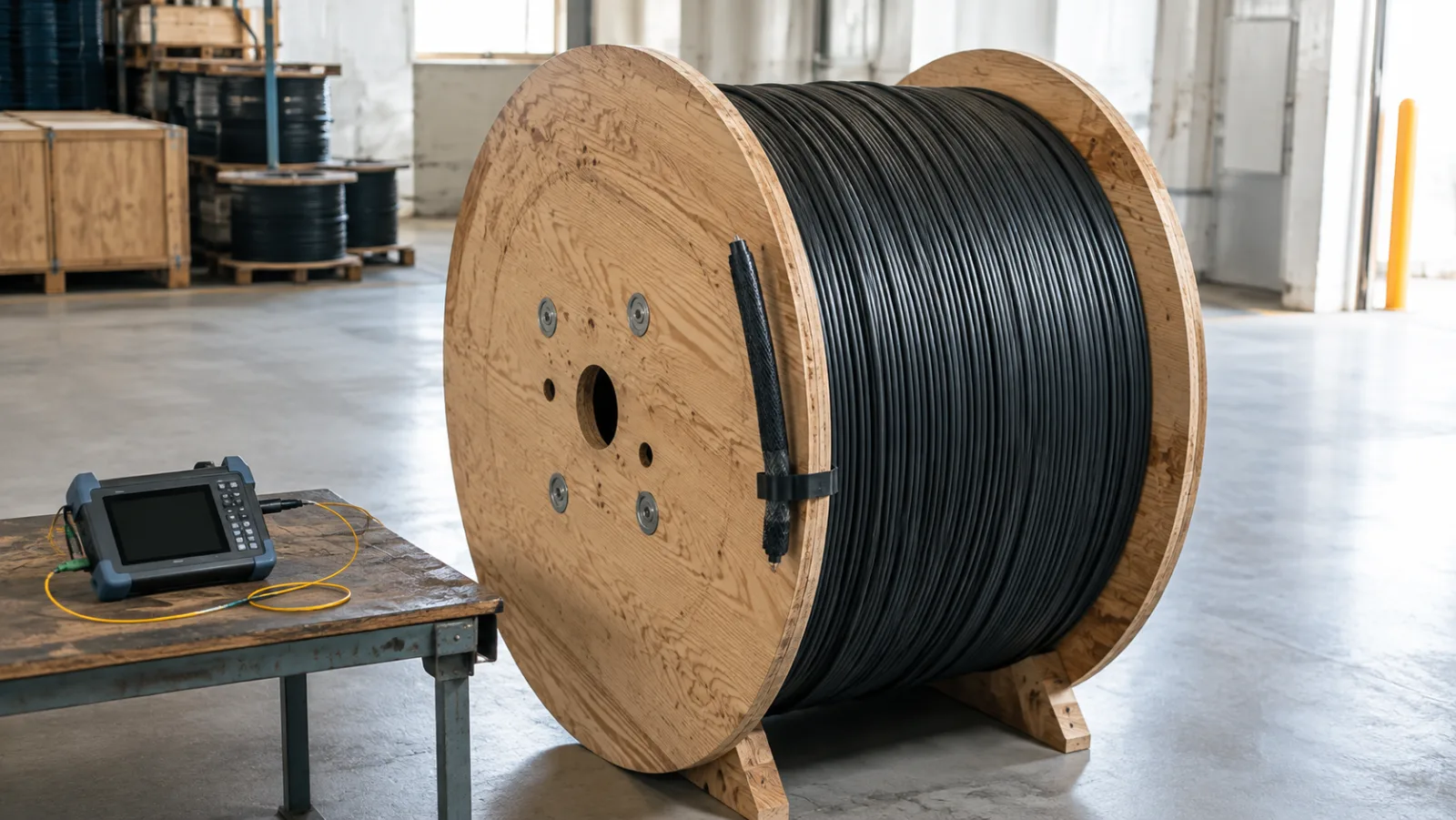
Summary: A useful fiber optic cable reel inspection before installation combines shipment identity, physical condition and a defined optical test scope. Record what arrived, what was examined and what remains untested. Release the reel only under the project’s agreed criteria, and keep a suspect reel separate until its disposition is authorized.
Receipt inspection is a checkpoint between manufacturing evidence and field installation. It does not reproduce every factory test, and it cannot prove the quality of a future installed link. Its value is to establish a traceable baseline while the cable is still accessible and responsibility for any discrepancy can be investigated.
Start with identity and completeness
Match the purchase order, delivery note and reel identifier. Confirm cable construction, fiber category, fiber count, nominal length and any required jacket or environmental designation. Compare the document revision with the approved order, especially if the supplier previously proposed a substitution.
The FOA receiving guidance emphasizes checking delivered components and protecting cable and terminated assemblies during handling. Translate that guidance into a job-specific record rather than relying on a signature that simply says “goods received.”
Keep the manufacturer’s test report linked to the exact reel or production identifier. If the report cannot be associated with the delivered item, record the evidence gap. A generic specification sheet and a serialized test record serve different purposes.
Inspect the package before disturbing it
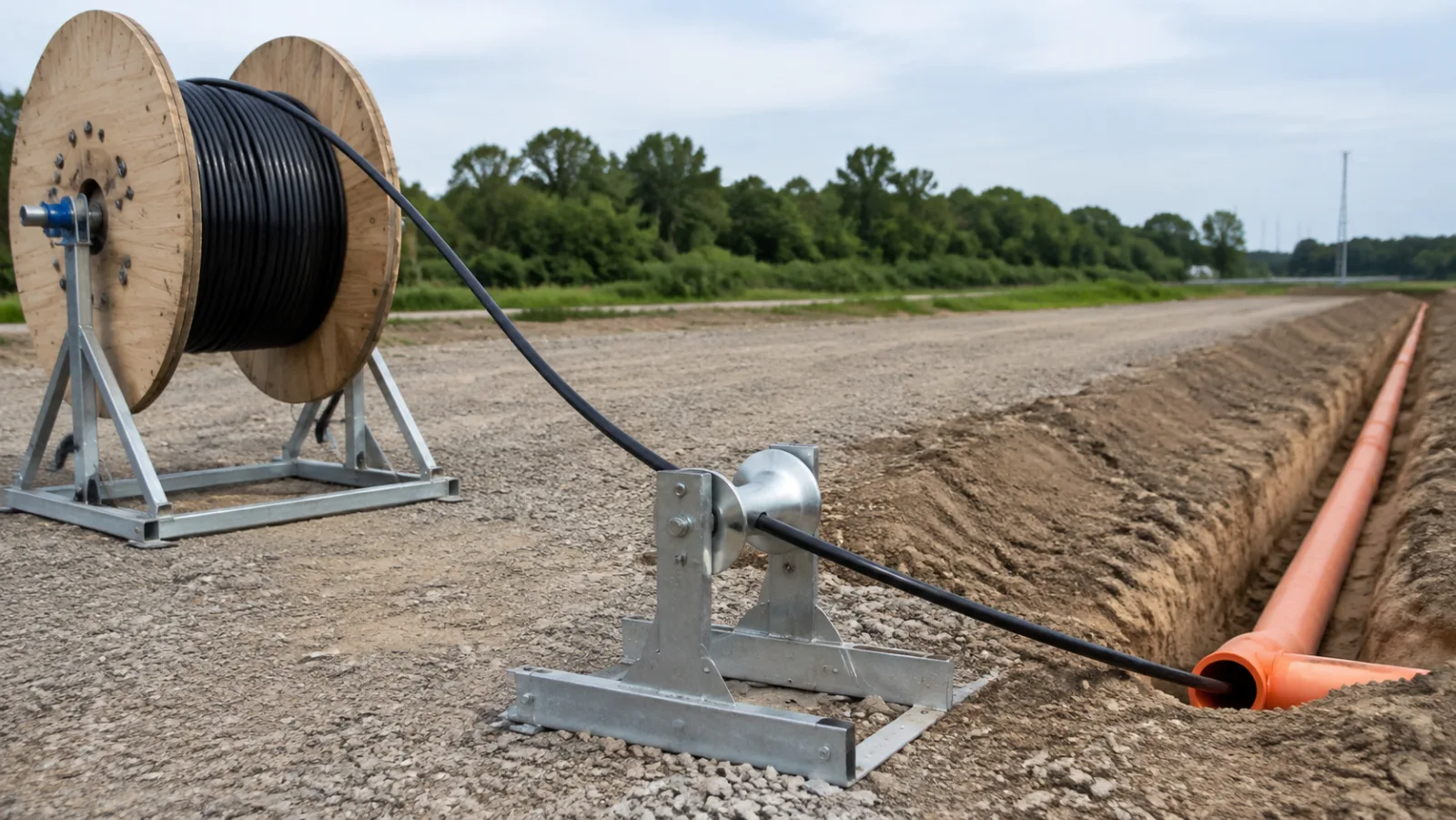
Record visible flange damage, displaced battens, damaged protective wrapping, exposed jacket, questionable end seals and evidence of improper storage. Photograph the condition before repair or repacking. Include enough context to associate each image with the correct reel and delivery position.
Do not turn a receipt check into an unsafe lifting operation. Use trained personnel and the approved handling equipment for the reel mass and geometry. Keep the cable supported and avoid applying lifting forces through the wound cable. A sound package can be damaged by an improvised inspection procedure.
Record whether both cable ends are accessible for the agreed tests. If access requires removing a seal or preparing bare fibers, follow the approved manufacturer procedure and restore protection afterward. Uncontrolled preparation can create the very damage the inspection was meant to detect.
Choose a test scope that answers the actual question
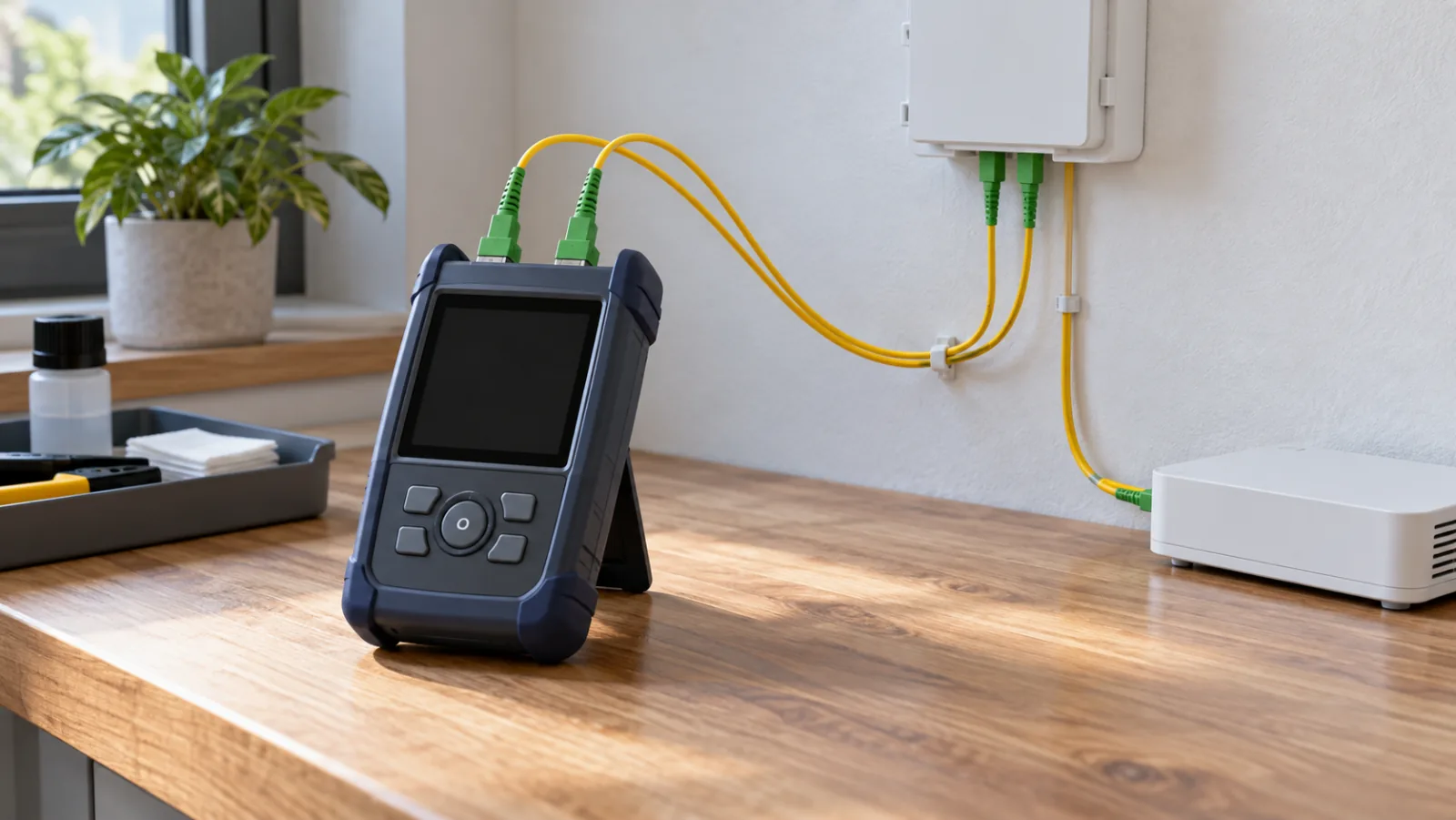
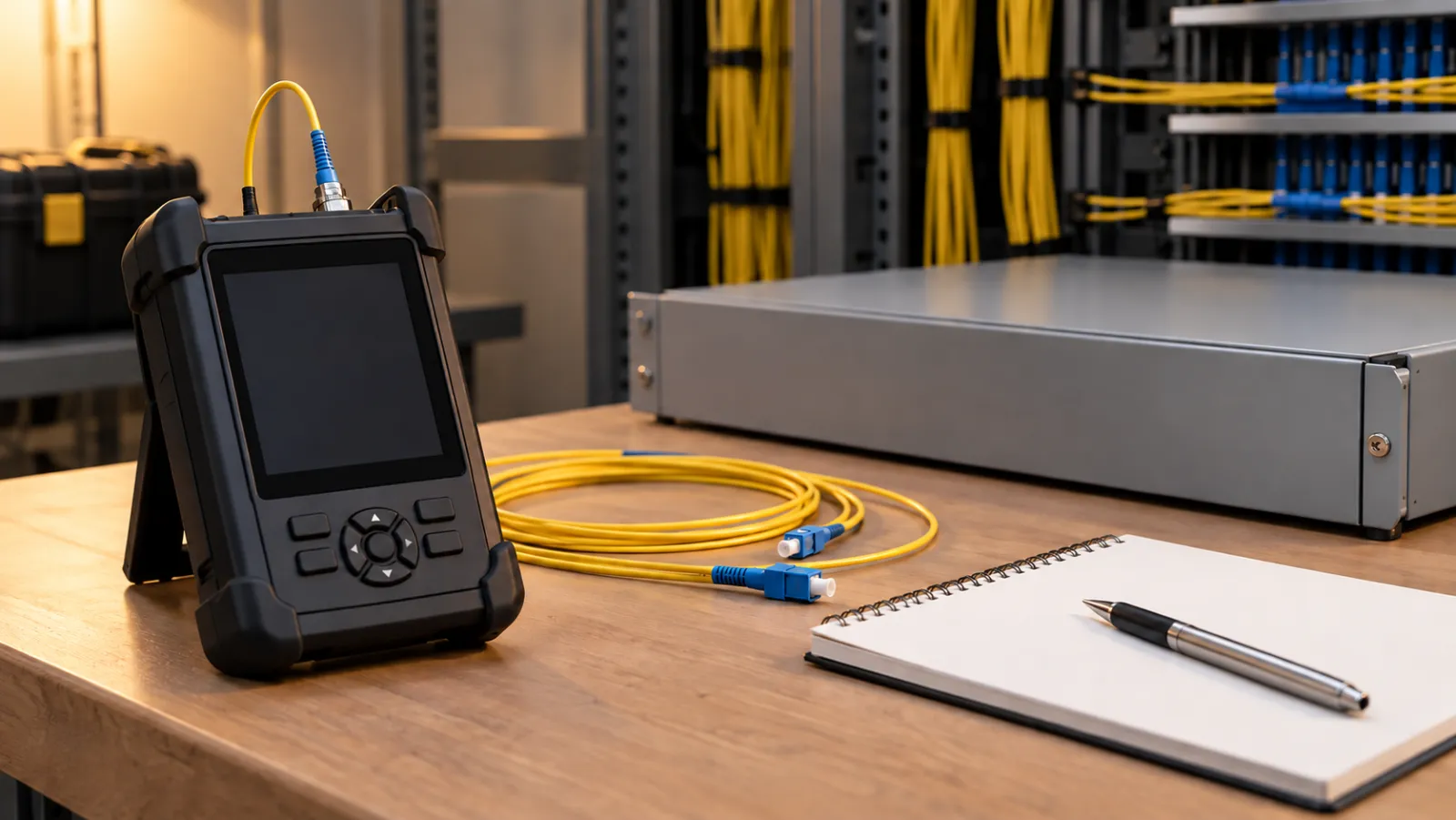
The FOA installation standard discusses receipt-stage inspection, sampled continuity checks and OTDR investigation where handling damage is suspected. Use the contract’s required scope when it is more specific; do not describe a sample as full-fiber acceptance.
| Check | Useful evidence | Important limit |
|---|---|---|
| Document and visual inspection | Identity, completeness and visible condition | Cannot establish hidden optical condition |
| Continuity check | A signal path on the tested strand | Not a calibrated loss measurement |
| OTDR examination | Trace, length and event information under stated settings | Requires suitable access, setup and interpretation |
| Specified loss test | Transmission loss under a defined reference method | Requires compatible preparation and measurement boundaries |
Define whether the plan samples fibers, covers every fiber, tests one or both directions and uses one or several wavelengths. The answer depends on contractual requirements, risk and evidence needs. Avoid inventing a universal acceptance percentage or assuming a supplier’s customary practice meets every project.
Worked resource estimate for a full-fiber scope
Assume a fictional delivery of four 48-fiber reels. The approved plan requires a recorded acquisition at two wavelengths from one end of every fiber. For planning, assume three minutes for the combined two-wavelength test and file association per fiber, plus 25 minutes of reel setup. These are scheduling assumptions, not measured productivity or test specifications.
| Work item | Calculation | Estimated time |
|---|---|---|
| Fiber-level work | 4 × 48 × 3 minutes | 576 minutes |
| Reel setup | 4 × 25 minutes | 100 minutes |
| Base estimate | 576 + 100 | 676 minutes |
| Planning contingency | 15% × 676 | 101.4 minutes |
| Total illustrative allowance | 777.4 ÷ 60 | About 13.0 hours |
The estimate excludes travel, unusual fiber preparation, fault investigation and any additional work not contained in the assumed three-minute cycle. Validate those exclusions before staffing the job. A nominal tester acquisition time alone is not the full labor requirement.
Understand what a sample changes
If a different approved plan tested only twelve fibers per reel using the same assumptions, the base estimate would be 4 × 12 × 3 + 4 × 25 = 244 minutes. With the same 15 percent contingency, the allowance becomes about 4.7 hours. The lower time buys less coverage; it is not equivalent evidence for the other 36 fibers on each reel.
State the sampling selection method, acceptance criteria and escalation trigger before testing. A deliberately convenient sample drawn only from easily accessible fibers can leave important parts of the construction unexamined. Any sampling plan should be approved by the responsible project parties.
Define hold, investigate and release conditions
Use separate decisions for identity, physical condition, optical evidence and documentation. A reel can pass a continuity sample but remain on hold because its construction does not match the purchase order. Conversely, superficial packaging damage may require documentation and investigation without automatically proving cable failure.
Hold
Identify the reel clearly, keep it in protected storage and prevent unintended issue to the installation crew. Preserve the original files and photographs. Record the unresolved condition and the person authorized to approve the next action.
Investigate
Request the relevant manufacturer evidence and repeat only the necessary checks under a documented plan. If the optical result is questionable, verify the test leads, wavelength settings, reference boundaries and prepared interfaces before attributing the result to the cable. Record changes between the initial and repeat conditions.
Release
Record which criteria were satisfied, any approved limitations and the release authority. A conditional release should state the remaining work and who owns it. Avoid an ambiguous “passed” label that conceals a partial test or missing documentation.
Preserve the baseline through installation
Give test files names or metadata that connect reel, tube, fiber, direction, wavelength and date. Keep the raw data, not only a PDF summary. Record the test equipment and relevant configuration so a later comparison can distinguish cable change from a different measurement setup.
After inspection, restore end protection, secure the cable and record the storage location. If the reel is moved again or shows later damage, review whether its release status still applies. A receipt baseline is tied to a condition and time; it is not permanent immunity from handling damage.
At installation handover, map the reel identifier into the installed cable segment record. This lets the project compare factory, receipt and post-installation evidence without guessing which drum supplied a particular route. It also makes any residual cable length traceable for future use.
Handle partial deliveries and remaining cable carefully
When one purchase order arrives in several shipments, give each reel its own receipt decision. Do not apply the first delivery’s release to later reels merely because the part number is unchanged. Link each shipment to its transport condition, supporting documents and inspection coverage.
After a partial reel is used, record the remaining length and how that estimate was established. Preserve the reel identifier and end protection so the remainder can be evaluated for another route. A shortened reel is not automatically a new fully documented supply item; its handling and usage history still matter.
If the remaining cable is proposed for a critical segment, review whether its available records and condition meet that project’s requirements. The earlier incoming test may cover the original cable, while subsequent storage or installation handling can introduce new uncertainty. Define any necessary additional checks instead of copying the original release label.
These records also help separate material planning from acceptance. A reel may contain enough estimated length for a route yet remain unsuitable because identity, condition or required evidence is unresolved. Keep the inventory quantity and technical release status as independent fields.
For supply inquiries, use the fiber optic cable supplier page and request the required identifiers, end access, packaging information and test documentation. The cable quality and factory-testing guide covers manufacturing evidence, while the installation and testing guide covers the later field stages.
The most useful incoming plan makes its coverage and limitations visible. It gives procurement a release decision, installers a known starting condition and engineers a baseline they can compare with the completed link.
Frequently Asked Questions
Does a factory report replace incoming inspection?
No. A factory record describes the tested product under its stated conditions. Incoming inspection checks identity, completeness and possible damage or changes during delivery and handling.
Must every fiber be OTDR-tested on every reel?
Follow the contract and approved inspection plan. Sampling for continuity and full-fiber testing provide different coverage. Suspected damage warrants escalation, and a sample does not certify every untested strand.
Can a VFL certify the attenuation of a reel?
No. A visual continuity indication is not a calibrated insertion-loss result and does not substitute for the specified OTDR or loss-test method.
Should a suspect reel be installed to see whether it works?
Place it on hold and preserve the delivery condition while obtaining an authorized disposition. Installation can complicate diagnosis and responsibility for any later damage.
Does a receipt-stage pass prove the final link is acceptable?
No. Installation, splicing and termination introduce new conditions. Complete the required post-installation and final acceptance tests separately.