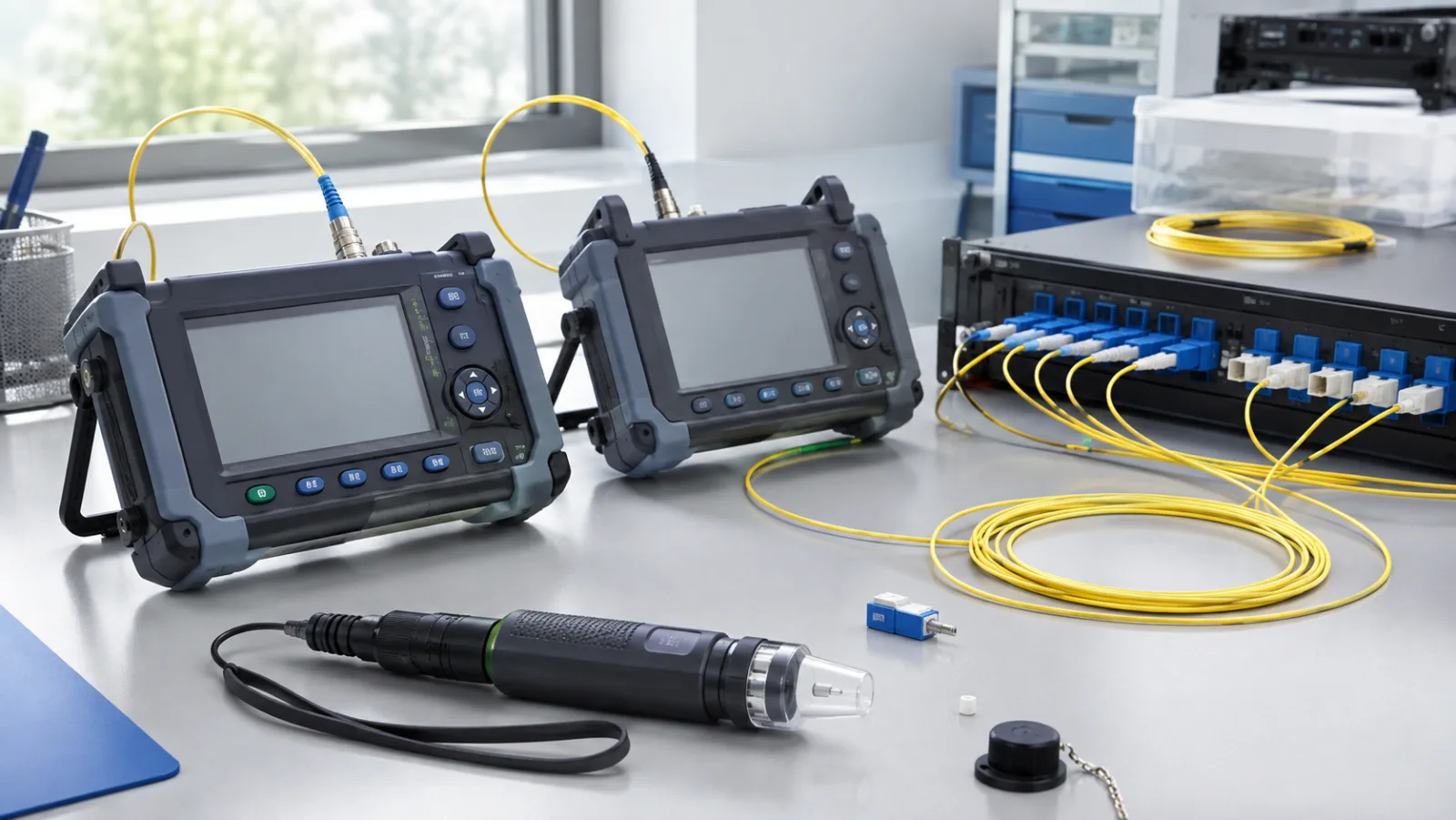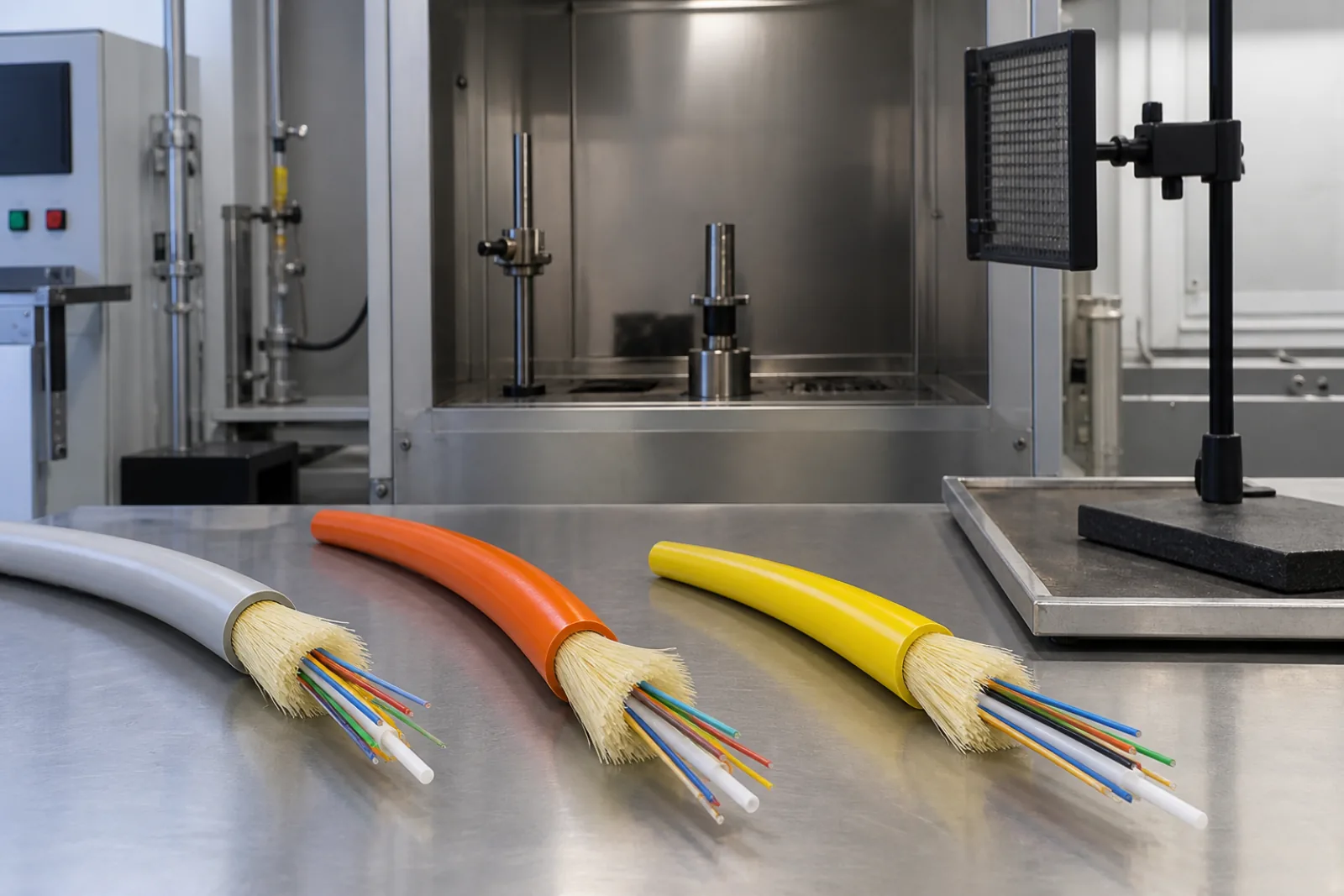
Summary: Comparing LSZH vs OFNR vs OFNP fiber cable is not a simple ranking from good to better. LSZH addresses smoke and halogen-related material performance under named tests; OFNR and OFNP are North American optical-fiber cable listings for riser and plenum applications. Start with jurisdiction and space classification, then verify the exact product’s listing and test evidence.
This guide supports specification review. It is not a code ruling, fire-engineering approval or claim that one Liqiba construction holds every classification discussed.
Why the labels are not interchangeable
LSZH means low smoke zero halogen, but the abbreviation alone does not identify one universal pass criterion. A credible specification names smoke-density, halogen-acid-gas, flame-propagation and other required test methods plus thresholds.
OFNR identifies optical fiber nonconductive riser cable; OFNP identifies optical fiber nonconductive plenum cable under the relevant North American listing framework. The installation permission depends on adopted code, cable construction, marking and the authority having jurisdiction.
A product can carry more than one appropriate designation when separately evaluated. For example, CommScope documents an indoor/outdoor cable family described as dual rated OFNR/LSZH. That example proves dual-rated products exist, not that all LSZH cable is OFNR.
Compare the decision questions
| Label | Primary specification question | Do not assume |
|---|---|---|
| LSZH | Which flame, smoke and halogen tests and limits apply? | Automatic NEC plenum or riser permission |
| OFNR | Is the exact cable listed and marked for the required riser use? | Automatic plenum acceptance |
| OFNP | Is the exact cable listed and marked for the required plenum use? | Compliance with every international LSZH test |
Begin with space and jurisdiction
Identify the country, adopted electrical/building code, building type and cable pathway. Determine whether the route is a plenum, riser, general-purpose area, industrial space, tunnel or indoor/outdoor transition. Ask the designer or authority having jurisdiction when classification is unclear.
Do not select from a global web catalog before this step. A jacket intended for one market can have excellent technical properties yet lack the listing or documentation required for another. Tender language such as “LSZH/OFNP equivalent” invites unsupported substitutions.
Read the exact product specification
A Corning LSZH product-family specification lists separate flame-propagation, smoke-density and non-corrosive-gas test references and identifies a specific flame rating. This is the right evidence pattern: named product family, construction, test methods and environmental use.
Corning’s generic specification for armored riser and plenum cables separately calls for OFNR or OFNP listings depending on the cable. Again, the evidence attaches to a defined construction, not to optical fiber as a raw glass product.
Use a jurisdiction-first selection worksheet
Assume a hypothetical project has three route segments: a European public building corridor, a North American vertical riser and a North American environmental-air plenum. The worksheet should not choose one acronym for all three.
| Route segment | Specification starting point | Evidence to confirm |
|---|---|---|
| European corridor | Applicable CPR class plus project smoke/halogen needs | Declaration and exact product scope |
| North American riser | Adopted code and OFNR/other permitted listing | Listing, marking and AHJ acceptance |
| North American plenum | Adopted code and OFNP/other permitted listing | Listing, marking and AHJ acceptance |
This table identifies questions, not final permissions. Codes contain substitution and pathway provisions that must be interpreted for the real installation. Firestopping, penetrations and pathway materials also remain part of the system.
Do not rank ratings by acronym alone
Buyers sometimes call OFNP “better” than OFNR or LSZH. That language is misleading. OFNP addresses suitability for a particular listed application; LSZH may be selected to limit smoke obscuration and corrosive halogen gases under particular tests. Performance objectives overlap but are not identical.
Material tradeoffs can include flexibility, cold-temperature handling, UV resistance, water blocking, abrasion and cost. A compliant fire-performance jacket still needs mechanical and environmental suitability for the route.
Check indoor/outdoor transitions
Outdoor cables may enter a building only under applicable code conditions, often with transition distance or termination requirements. Do not route an outdoor-only cable deep inside because its jacket is rugged. Conversely, an indoor cable may lack water, sunlight or temperature performance needed outdoors.
Specify where the transition occurs and which closure, splice or listed indoor/outdoor cable will be used. Environmental differences and local code review must both be resolved before installation.
Separate conductor status from jacket rating
The “N” in OFNR or OFNP denotes a nonconductive optical-fiber cable. A cable with metallic armor, strength members or other conductive components can fall under a different designation and bonding requirement. Do not copy a nonconductive listing onto an armored construction.
Ask whether armor is dielectric, corrugated steel, aluminum interlock or another system. Record grounding and bonding design separately from flame classification. A metal-free marketing phrase also needs confirmation against the exact construction.
Define tests instead of relying on LSZH wording
If low smoke and halogen performance is required, list the applicable test standards and thresholds. Smoke density, halogen acid gas and flame spread measure different outcomes. Passing one does not demonstrate the others.
Include the number of cables or bundle condition where the method distinguishes single-cable and bunched-cable tests. State whether the project requires toxicity or corrosivity criteria beyond common LSZH references. The acronym should summarize the specification, not replace it.
Check markings on delivered cable
Review jacket print for manufacturer, product or file identification, fiber count, length marks, listing and other required information. Compare it with the approved submittal before cutting the reel. Photograph representative markings when the quality plan permits.
If the delivered marking differs, quarantine and investigate. Do not accept a sales email stating “same material.” Listing can depend on the complete construction, including jacket thickness, fillers, armor and strength members.
Account for mixed pathways
A route can pass through outdoor duct, entrance room, riser and plenum. Create a segment table that shows environment, space classification, maximum permitted transition and termination location. Then assign an approved cable or splice point to each segment.
Reducing splice count is desirable, but it does not authorize a cable in a space where it is not permitted. A separately listed indoor/outdoor construction may simplify the route if it meets every environmental and code requirement.
Manage substitutions through equivalence evidence
A proposed substitute should provide a side-by-side matrix of exact required properties. Compare fire classification, smoke/halogen tests, optical fiber, cable geometry, mechanical performance, environment, listing scope and documentation.
Mark every deviation. “Meets or exceeds” is not evidence when standards use different methods. The responsible designer and authority decide acceptability; the supplier should provide accurate product data rather than issue a code ruling.
Build a defensible submittal review
Match the manufacturer name, product code and jacket marking across datasheet, listing/certificate and delivery documents. Check edition, validity and scope. A certificate for a similar family name or different armor construction does not prove the delivered cable complies.
| Submittal field | Required detail | Common failure |
|---|---|---|
| Product identity | Exact code and construction | Generic brochure only |
| Fire classification | Required listing/test and marking | “Flame retardant” without method |
| Environmental use | Indoor/outdoor, temperature, UV, water | Fire label used as full suitability proof |
| Authority review | Responsible designer/AHJ decision | Supplier asked to interpret local code |
Write the request without ambiguity
The commercial fiber optic cable manufacturer page is the correct place to submit fiber type/count, construction, armor, environment, route and required fire classification. Ask for matching evidence before accepting a substitute.
Our fiber optic cable quality standards guide explains how standards, tests and product evidence fit together. The factory capabilities and certifications page states Liqiba’s disclosed evidence boundaries; it should not be read as a claim that every product carries every regional listing.
An SEO-friendly comparison remains technically honest when it gives a conditional answer: OFNR, OFNP and LSZH solve different specification questions. The safe choice is the exact cable whose construction, marking and documented evaluation satisfy the real jurisdiction, space and project requirements.
Frequently Asked Questions
Is LSZH automatically equivalent to OFNP?
No. LSZH describes low-smoke and halogen-related performance under specified tests, while OFNP is a North American plenum listing. One label does not automatically satisfy the other.
Can OFNR cable be installed in a plenum space?
Do not assume so. The applicable code, authority having jurisdiction and product listing determine what is permitted; a riser listing is not automatically a plenum listing.
Is every indoor fiber cable flame rated?
No. Product construction and listing vary. Verify the exact cable marking, certificate or listing record and intended space before purchase or installation.
Does a CPR class equal an OFNR or OFNP rating?
No direct substitution should be assumed. CPR and NEC-related classifications use different regulatory frameworks and test/assessment routes. Specify the required framework explicitly.
What evidence should a buyer request?
Request the exact product designation, jacket marking, applicable test or listing, issuing body, scope, current status and a datasheet matching the delivered construction.