Summary: A useful fiber cable water penetration test F5 requirement identifies the exact method variant, sample preparation, exposed cable region, water, pressure head, duration and detection rule. “Waterproof cable” is not a measurable acceptance statement.
This article explains procurement and reporting logic. The worked pressure value is calculated from stated assumptions and is not Liqiba factory test data. Obtain the applicable licensed standard and product specification before testing.
Decide what water path the test is meant to challenge
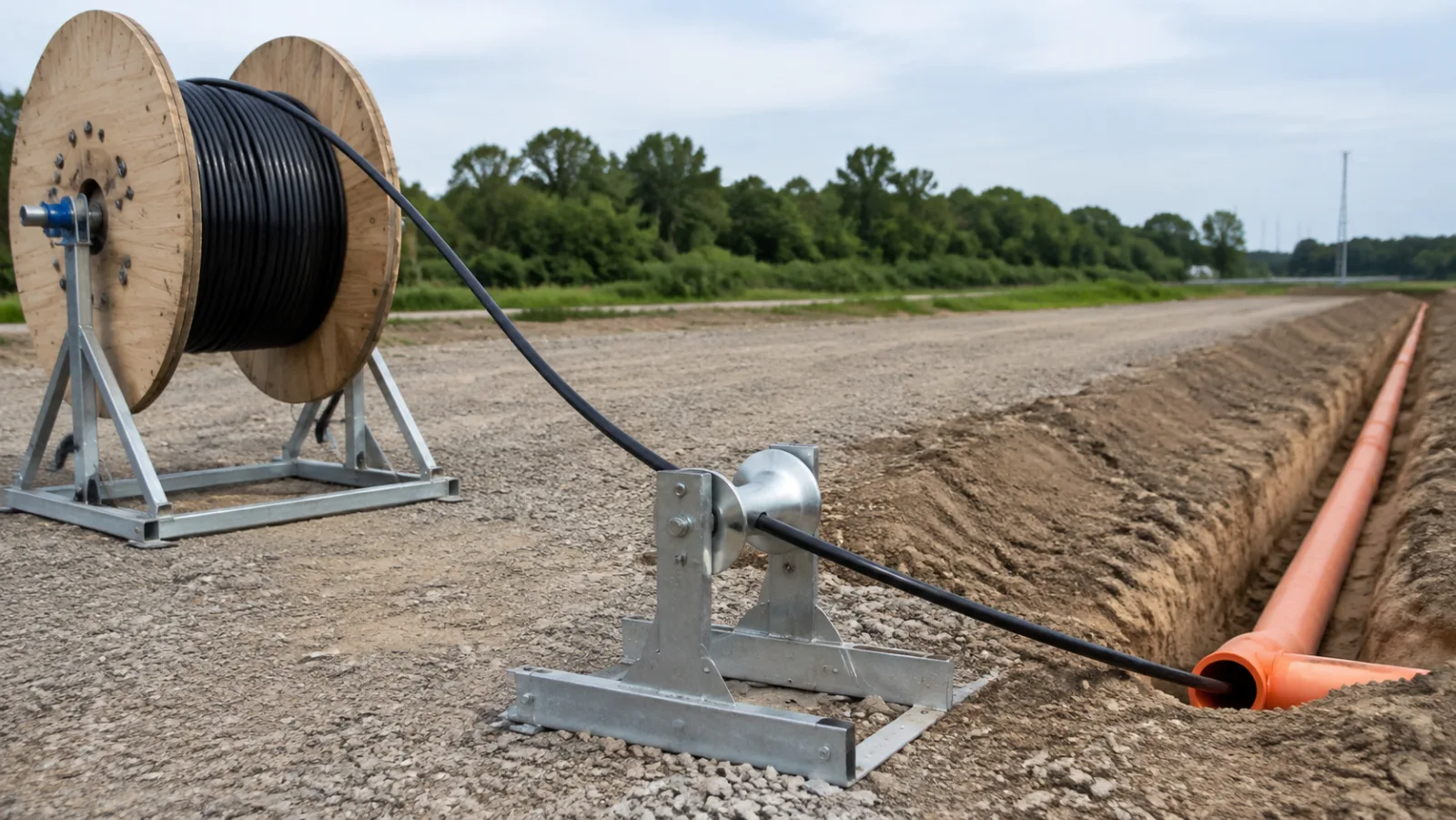
Water blocking limits longitudinal migration after a sheath breach or exposed end; it does not mean an unterminated cable can be submerged indefinitely. Specify whether the construction uses gel, swellable yarn, tape or another system and which cable regions must block water.
IEC 60794-1-22:2017 groups environmental cable methods and includes F5 water penetration, while its catalogue notes that newer method-specific publications partially replace the document. The purchase order should name the exact edition accepted by both parties.
Select F5A, F5B or F5C deliberately
The variants challenge different prepared paths. F5A is associated with radial access created near the sheath, F5B with longitudinal entry through the cable cross-section, and F5C with constructions using swellable water-blocking material and additional preparation options. Do not report simply “F5 pass” without the suffix and sample drawing.
Corning generic specification PGS066 gives a product-specific FOTP-82 fluid-penetration requirement using a one-metre static head. Its procedure is manufacturer guidance, not a substitute for the governing edition.
Specify the apparatus and exposure
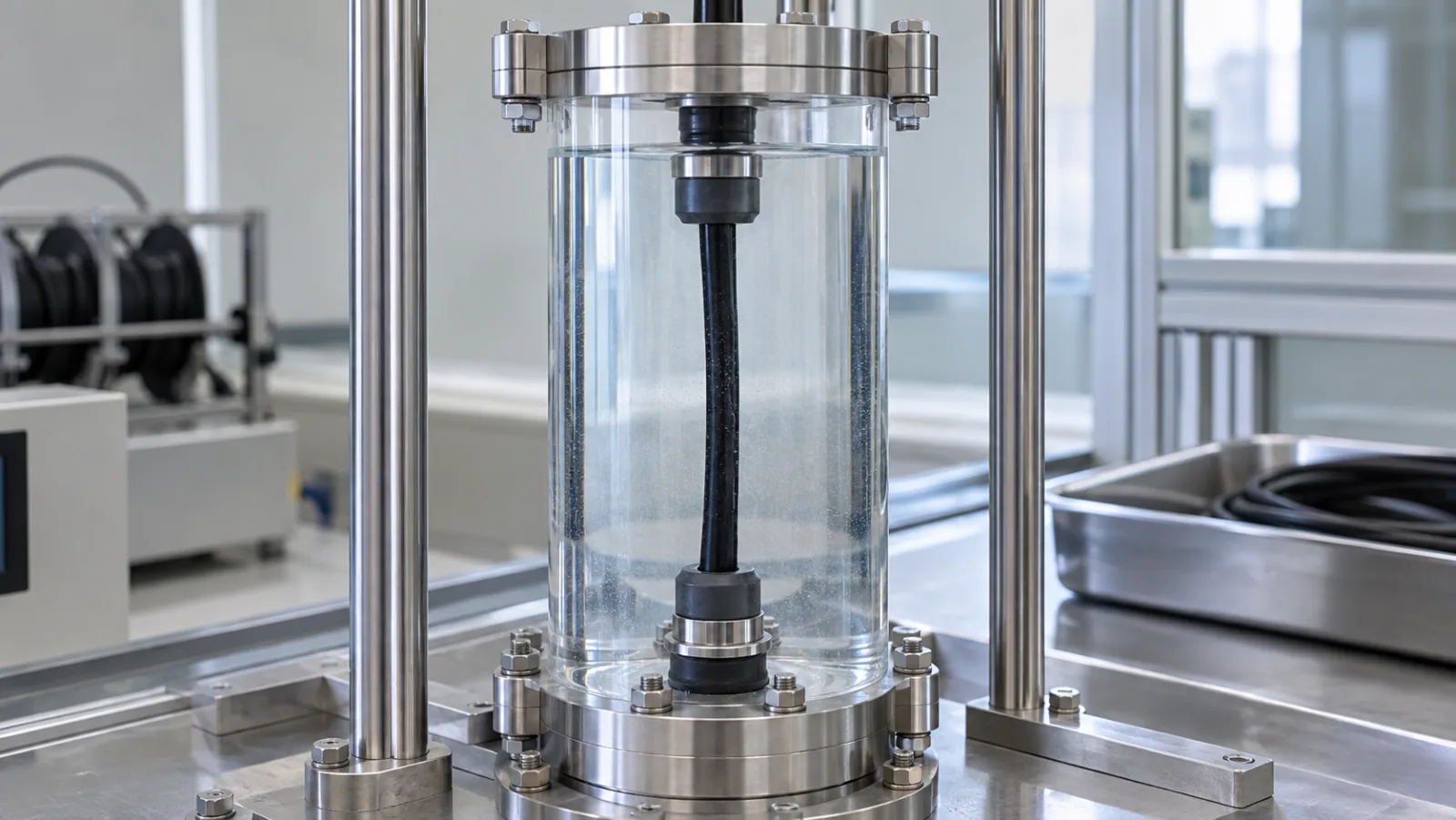
Record sample length, exposed-core preparation, sealing fixture, water type, dye if used, column height, temperature, duration and the method used to detect leakage. Confirm that dye chemistry does not suppress swelling or react with cable components.
A one-metre column of fresh water represents approximately 9.81 kPa gauge pressure using P = ρgh with ρ = 1000 kg/m³, g = 9.81 m/s² and h = 1 m. This calculation explains the head; it does not change a standard’s prescribed apparatus.
Inspect the right endpoint and document the result
Define where water must not appear and how it will be observed. A dry exterior does not prove the internal path passed. After exposure, preserve the time log, water level, leakage observations, photographs and any dissection required by the procedure.
Our IEC cable test buyer guide places environmental tests in a broader qualification plan. The incoming cable reel inspection guide covers damage checks that factory type-test evidence cannot replace.
F5 purchase-order worksheet
The following is a planning form, not a completed certificate. Replace every placeholder with the governing requirement.
| Field | Example entry | Buyer check |
| Method | F5A / F5B / F5C | Name one variant |
| Water head | 1.0 m | Confirm tolerance |
| Duration | 24 h | Confirm edition |
| Detection | Open-end observation / approved dye | State pass rule |
| Evidence | Setup, time log, result | Link to sample ID |
Do not use the example head or duration when another contract or standard edition governs. The report must show actual values and any allowed deviation.
Write the requirement before requesting evidence
Start with the exact product, application and document revision. State the sample configuration, environmental or optical conditions, measurement points, units and required report fields. Identify the acceptance value and whether it applies per fiber, per channel, per cable sample or to a statistical lot. A standard method and a project limit are different things: cite the method that governs the procedure and the specification that supplies the pass/fail value.
On the commercial fiber optic cable supplier page, provide these details with the inquiry. This lets a proposed construction and test plan be reviewed against the intended deployment. Do not assume a broad product-family description proves compliance for every design option.
Control samples, instruments and revisions
Give every sample and fiber a traceable identifier. Record cable marking, length, conditioning, termination method and any preparation that could influence the result. Instrument records should include model, serial number, calibration status, wavelength, reference method, settings and raw file name. If a setup changes during the sequence, document the change rather than combining unlike readings silently.
Use approved documents at the work station and archive superseded versions. Review drawings, purchase requirements and manufacturer instructions before starting. Where they conflict, stop and obtain a written disposition. This protects both buyer and supplier from judging a test by a limit that was introduced after the sample was prepared.
Apply a reproducible decision rule
Define rounding and measurement uncertainty before results are known. A displayed value at the limit can represent raw values on either side of it. Preserve additional digits in the record, then apply the agreed rounding or guard-band rule once. Repeating a measurement only until it passes is not a valid process; repeats need a stated trigger and all valid observations should remain in the file.
When a result fails, first verify identity, setup integrity, reference stability and data transcription. Then follow the approved route: retest, inspect, rework, reject or request engineering review. The record must distinguish a confirmed product nonconformance from an invalid test. Neither should be hidden by averaging unrelated samples.
Preserve a useful delivery record
A complete report contains the requirement, procedure, sample description, apparatus, conditions, chronological readings, calculation, uncertainty rule, decision and authorization. Native instrument files and photographs may support the report, but screenshots and photos do not replace numeric evidence. Mark hypothetical worksheets as examples so they cannot later be mistaken for factory results.
Keep incoming, pre-installation and post-installation checks separate. Transport, storage and field handling occur after factory release and can alter condition. If the asset is repaired or rerouted, update its configuration record and create a new baseline using the same method where practical. A clean change history makes later troubleshooting faster and supports fair warranty discussions.
Common errors and safety boundaries
Avoid calling jacket abrasion resistance a water-blocking result, mixing radial and longitudinal test claims, or using a sealed far end that prevents observation. Do not infer long-term submerged service from one F5 result.
Never copy a limit from a visually similar cable or instrument without checking construction, wavelength, reference condition and standard edition. Follow site rules for invisible laser radiation, sharp fiber fragments, pressurized apparatus, environmental chambers and electrical equipment. Qualified personnel should use the manufacturer’s safety instructions and the project risk assessment.
Plan the sampling and witness process
State whether the evidence is a design qualification, periodic type test, production sample test or inspection of the delivered lot. These categories are not interchangeable. Define lot boundaries, sample quantity, selection method and what happens to the remainder of a lot when one sample fails. If testing is destructive or changes the sample, mark it so it cannot return to saleable stock unnoticed.
Where a customer witness is required, agree the date, language, remote-view arrangements and hold points in advance. A witness observes the approved procedure; the witness should not improvise new limits after testing begins. Record deviations and obtain signatures from the authorized representatives.
Check report completeness before release
Use an independent review to compare the report against the purchase order. Confirm that identifiers, units, wavelength, environmental conditions, calculations and pass/fail statements agree across the cover page and raw data. Verify that attachments open and that photographs show the intended sample without exposing confidential information.
The reviewer should also confirm that a statement of conformity does not extend beyond the tested configuration. A result on one cable length, instrument module or connector arrangement cannot silently qualify every variant in a catalogue. Release the report only after discrepancies are corrected or formally explained, then retain it according to the project’s record policy.
Record the final approval date and the person or organization authorized to release the result.
Frequently Asked Questions
Does an F5 pass mean the cable is waterproof?
No. It demonstrates resistance to water migration under the specified prepared sample and test conditions, not unlimited immersion performance.
Why must the F5 suffix be recorded?
F5A, F5B and F5C use different sample preparations or construction contexts, so “F5” alone is incomplete.
Is one metre of water equal to one bar?
No. One metre of fresh water is about 9.81 kPa, approximately 0.098 bar, under the stated density and gravity assumptions.
Can fluorescent dye always be used?
Only when the procedure permits it and the chosen dye does not react with or inhibit the water-blocking materials.
Should every delivered reel receive a destructive F5 test?
Not automatically. Define type, routine or sample testing and incoming inspection separately in the quality plan.