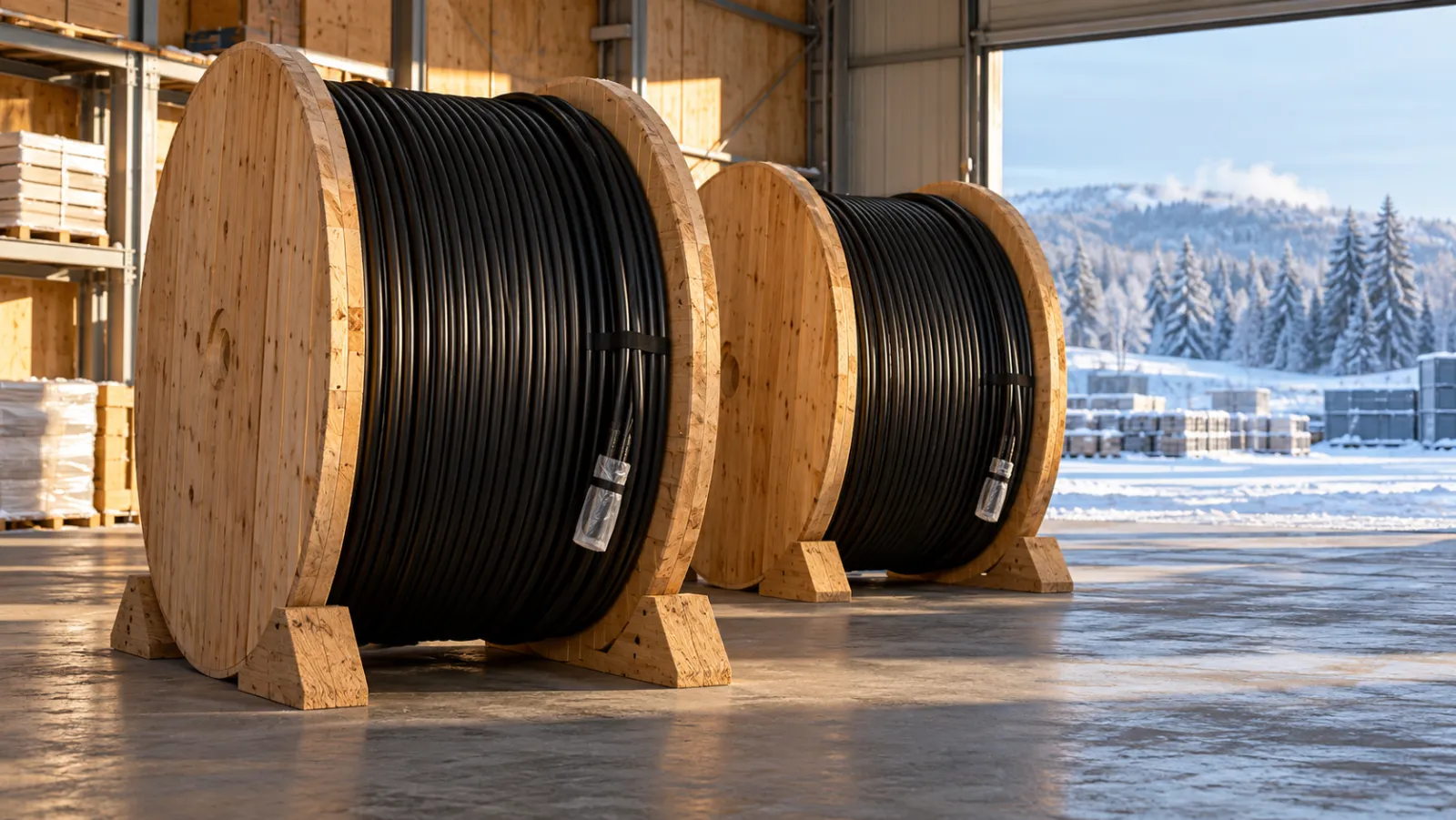
Summary: Fiber optic cable installation temperature is not interchangeable with storage or operating temperature. A reel can remain within its storage rating overnight yet be too cold to pull the next morning. Specify all three ranges for the exact construction, confirm any conditioning instructions, and release installation only when the cable and work conditions meet the applicable requirements. The comparison and scheduling examples below explain how to turn those ratings into a practical purchase and site plan without inventing a universal warming time.
Three temperature ranges answer three different questions
Storage and shipping: before the cable is placed
The storage range describes permitted conditions for the cable in its specified stored state. It is not authorization to bend, pull, unwind or repeatedly handle the cable at every temperature within that range. Read any packaging, duration and moisture restrictions with the temperature figures. A number on a cable datasheet also does not automatically cover a fitted connector, pulling head or enclosure supplied as part of an assembly.
Installation: while the cable is being handled
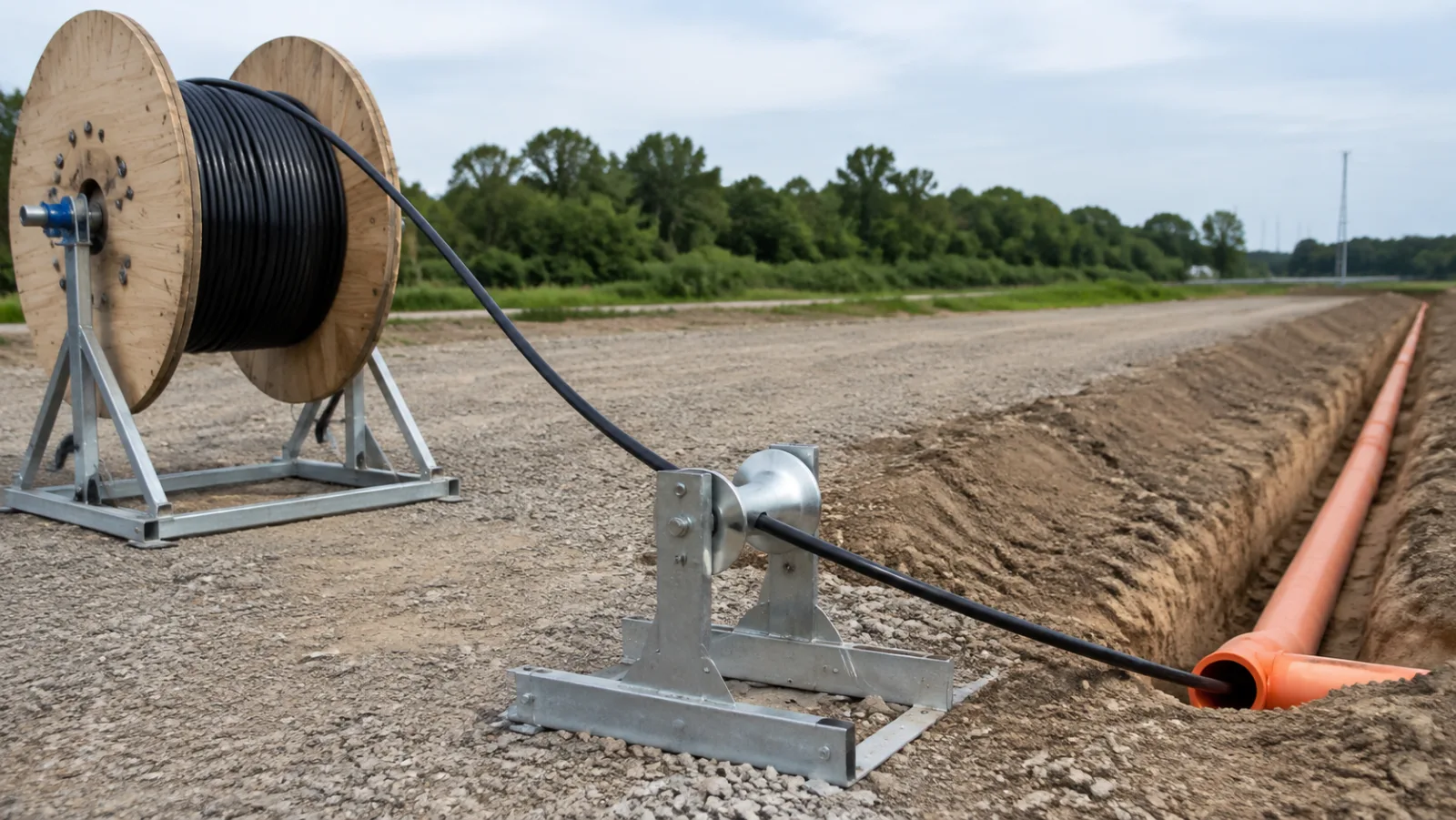
Installation combines temperature with mechanical activity. The cable leaves its reel, passes through guides, bends and experiences tension. That is why a separate installation range matters. The specification should identify the relevant cable temperature and any ambient or process restrictions rather than leaving the crew to interpret a weather forecast as proof of compliance. Manufacturer instructions may require conditioning before placement; obtain those instructions before scheduling the pull.
Operation: after the installation is complete
The operating range applies to the intended service configuration. It should not be used as a substitute installation rating during repairs or rerouting. A cable operating successfully on a cold morning may still be outside its permitted handling conditions. Maintenance planning therefore needs a separate decision about movement, access and replacement, even when the existing optical link remains in service.
Compare real documents without transferring their ratings
Corning’s PGS131 generic cable specification, December 2022 revision 2, gives shipping, storage and operation as minus 40 to plus 70 degrees Celsius, but installation as minus 30 to plus 70. That ten-degree difference at the lower end directly demonstrates why the fields must remain separate. These figures describe the referenced construction, not every outdoor cable and not a Liqiba product guarantee.
The Prysmian AIRGUARD XP fiber cable datasheet, displayed revision TLS-DS-D-101-0626 CAN, lists another pattern for its steel-tape armored XPRLTMD series: storage at minus 40 to plus 70 degrees Celsius and installation at minus 30 to plus 60. Operation varies with fiber count: minus 50 to plus 70 for 12–72 fibers, and minus 40 to plus 70 above 72 fibers. The document also recommends appropriate temperature conditioning for at least 24 hours before placement. Its dielectric XPRLTM series has different ratings; do not mix the two tables.
| Referenced document | Storage range | Installation range | Procurement lesson |
|---|---|---|---|
| Corning PGS131, revision 2 | -40 to +70 °C | -30 to +70 °C | Lower storage limit does not authorize pulling |
| Prysmian AIRGUARD XP, XPRLTMD series | -40 to +70 °C | -30 to +60 °C | Upper limits and conditioning also matter |
| Your purchase order | Supplier-confirmed value | Supplier-confirmed value | Match the exact cable and handling instructions |
Do not turn the second manufacturer’s conditioning recommendation into a rule for the first product or an unrelated reel. These are document-reading examples, not a ranking of brands. The purchase order must identify the offered construction, current approved revision and project conditions. If the supplier proposes a substitution, repeat the comparison even when fiber count and jacket color are unchanged.
Worked release example: an acceptable stored reel
Assume a fictional cable with an approved storage range of -40 to +70 °C and an installation range of -20 to +60 °C. Assume the reel has been stored at -25 °C and that this is a confirmed cable condition, not merely a nearby weather reading. It is inside the stated storage range, but five degrees below the installation minimum. The correct release status is “hold for approved conditioning,” not “pass because storage was acceptable.”
The five-degree difference is simply -20 minus -25. It is not a heating-energy calculation or a prediction of the time needed for the reel to warm. Reel dimensions, packaging, airflow, cable mass and the surrounding environment affect the process. A small exposed cable end can warm sooner than material deeper in a reel, so one convenient surface reading may not satisfy the supplier’s release method.
Now assume the supplier’s approved procedure requires a full 24-hour conditioning period under specified conditions, and the documented start is 14:00 on Monday. The earliest time allowed by that duration alone is 14:00 on Tuesday. A proposed 09:00 Tuesday pull allows only 19 hours and is five hours short. The calculation is a scheduling example; reaching Tuesday afternoon still does not release the reel unless the other specified conditions are met.
Create a temperature decision record, not a guess
A useful release sheet has fields for reel identity, cable part number, approved document revision, required installation range, storage history, conditioning location, start time, verification method and release authority. Record units explicitly. If a subcontractor reports Fahrenheit and the purchase order uses Celsius, convert before comparison and retain the original value. Avoid rounding a borderline measurement into compliance.
Define who is permitted to release the material and what happens if conditions change after release. A reel moved from conditioned storage to an exposed work area is no longer in the same environment. The allowed delay before use and any reconditioning requirement should come from the applicable procedure, not an improvised blanket rule. Include forecast changes in planning, but distinguish forecasts from measured conditions.
If temperature history is unknown, record that uncertainty. Do not reconstruct a compliant history from the absence of visible damage. Request manufacturer disposition where needed and keep the reel separate from released material. A later optical test can provide useful evidence of condition, but it does not retroactively prove that every handling restriction was followed.
Keep the complete installation inside its limits
The cable is one part of the work system. Review the temperature limits and instructions for pulling lubricant, grips, seals, connectors, test equipment and any powered installation equipment. The acceptable work window must satisfy all relevant requirements. If a lubricant is unsuitable at the planned temperature, an acceptable cable rating alone cannot resolve that mismatch. Use compatible materials and the approved installation method.
Likewise, meeting the temperature range does not cancel bend-radius or pulling-tension limits. Do not infer that warming a cable allows tighter routing or a higher pull force. Keep separate checks for route geometry, handling equipment, mechanical limits and weather exposure. Avoid localized or uncontrolled heating methods unless the cable manufacturer specifically permits them and the site procedure addresses the associated hazards.
What the RFQ should require
Ask bidders to state storage, installation and operating ranges separately, with any distinctions by fiber count, sheath, armor, connectorization or environment. Include the anticipated delivery season, storage arrangement and installation method in the inquiry for fiber optic cable supply. Request a written conditioning procedure where the project may approach a temperature boundary, rather than accepting a generic “suitable for cold weather” statement.
Also ask how deviations are handled. The response should identify the information needed for technical disposition, the party authorized to approve it and the records that must remain with the reel. Agree on these fields before shipment, when replacement or schedule changes can still be planned. This avoids forcing a site supervisor to choose between an undocumented exception and a missed installation slot.
Link qualification, receipt and field release
Related reading: the temperature-cycling test guide addresses laboratory evidence, while the incoming reel inspection plan addresses received material. Neither record replaces the installation-temperature release. Keep all three associated with the same cable identity and revision so evidence from a different construction is not attached accidentally.
The practical objective is a clear decision at the reel: release, hold for conditioning, or seek documented disposition. A well-specified temperature schedule supports that decision before equipment and crews are committed. It does not promise that cable is immune to handling damage, and it never turns an example datasheet into a project-specific approval.
Frequently Asked Questions
Can cable be installed anywhere within its storage temperature range?
No. The installation range is a separate requirement. Cable can be within its storage rating while remaining outside its permitted handling or pulling conditions.
Does operating temperature authorize cold-weather cable repairs?
Not by itself. Moving or rerouting an installed cable introduces handling conditions. Check the manufacturer’s applicable installation and maintenance instructions before the work.
How long should a cold fiber cable reel be conditioned?
Use the procedure for the exact cable and reel conditions. A duration stated for one manufacturer’s product is not a universal rule, and elapsed time alone may not satisfy every release condition.
Is the weather forecast enough to release a reel for pulling?
No. A forecast supports scheduling but does not establish the cable’s actual condition. Use the approved verification method and record any required conditioning and release checks.
Can a passing optical test prove that temperature restrictions were followed?
No. It provides evidence of optical condition under the test conditions, not a complete temperature or handling history. Preserve the installation records and seek documented disposition for deviations.