Summary: Comparing a zirconia vs phosphor bronze fiber adapter sleeve requires more than choosing ceramic over metal. The alignment sleeve is one part of a complete mating system, and its material name does not establish insertion loss, repeatability or application suitability. This guide shows how to separate housing and sleeve materials, read model-specific evidence and create a fair qualification comparison for a purchasing decision.
Locate the component you are specifying
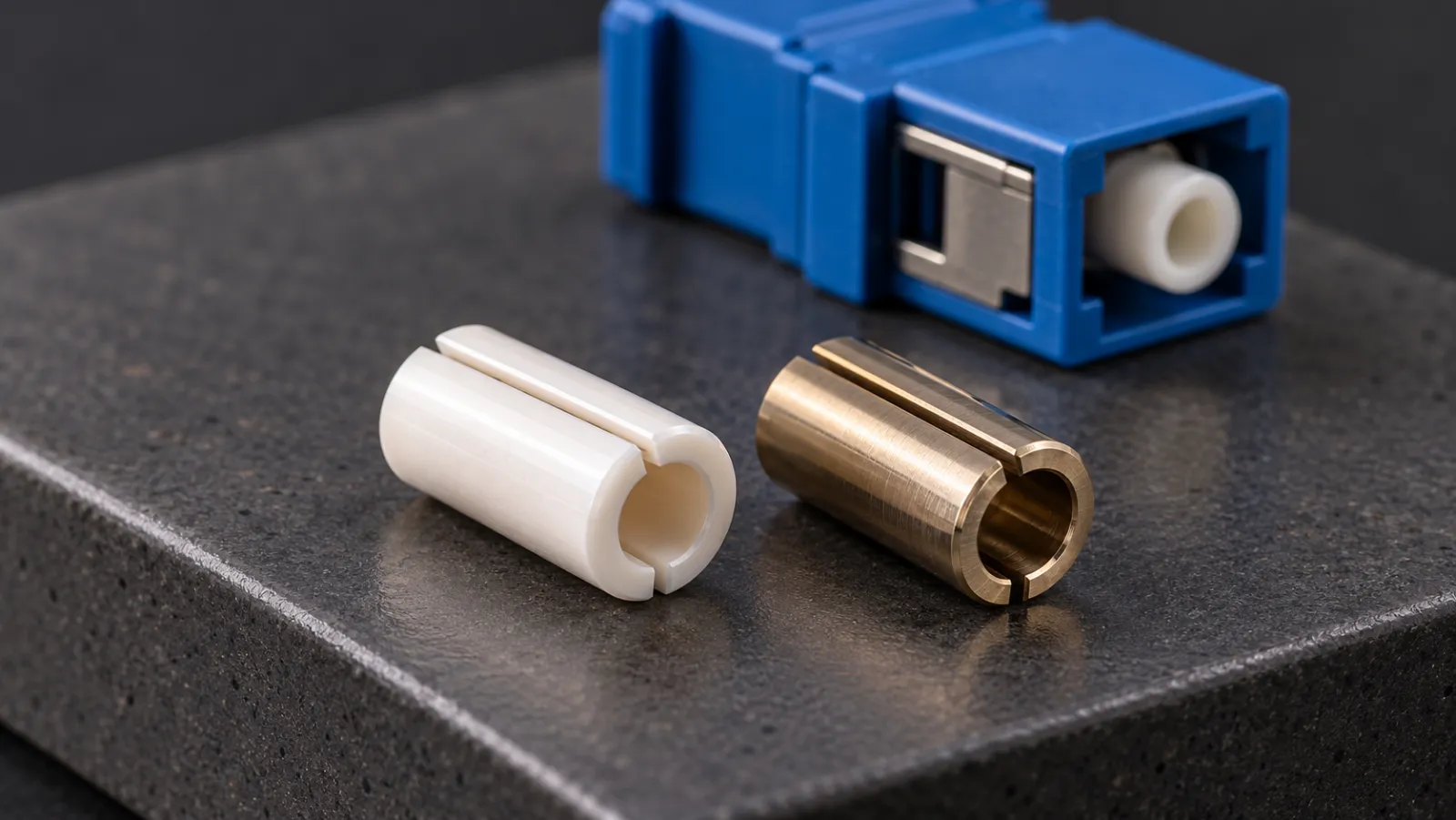
In a conventional ferrule-based adapter, the sleeve guides the mating ferrules into alignment while the outer body provides mounting and connector retention features. These jobs are related but not identical. A metal adapter body can contain a ceramic sleeve, and a plastic body can be offered with different sleeve options.
For a clear published example, SENKO’s FC round adapter page identifies a nickel-plated brass housing with a zirconia split sleeve. It also offers different connector-key options. The example demonstrates why a purchase line saying only “metal FC adapter” is incomplete: it describes neither the internal sleeve choice nor every mechanical compatibility detail.
Specify the complete adapter part number and its controlled drawing. Keep body material, alignment sleeve material, connector interface, mounting arrangement and optical performance in separate fields. This reduces the chance that a distributor substitutes an apparently similar body with a different internal component.
Color and photographs are not material certificates
Housing color can help organize a system, but it is not proof of the sleeve composition inside. Product photographs may show a representative family rather than the exact orderable variant. A written specification tied to a part number is more reliable than interpreting a small white or metallic area in an image.
Do not dismantle finished adapters just to verify a purchasing assumption. Disassembly can contaminate or damage parts and may invalidate the product’s intended assembly condition. If material identity is critical, agree an appropriate declaration, traceability record or inspection method with the supplier before ordering.
Avoid the “bronze means multimode only” shortcut
FiberSource’s SC adapter documentation describes singlemode applications with either singlemode-grade phosphor bronze or zirconia ceramic sleeves. That published counterexample means a blanket rule excluding every bronze sleeve from singlemode use is not defensible. It does not establish that all bronze sleeves are suitable, or that all products using either material perform identically.
The practical question is whether the exact adapter meets the required interface and optical performance with the intended connector population. Material is a useful controlled design attribute; it is not a substitute for dimensions, manufacturing control and tested performance. Equally, the word zirconia should not be treated as an automatic guarantee of a particular loss grade.
Compare the right evidence
| Evidence field | Useful purchasing question | Misleading shortcut |
|---|---|---|
| Interface and ferrule compatibility | Which connector geometry and keying does the part support? | All adapters with similar bodies are interchangeable |
| Sleeve material and grade | What is controlled in the ordered variant? | Material name alone establishes optical grade |
| Insertion-loss method | Which reference and mating arrangement produced the value? | Any two catalogue loss values are directly comparable |
| Connector population | Were reference or production connectors used? | A selected best pair represents every field connection |
| Repeatability and environment | What sequence and conditions were evaluated? | One initial reading proves lifetime behavior |
| Traceability | Does the report cover the ordered revision and lot? | A family brochure proves every variant |
For example, a loss figure based on a reference-grade jumper and a stated random-mating arrangement should retain those conditions when quoted. It should not silently become a maximum for arbitrary dirty field connectors. Likewise, an initial measurement at room conditions is a different claim from performance after an environmental or durability sequence.
Design a controlled comparison, not a material contest
Suppose a project is considering two qualified candidate adapters, one with each sleeve material. To compare their initial mating behavior, keep the connector interface, fiber type, polish compatibility, wavelength, reference method and measurement equipment fixed. Select documented production samples rather than asking each supplier to submit only its best reading.
Use the same identified connector-pair set across candidates where the agreed method permits it. Define the mating order in advance, and account for wear or contamination that could favor whichever candidate is tested first. If the two candidates also have different housings or retention designs, state that the exercise compares complete adapters, not the isolated causal effect of sleeve material.
Illustrative workload calculation
Assume ten adapter specimens per candidate, three identified connector pairs per specimen, and two independent rematings per pair at one wavelength. That creates 10 × 3 × 2 = 60 planned mating observations per candidate, or 120 across both candidates. This is an example of test-workload planning only. It is not a standard sampling requirement, statistical qualification claim or actual test result.
| Planning item | Assumption | Purpose |
|---|---|---|
| Adapter specimens | 10 per candidate | Observe more than one physical unit |
| Connector pairs | 3 identified pairs | Explore pairing dependence within this small set |
| Rematings | 2 per pairing | Record short-term repeatability |
| Observations | 60 per candidate | Estimate measurement workload |
Those 60 observations are not necessarily 60 independent manufacturing samples. Several share the same adapter or connector pair. Keep individual identities in the results so the reviewer can distinguish a consistently troublesome specimen from one connector pair that performs poorly across both candidates. A single pooled average would hide that distinction.
Agree the decision rule before collecting data
Define the applicable per-connection limit, any repeatability criterion and the treatment of measurement uncertainty. Decide how an outlier will be investigated and whether a confirmed defect triggers rejection, replacement sampling or a broader review. These rules should follow the project requirements and risk, not be invented after the preferred material receives a disappointing result.
Record every original reading. If cleaning is allowed after a failed observation, preserve both the original and the retest with an explanation. An unexplained best-of-several value is not a transparent acceptance record. Keep continuity, insertion loss and return loss as separate requirements where the application calls for them.
Initial optical acceptance is only one part of qualification. If the application requires a mating-durability or environmental sequence, request evidence for that sequence and the post-test criteria. Do not extrapolate a short remating exercise into a long service-life prediction. Similarly, laboratory results should not be presented as field reliability statistics.
Control contamination and handling
Compatible, clean connector end faces are essential to a meaningful adapter comparison. Establish an inspection and cleaning procedure for the measurement setup and document how test leads are protected between uses. Never look into a potentially live fiber, and follow the instrument’s safe inspection procedure.
Do not probe an alignment sleeve with an arbitrary metal object to judge its grip or cleanliness. Use only approved tools and methods for the particular connector system. Damage introduced during an improvised inspection can become a hidden confounding variable in the optical results.
What to put in an adapter inquiry
When requesting fiber optic adapters, identify both connector ends, polish compatibility, mounting format, sleeve requirement, body material and operating environment. Include the required performance limits and how they will be measured. If a specific sleeve material is mandatory for an approved design, say so explicitly rather than allowing substitutions based on a generic “equivalent” description.
If alternatives are acceptable, ask for a separately identified proposal with its evidence. Maintain the original requirement until the alternative has been reviewed. A cheaper or more readily available part can be a reasonable choice, but only when its complete fit and qualification boundary are understood.
Related selection and verification guides
Before ordering a replacement, use our adapter panel-cutout guide to check the physical installation. For service involving repeated connections, see our connector mating-durability guide. Together, these checks keep sleeve selection connected to actual optical, mechanical and maintenance requirements rather than a material label alone.
Frequently Asked Questions
Does a metal adapter housing imply a metal sleeve?
No. Housing and alignment sleeve are separate components. A metal body can contain a zirconia sleeve; verify both in the exact part specification.
Are phosphor bronze sleeves always limited to multimode?
No. Some manufacturers explicitly offer singlemode-grade phosphor bronze variants. Suitability must be checked for the exact adapter and intended connector system.
Does zirconia alone guarantee low insertion loss?
No. The complete mating system, dimensional control, connector condition and test method affect performance. Use the specified and verified product limits.
Can two catalogue insertion-loss values be compared directly?
Only after checking the reference method, connector population, wavelength and stated conditions. Different test boundaries can make the numbers unsuitable for a direct comparison.
How should an adapter material substitution be approved?
Identify the alternative part and revision, review its mechanical fit and optical qualification, and obtain project approval before replacing a controlled material requirement.