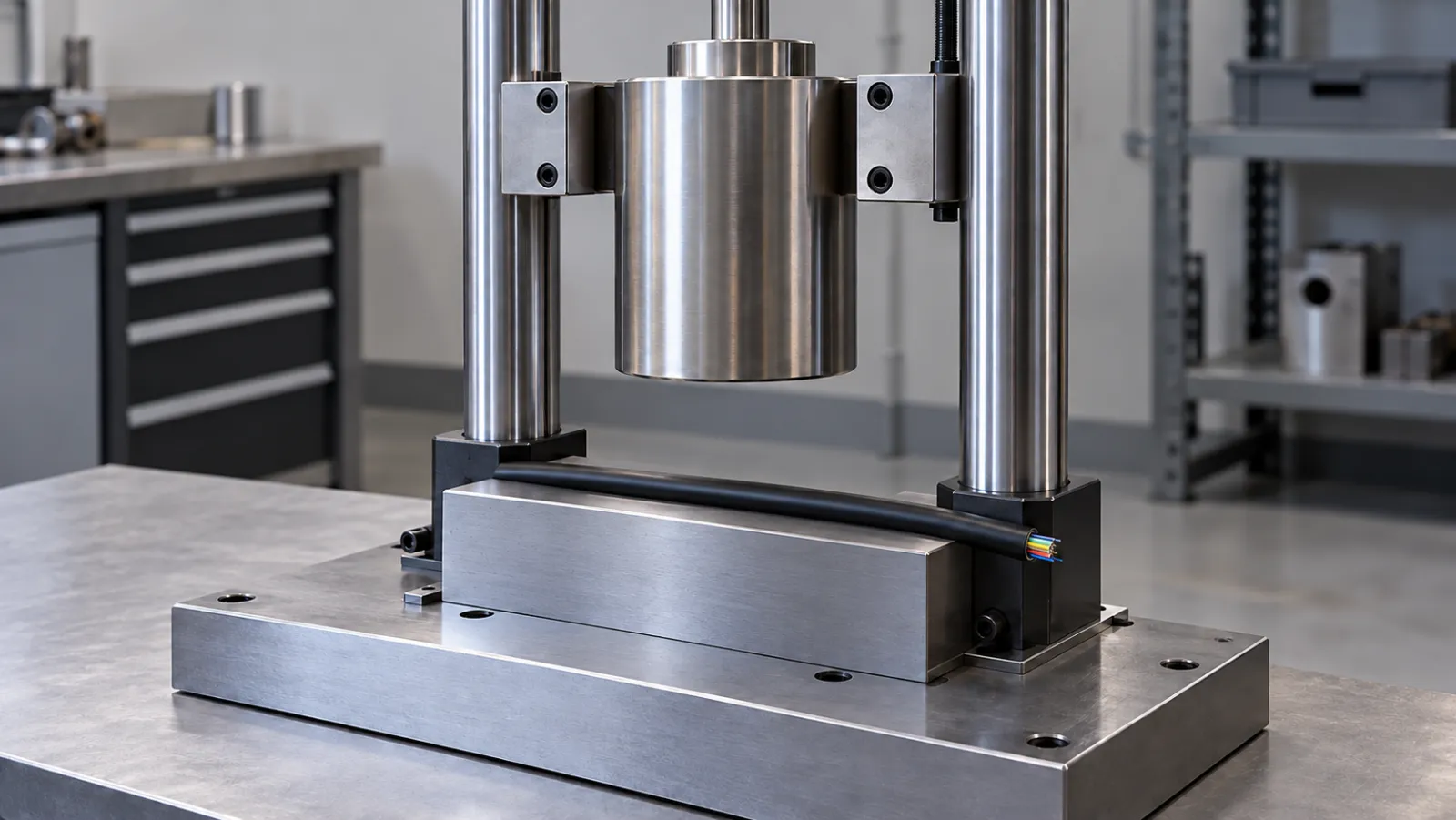
Summary: A fiber optic cable impact test evaluates a defined mechanical strike under specified conditions. An energy value in joules is only one part of that description. Buyers also need the method, striker geometry, supporting arrangement, strike sequence and optical acceptance criteria. This guide explains IEC E4 evidence and provides a calculation that shows why equal impact energy does not make two test setups equivalent.
Start with the referenced method
IEC 60794-1-104:2024 covers impact method E4 for optical cables. The IEC catalogue describes its relationship to the earlier IEC 60794-1-21:2015 collection of mechanical methods. It establishes the subject and document history, but the public abstract is not a complete laboratory procedure or a universal cable impact rating.
Specify the required edition in the purchase documents and obtain the applicable full method for qualification work. The product specification or project schedule must define the required severity and acceptance conditions. A statement that a cable is “IEC tested” does not identify which mechanical test was performed or whether it matches the ordered construction.
Keep any proposed alternative method visible in the compliance matrix. If the supplier offers a report under another standard, request a documented comparison and an authorized decision. Do not silently replace the contract’s method name because the alternative report contains a familiar energy value.
Impact is not sustained crush
A crush test applies a specified compressive loading arrangement, often for a stated duration. An impact test involves a dynamic strike. A cable can respond differently to these load histories, even when both leave a mark on the jacket. Neither report should be used as an automatic substitute for the other.
The cable construction matters as well. Jacket material, armor, strength members, tube layout, diameter and fiber arrangement affect how a load is transferred. Evidence for one construction should be reviewed before being applied to a different fiber count or mechanical design. Matching the outside color is not a qualification argument.
Distinguish the declared result
“No fiber break” is not the same acceptance statement as “attenuation change within the agreed limit,” and neither necessarily addresses all permitted jacket damage. Ask which observations were made during the sequence, after each strike if required, and after any specified recovery period. The word pass is meaningful only alongside its criteria.
Worked energy calculation with clear limits
For an ideal freely falling mass, the available gravitational potential energy is E = m × g × h. Use mass m in kilograms, gravitational acceleration g in meters per second squared and drop height h in meters to obtain joules. For this illustrative calculation, assume g = 9.81 m/s² and neglect guide friction, air resistance and losses before contact.
| Hypothetical setup | Mass | Drop height | Calculated energy |
|---|---|---|---|
| A | 1 kg | 0.50 m | 4.905 J |
| B | 2 kg | 0.25 m | 4.905 J |
| C | 1 kg | 0.25 m | 2.453 J, rounded |
These are textbook energy calculations, not IEC E4 settings, measured delivered energies or recommended cable ratings. A and B have equal calculated energy but different ideal impact velocities: approximately 3.13 m/s and 2.21 m/s respectively, using the square root of 2gh. Their momentum and contact-time behavior need not match.
Most importantly, energy alone does not determine peak force on the cable. The striker nose, supporting surface and deformation influence how the event develops. Dividing energy by an assumed stopping distance can produce a rough average-force model, but it cannot establish a standard-compliant peak load without a justified mechanical model and measurement method.
Read the units without changing the physical quantity
A joule is dimensionally equivalent to a newton-meter of work. In an impact specification, a value written as N·m may therefore describe energy. It should not be interpreted as a twisting torque merely because torque uses the same unit combination. The surrounding test description determines the quantity.
Also distinguish mass from force. A fixture drawing that lists kilograms identifies a mass unless stated otherwise; newtons identify force. A catalogue value expressed in kilograms-force requires an explicit conversion and still does not, by itself, define the impact energy. Preserve the original units and method reference when normalizing supplier data.
A manufacturer example, not a transferable qualification
Corning PGS131, December 2022 revision 2, section 5.6, describes an FOTP-25 repeated-impact requirement for its stated cable family. It specifies two cycles at three locations along a one-meter cable length, an impact energy of at least 4.4 N·m, and wavelength-specific attenuation-change limits. This demonstrates how a product requirement combines energy, repetition, location and optical criteria.
That example does not establish compliance for Liqiba products or equivalence between FOTP-25 and IEC E4. It should not be copied into a quotation as if it were a test result. The appropriate evidence is a report covering the offered cable construction and the agreed requirement, with any deviations clearly recorded.
Create a report completeness checklist
| Report field | Why it matters | Question if missing |
|---|---|---|
| Method and edition | Identifies the procedure | Which exact reference governs the test? |
| Specimen identity and conditioning | Connects the test to the cable and environment | Does this represent the ordered construction? |
| Striker and support geometry | Defines contact and load transfer | Were the required fixture dimensions used? |
| Energy and its establishment | Defines the intended severity | How were mass, height or other settings verified? |
| Strike locations and sequence | Distinguishes repeated and distributed loading | How many strikes occurred at each location? |
| Optical and physical criteria | Defines acceptance | What was monitored, when and against which limits? |
This is a purchaser’s review worksheet, not a reproduction of the standard’s mandatory report format. Use it to identify unresolved evidence rather than to invent missing conditions. Mark a field as not applicable only when the agreed method supports that treatment.
Count strikes and measurements separately
For a hypothetical plan with three specimens, four strike locations per specimen and two strikes at each location, the planned strike count is 3 × 4 × 2 = 24. That does not determine the number of optical records. The latter also depends on monitored fibers, wavelengths and measurement checkpoints.
Prepare separate schedules for mechanical actions and optical observations. This prevents a report with 24 mechanical events from being mistaken for complete optical monitoring of every fiber. State whether the project requires selected-fiber monitoring or broader coverage, and record the basis for that choice.
Resolve deviations before accepting the report
If the laboratory used a different support, energy or conditioning period, request an explanation of the deviation and its relevance. A more severe value in one field does not automatically compensate for a less demanding condition elsewhere. The qualified reviewer should decide whether the report supports the intended requirement.
For borderline optical changes, check reference stability and the agreed measurement decision rule. Preserve original readings and any justified retests. A cable that looks intact should not be accepted solely on appearance when the contract includes optical criteria; conversely, a photograph of a mark should be assessed against the actual permitted physical condition.
Translate test evidence into the order
For a fiber optic cable inquiry, provide the installation environment, cable construction and required mechanical test schedule. Ask which reports are available and whether they cover the exact offered design. Qualification testing is different from routine acceptance of every shipped reel, so specify both scopes when they are required.
Our crush-rating guide covers sustained compression separately, while the incoming reel inspection plan addresses delivery checks. An impact qualification does not authorize rough handling on site or replace the manufacturer’s installation instructions. Its value is evidence of performance under a defined and traceable test boundary.
Frequently Asked Questions
Which IEC document addresses cable impact method E4?
IEC 60794-1-104:2024 addresses impact method E4. Use the edition required by the project together with the applicable cable specification.
Is an impact energy rating enough to compare two cables?
No. The method, specimen, striker, support, strike sequence, environment and acceptance conditions must also be compared.
Can equal drop energies produce different impact behavior?
Yes. Different mass and height combinations can have equal potential energy but different velocities and contact behavior. Energy alone does not define peak force.
Does N·m mean torque in a cable impact report?
Not necessarily. In this context it can express energy, equivalent dimensionally to joules. Interpret the unit with the physical quantity and test description.
Can a crush test substitute for an impact test?
No automatic substitution is valid. Sustained compression and a dynamic strike are different load cases and need the evidence required by the contract.