Summary: A fiber optic cable crush resistance rating in N/100 mm describes a specified mechanical loading condition, not a universal safe weight for the cable. To compare offers, align the units, contact arrangement, duration, optical monitoring and acceptance criteria. A large number without those details is weaker purchasing evidence than a traceable report with an explicit test boundary.
Read the unit before comparing the number
The newton, N, is a unit of force. A rating written per unit length must be read with its stated reference length and fixture conditions. It is not pressure in pascals, because the denominator is length rather than contact area. It also does not give an allowable vehicle weight, burial depth or clamp tightening torque. Those applications involve different geometries and load paths that need their own engineering review.
A datasheet may show N/100 mm, N/cm, N/mm or simply N for a defined plate arrangement. Copy the original notation into the comparison sheet before normalizing anything. Preserve short-term and long-term columns separately. A test load applied briefly cannot be relabeled as a continuous service load merely because both entries use newtons. If a supplier leaves out the denominator, ask what physical test configuration the value represents.
Separate the method from the product requirement
The IEC 60794-1-21 catalog describes a family of mechanical test procedures and notes that parts have been replaced by method-specific publications. An RFQ should therefore identify the exact method, edition and amendments required by its governing cable specification. A general statement such as “IEC tested” does not establish which test was performed or which pass limits were applied.
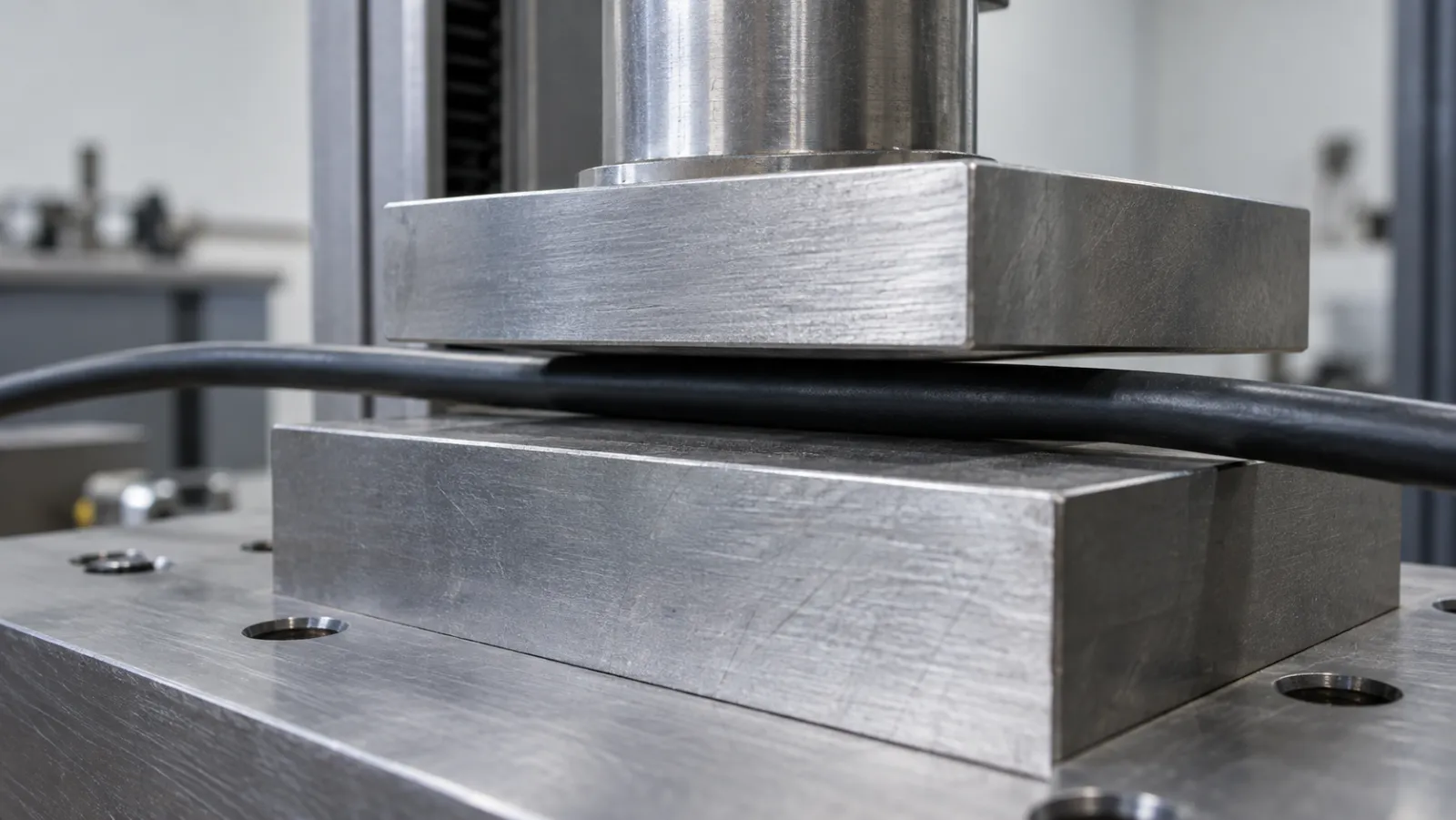
For a defined application example, ITU-T L.101 (08/2024) addresses directly buried optical cables and specifies plate-to-plate E3A crush testing in Annex A.3.5. It distinguishes short and long loading periods and calls for an optical observation before releasing the long-term load. That scope matters: requirements for directly buried cable should not be casually transferred to a patch cord or a different installation category.
Ask which result the claimed rating describes
A report can contain the commanded load, the measured load, attenuation while loaded and attenuation after recovery. These are different quantities. A value observed only after release cannot establish what happened during loading. Conversely, a temporary optical change is not automatically a failure unless the agreed criteria make it one. Require a clear relationship between the observation, the corresponding limit and the resulting decision.
A unit-normalization example with strict limits
Suppose three hypothetical offers state 1,000 N/100 mm, 100 N/cm and 10 N/mm. As numerical force-per-length expressions, all three equal 10 N/mm. Offer A converts as 1,000 divided by 100; offer B as 100 divided by 10. This arithmetic helps prevent a tenfold comparison error. It does not prove the cables have equal crush performance, because the test geometry and other conditions may differ.
| Hypothetical entry | Normalized expression | What remains unconfirmed |
|---|---|---|
| 1,000 N/100 mm | 10 N/mm | Fixture and duration |
| 100 N/cm | 10 N/mm | Optical criteria and sample construction |
| 10 N/mm | 10 N/mm | Whether the rating was normalized from a defined test |
| 1,000 N, plate dimensions omitted | Not safely comparable | Contact length and method |
Even where a uniformly distributed engineering model gives force as line load multiplied by length, do not scale a qualification result to an untested fixture. Halving the contact length and assuming exactly half the allowed force changes the mechanical problem. Cable curvature, jacket deformation and internal elements can alter the response. A narrower clamp or stone contact is not made equivalent to a broad plate by a unit conversion.
Construct the report comparison sheet
Start with specimen identity: manufacturer, cable designation, fiber count, nominal diameter, armor or dielectric construction, production lot and sample conditioning. A report on a similar-looking cable may concern a different structure. Ask which design changes require requalification and whether the offered item falls inside the qualified family. Keep the drawing revision associated with the evidence instead of accepting an untraceable sales description.
Next capture the loading sequence, fixture contact dimensions, number of tested positions, duration, environmental conditions and recovery interval. These fields explain what was actually done without inventing a procedure from a catalog summary. The licensed standard and approved test plan govern the laboratory work. If an accredited report is required, verify the relevant laboratory scope separately; a logo on a PDF is not enough.
Make the optical boundary reproducible
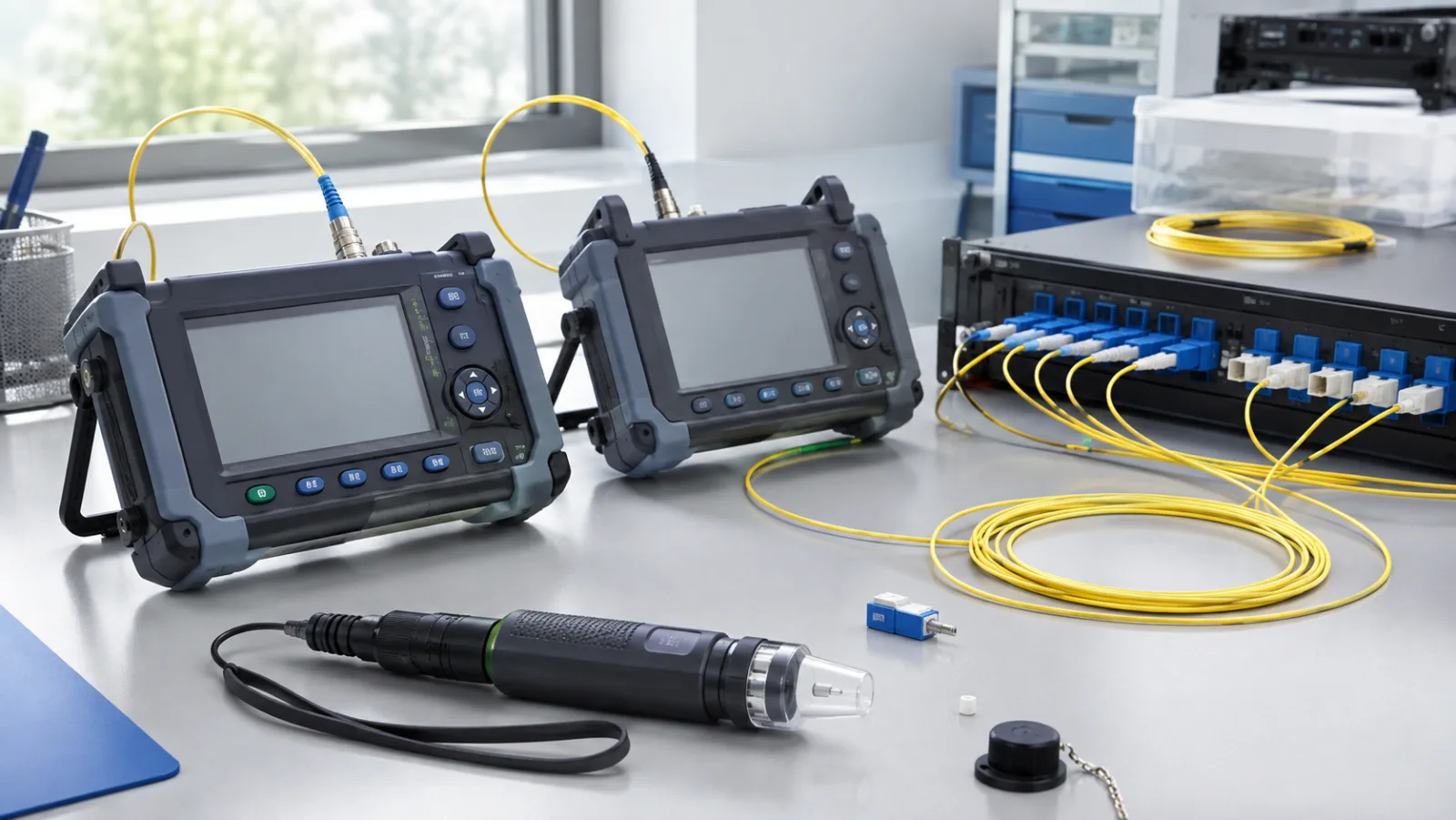
Record which fibers were monitored, the wavelengths, instrument identities, reference arrangement and baseline stability check. Identify any fiber loops or splices used to create the measured path. Distinguish attenuation change in dB from attenuation coefficient in dB/km. A short localized mechanical test does not become a kilometer-normalized cable attenuation test merely because the instrument can display that unit.
Keep both individual-fiber results and any summary. An average across fibers can hide one unacceptable path. Define how missing readings, source drift or an interrupted loading sequence are handled before testing begins. Repeating a questionable run may be reasonable, but the earlier observation and reason for repetition should remain in the report history. Do not silently replace an unfavorable value with the most convenient repeat.
Use a transparent optical-change worksheet
Assume a planning example with baseline path loss of 0.62 dB, loss at the specified loaded checkpoint of 0.70 dB and recovery loss of 0.64 dB. The respective changes from baseline are +0.08 dB and +0.02 dB. These invented values illustrate subtraction only; they are not Liqiba measurements, product limits or proof of compliance. A real decision needs the specified tolerances, measurement uncertainty and agreed decision rule.
The worksheet should have separate columns for baseline, loaded checkpoint, recovery checkpoint, applicable limit and disposition. Never compare the absolute 0.70 dB reading with a limit defined for change alone. Where the specification requires no change, establish how the laboratory evaluates that requirement within the approved measurement method. Do not invent a rounding allowance after a result has been obtained.
Translate the evidence into a purchasing decision
For a fiber optic cable quotation, describe the installation environment and request the matching mechanical evidence. State whether the requirement is a contractual minimum or an informational target. Ask the supplier to list deviations explicitly, including unavailable reports, different editions or alternative sample constructions. This allows a buyer to distinguish a confirmed compliant offer from a proposal needing further qualification.
Do not treat crush qualification as permission to ignore installation controls. Pulling tension and sidewall loading require the separate checks described in the fiber cable pulling guide. Environmental behavior also needs its own evidence; the temperature-cycling test guide explains a different qualification boundary. Passing one test does not automatically establish performance under all simultaneous stresses.
Close gaps without rewriting the evidence
Also distinguish design qualification from routine delivery inspection. A laboratory crush report may support a particular construction, while incoming inspection confirms that the delivered reels match the order and have not suffered visible transport damage. One does not replace the other. Agree on sample selection and witness requirements when qualification testing is purchased, and identify which party retains the specimens and raw records. Avoid demanding a destructive test on every delivered length unless that is actually part of the approved purchase specification.
When the report is incomplete, issue a focused clarification request naming the missing condition and its effect on comparability. For example, ask whether a quoted load is total force under a specified plate or a normalized line-load rating. Request the original test report or an authorized clarification rather than editing a supplier’s result into the desired format. Record the approval owner and final disposition in the purchase file.
The resulting decision may be acceptance, an agreed additional test or rejection of the proposed substitution. None should depend on the largest unexplained number in a comparison table. A usable crush specification connects the delivered cable, an applicable method, the stated load conditions and auditable optical and physical outcomes. That chain is the practical engineering value behind the rating.
Frequently Asked Questions
Is N/100 mm a pressure measurement?
No. It expresses force relative to length, not force per area. Interpret it with the defined fixture and loading conditions.
Are 1000 N/100 mm and 100 N/cm numerically equivalent?
Yes, both normalize to 10 N/mm. This unit equivalence does not prove equal performance when the test conditions or cable constructions differ.
Can I scale a crush rating to a narrower clamp?
Not from unit arithmetic alone. Changing contact geometry changes the mechanical problem and requires an appropriate engineering assessment or test.
Does recovered attenuation prove there was no loss increase under load?
No. Loaded and recovery observations are different checkpoints. Obtain the measurements required by the governing specification.
Does a crush test permit vehicle traffic directly over the cable?
No. A laboratory rating is not an allowable vehicle load or a site protection design. Evaluate the actual installation and mechanical load paths separately.