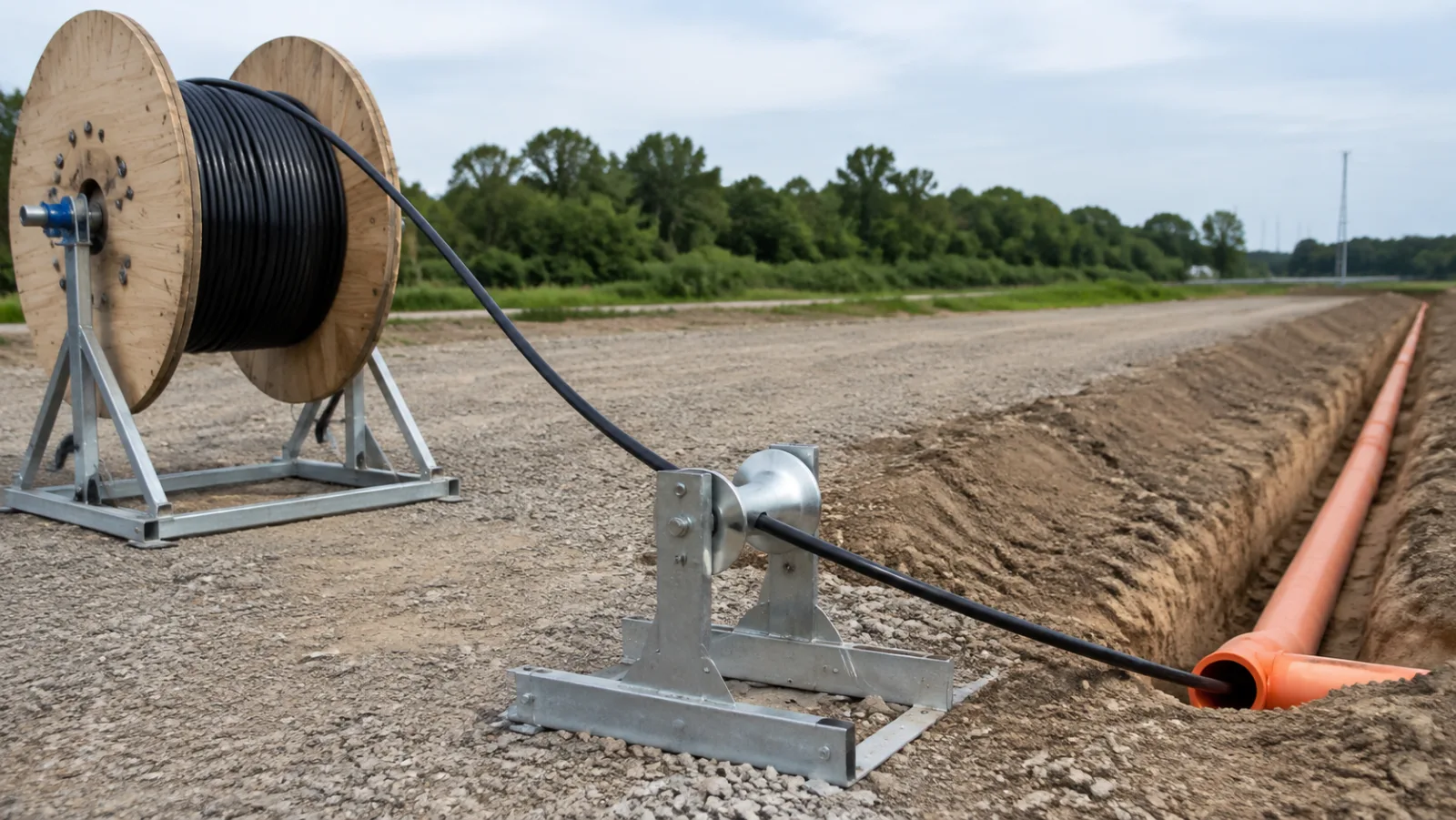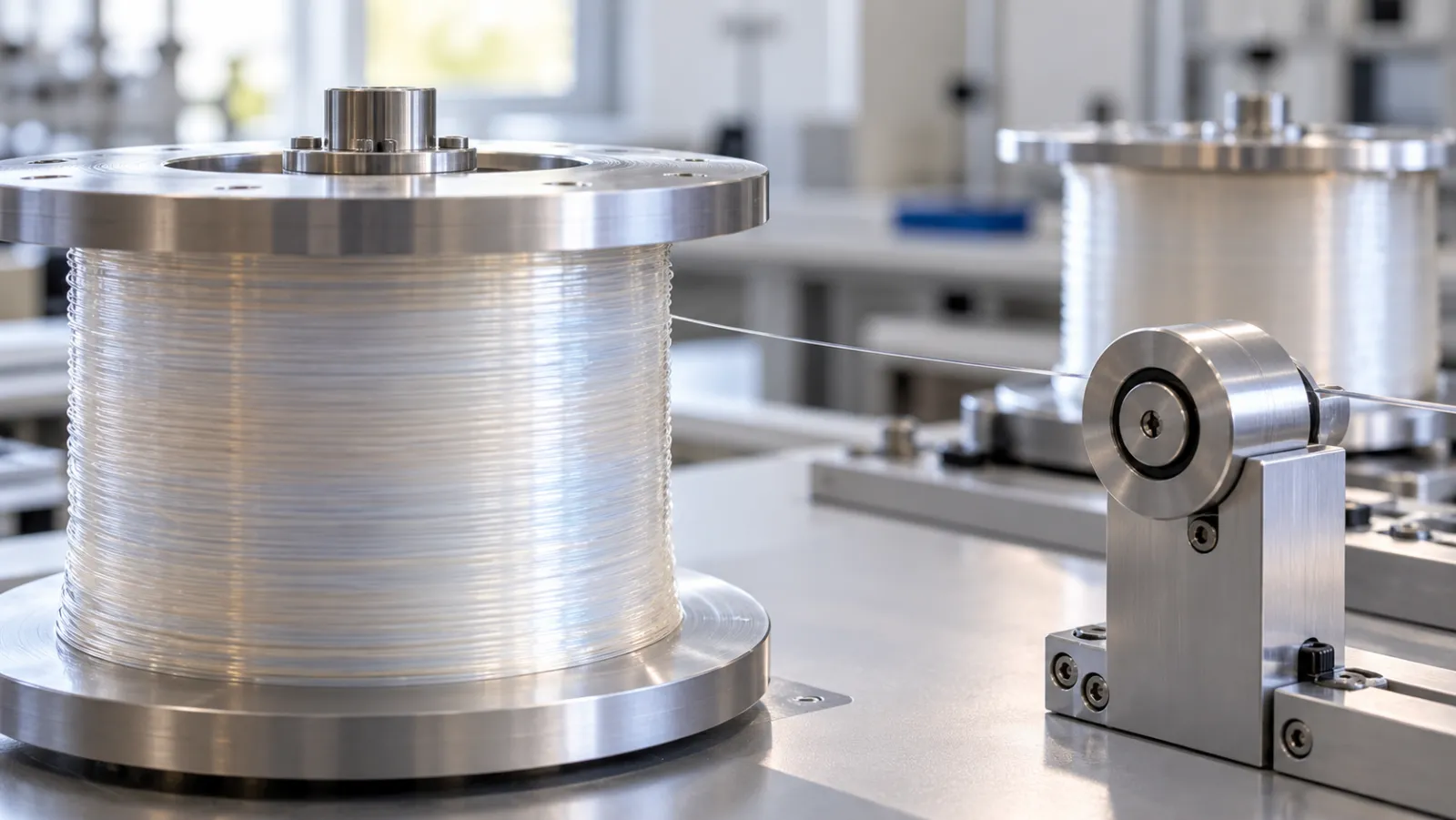
Summary: A fiber proof test at 100 kpsi is a brief mechanical screening condition for the glass, not a permitted pulling force for a finished cable. To review a purchase specification, separate stress from force, identify the fiber and cable documents, and keep the manufacturing evidence traceable to the delivered reel. The calculation below explains the units without creating an installation rating.
What the proof-test statement actually describes
A specification may list optical attenuation, cladding diameter and proof-test stress on the same sheet. These properties answer different questions. Attenuation concerns optical transmission under stated conditions. Geometry describes dimensions. Proof testing addresses a mechanical screening step applied to a continuous length of fiber. A compliant value in one row does not replace evidence for the other rows.
The public scope of IEC 60793-1-30:2010 describes briefly applying a specified tensile load to continuous optical fiber, long enough for the glass to experience the intended stress. It states that this is typically much less than one second. That short exposure is important: it is not a declaration that the same stress may remain on the glass throughout the service life.
Keep the method designation, edition and specified level together. A statement that material was tested “to IEC” without a part number, a defined level or an identified production lot leaves important questions unanswered. The public abstract establishes the method’s purpose; it does not provide every apparatus, process-control or reporting requirement in the full standard.
Do not confuse a fiber screen with a splice check
The word proof may also appear in fusion-splicing instructions. A splicer’s mechanical check concerns a particular prepared joint and its defined procedure. It is not evidence that every meter of the delivered fiber underwent the original continuous-length manufacturing screen. Label these records separately so that a field splice log cannot accidentally stand in for the fiber manufacturer’s documentation.
Read a real manufacturer’s value in its proper scope
Corning’s SMF-28e+ product information sheet specifies a proof stress of at least 100 kpsi, expressed there as 0.69 GPa, over the entire fiber length. The sheet also lists a nominal glass cladding diameter of 125 micrometers. These are published specifications for that named fiber, not test results for a Liqiba product or proof that another fiber shares the same characteristics.
For procurement, request the corresponding sheet for the exact offered fiber. Check whether the quoted value is a minimum screening level, an optional higher level or merely an unqualified description in a distributor’s listing. A higher number should trigger a review of the intended application and supporting evidence, not an automatic conclusion that the completed cable can be pulled harder.
Worked calculation: convert stress into an illustrative force
Stress is force divided by area. For an ideal circular glass cross-section under uniform axial stress, the relationship is F = stress × area, with area = pi × diameter squared / 4. The area is the load-bearing glass area for this simplified calculation. It is not the cable jacket area and it is not the area based on the coating’s outside diameter.
Assume a nominal glass diameter of 125 micrometers and use 1 psi = 6,894.757 pascals. Then 100 kpsi is 100,000 psi, or approximately 689.476 MPa. Converting the diameter to meters gives 0.000125 m. The circular area is approximately 1.2272 × 10⁻⁸ m2, producing an illustrative axial force of about 8.46 N.
| Assumed glass diameter | Illustrative stress | Calculated glass area | Calculated axial force |
|---|---|---|---|
| 125 micrometers | 100 kpsi, approximately 689 MPa | 0.01227 mm² | 8.46 N |
| 125 micrometers | 200 kpsi, approximately 1,379 MPa | 0.01227 mm² | 16.92 N |
The second row only illustrates proportionality at the same assumed diameter. It is not a recommendation to specify 200 kpsi, a product availability statement or a safe operating limit. Both rows omit coating mechanics, manufacturing dynamics, bending, fatigue and cable construction. Do not use either calculated force as a field pulling instruction.
Why multiplying by the fiber count fails
A tempting shortcut is to multiply 8.46 N by the number of fibers in a cable. That calculation assumes all glass fibers share an applied cable load equally and directly, which is not a justified model of a real cable. Strength members, excess fiber length, buffer tubes, friction, termination details and the pulling attachment all influence how loads are transferred.
Likewise, treating the larger coating diameter as solid glass would produce an inappropriate area and an inflated force estimate. The exercise is useful precisely because it exposes the missing assumptions. It explains the dimensions of the specification, but it cannot manufacture a cable rating from a fiber data sheet.
Keep three mechanical questions in separate columns
| Question | Evidence to request | Do not substitute |
|---|---|---|
| What manufacturing screen was applied to the glass? | Fiber identity, proof-test level and traceable manufacturing declaration | A cable pulling instruction |
| What load is permitted during cable installation? | Exact cable construction, rated installation tension and approved attachment method | Fiber stress multiplied by fiber count |
| What conditions apply after installation? | Operating limits and application-specific mechanical guidance | A short-duration proof-test level |
The installer should work from the completed cable’s instructions and the approved route plan. A design review should also consider bends and local contact forces, not only the pulling machine’s indicated tension. Those installation questions are addressed separately in the related guidance below. This article’s calculation does not establish a universal safety factor between proof stress and operating stress.
Build an evidence chain from fiber to delivered cable
Start with an identity map. Record the cable order number, reel number, cable manufacturer’s lot reference, fiber manufacturer and offered fiber designation. Ask how the fiber lots used in the cable are associated with that reel. The supplier may provide a controlled declaration or traceable production documentation rather than disclosing every proprietary process record; the agreed evidence should still identify what it actually covers.
Next, distinguish a data sheet from a batch record. A data sheet states the product specification. A batch declaration states that identified material was made to the agreed requirements. Neither should be renamed an independent laboratory certificate unless it genuinely is one. Record who issued the document, its revision, the referenced lots and any stated exclusions.
For a cable containing several fiber lots, make the association explicit rather than assuming one attached document covers every fiber. If part of an order is substituted, review the substitute’s optical and mechanical properties together. Matching proof stress alone does not establish matching attenuation, bend performance, geometry or compatibility with the rest of the system.
Use a focused discrepancy process
If an offer says 100 kpsi and a delivery document says 0.69 GPa, first check the units and rounding: those statements are consistent at the displayed precision. If the document instead lists an unexplained force in newtons, ask what component and procedure it describes. Do not reject or accept the delivery solely because two numbers look different.
If traceability is missing, identify the affected reels and request clarification before releasing them under the disputed requirement. Do not improvise a destructive field tensile test on production fibers to recreate factory screening. Any additional testing requires an agreed method, appropriate equipment, competent personnel and a clear disposition plan for the tested material.
Turn the review into a usable purchase requirement
A useful RFQ separates the fiber specification from the cable construction and installation requirements. State the intended environment, required fiber category, applicable proof-test method and level, the evidence expected with shipment, and the completed cable’s mechanical requirements. Ask the supplier to identify deviations explicitly instead of accepting a generic “compliant” response covering several unrelated properties.
Use the optical fiber selection page to organize the fiber-side inquiry. Send the project requirements and ask for the exact offered specification and traceability documentation; the educational example here is not a warranty of a particular product’s proof-test performance.
Related engineering guidance
For the installation-side calculation, see fiber cable pulling tension and sidewall pressure. For receiving checks that keep optical measurements and reel identification together, see the fiber cable reel inspection plan. Keep those records alongside the fiber evidence rather than treating any one document as complete acceptance of the entire cable system.
Frequently Asked Questions
What does a 100 kpsi fiber proof test mean?
It identifies a specified brief tensile screening stress for the optical fiber. It is not a permitted continuous operating stress or a pulling-force rating for the completed cable.
Is 100 kpsi approximately the same as 0.69 GPa?
Yes. Using the pressure-unit conversion, 100,000 psi is approximately 689.5 MPa or 0.6895 GPa, commonly rounded to 0.69 GPa.
Can I multiply the proof-test force by the cable fiber count?
No. That would assume a load-sharing model that does not describe the completed cable. Use the cable manufacturer’s installation rating and approved pulling method.
Does a higher proof-test level automatically improve every cable application?
No. Review the intended mechanical conditions, exact fiber specification and completed cable design. A larger proof-test number alone does not establish the appropriate product or installation limits.
What documents should accompany a proof-test requirement?
Request the exact fiber specification, method and level, and traceable evidence connecting the offered fiber lots to the delivered cable reels. Keep cable installation limits in separate documentation.