Summary: The Verizon Corning fiber supply agreement 2026 is notable not only for its announced scale, but for what it says about planning physical fiber capacity years before deployment. For procurement teams, the practical lessons are to separate fiber miles from cable miles, qualify density against real pathways, contract for forecast changes, preserve traceability, and connect incoming inspection to release schedules.
This analysis uses public company statements. It does not claim access to commercial terms that were not disclosed, and it does not imply that Liqiba participates in the agreement.
What the companies publicly announced
On September 8, 2026, Verizon announced a multi-year, multi-billion-dollar agreement with Corning for more than 80 million miles of high-density optical fiber and connectivity solutions from 2027 through 2032. Verizon linked the program to consumer broadband, mobile convergence and long-haul connectivity for AI infrastructure.
Corning’s newsroom lists the same announcement. The release identifies a high-density flexible-ribbon cable family, but it does not publish all cable constructions, route-level quantities, prices, acceptance criteria or detailed delivery releases.
The broader pattern is not limited to one operator. In August, Corning and Zayo announced a separate long-term supply arrangement tied to planned long-haul expansion. These announcements support an inference that large builders are treating fiber availability and manufacturing alignment as early program inputs. They do not prove a universal shortage or predict pricing for every region.
Lesson 1: distinguish fiber miles from cable miles
A fiber mile is one fiber strand extending one mile. A cable mile is one mile of finished cable, regardless of fiber count. The difference is essential when a headline uses a very large fiber-mile number.
For a simplified illustration, assume 80 million fiber miles were delivered entirely as one uniform 1,728-fiber cable. Dividing 80,000,000 by 1,728 gives about 46,296 cable miles. If the same fiber-mile total used 864-fiber cable, the equivalent would be about 92,593 cable miles. Real programs use multiple counts and constructions, so neither value estimates Verizon’s actual route mileage.
| Hypothetical cable count | Fiber-mile total | Equivalent cable miles | What remains unknown |
|---|---|---|---|
| 1,728 fibers | 80,000,000 | 46,296 | Routes, slack, product mix and releases |
| 864 fibers | 80,000,000 | 92,593 | Routes, slack, product mix and releases |
| 288 fibers | 80,000,000 | 277,778 | Routes, slack, product mix and releases |
Procurement documents should therefore state finished-cable length by construction and fiber count. Fiber miles can summarize capacity, but they cannot replace drum schedules, route takeoffs or cable-mile quantities.
Lesson 2: density is a pathway decision
High fiber count can increase capacity within constrained conduit, but the smallest outside diameter is not automatically the best solution. Cable OD, bend behavior, pulling or jetting limits, closure compatibility, access practices and restoration methods must be reviewed together.
Buyers should request dimensional tolerances, not only nominal OD. They should model duct occupancy using actual inner diameter and identify the limiting bends and couplers. A design that fits mathematically may still be unsuitable for the installed route or available equipment.
Our microduct fill-ratio worksheet explains how to preserve worst-case diameter assumptions. The same principle applies to high-density backbone cables: calculate with documented values and keep the pathway evidence with the purchase record.
Lesson 3: long-term volume needs release logic
A multi-year framework is not a single purchase order delivered at once. A usable agreement needs forecast horizons, binding and non-binding windows, minimum release quantities, lead-time rules, packaging units and a method for changing product mix.
Assume a buyer forecasts 120,000 cable km over four years. A flat planning average is 30,000 km per year, but construction rarely follows a flat curve. If the first-year field program slips by 20%, inventory, drum storage and later capacity reservations change. The contract should say how forecasts are updated and which party carries committed-material risk.
Our fiber cable supply agreement checklist covers release schedules, substitutions and remedies in more detail. It is a planning aid, not legal advice; governing law and negotiated terms require qualified review.
Lesson 4: scale increases traceability requirements
Large volume makes lot identity more important, not less. Each drum should connect product code, fiber type, length, manufacturing lot, inspection status and destination. If a nonconformance appears, the buyer must identify affected material without holding unrelated drums.
Define what accompanies each shipment: drum list, dimensional data, attenuation or other agreed test results, declaration documents, packing photographs if required, and exception records. Do not request certificates by vague name. State the required document, edition, product scope and disclosure rules.
| Control | Contract field | Receiving evidence |
|---|---|---|
| Product identity | Construction and approved revision | Drum label and packing list |
| Quantity | Length tolerance and unit | Drum length record |
| Quality | Tests, sampling and limits | Lot or drum report |
| Change control | Approval before substitution | Signed deviation record |
| Destination | Route or warehouse release | Traceable receipt |
Lesson 5: incoming inspection must match deployment pace
A supply program fails operationally if material is installed before documents and visible condition are checked. Receiving teams need enough time and equipment to inspect reels, verify labels, reconcile lengths and quarantine damage without stopping construction.
Use risk-based sampling where the quality plan permits it, but never treat an unopened package as proof of compliance. A reel incoming-inspection plan should separate document review, physical condition and project-specific testing.
Translate demand into a drum schedule
Network capacity is purchased and transported as actual reels, not an abstract fiber-mile total. Divide each route into installable sections, add only approved slack and handling allowances, and then map those lengths to manufacturing and transport constraints. A random standard drum length can create extra joints or unusable remnants.
Assume a 10.0 km route has four planned pulling sections of 2.3, 2.6, 2.1 and 3.0 km. If the buyer simply orders two 5 km drums, neither drum schedule matches all sections without a field joint or reallocation. A section-based plan can specify four lengths plus approved end allowances and document which drum serves each section.
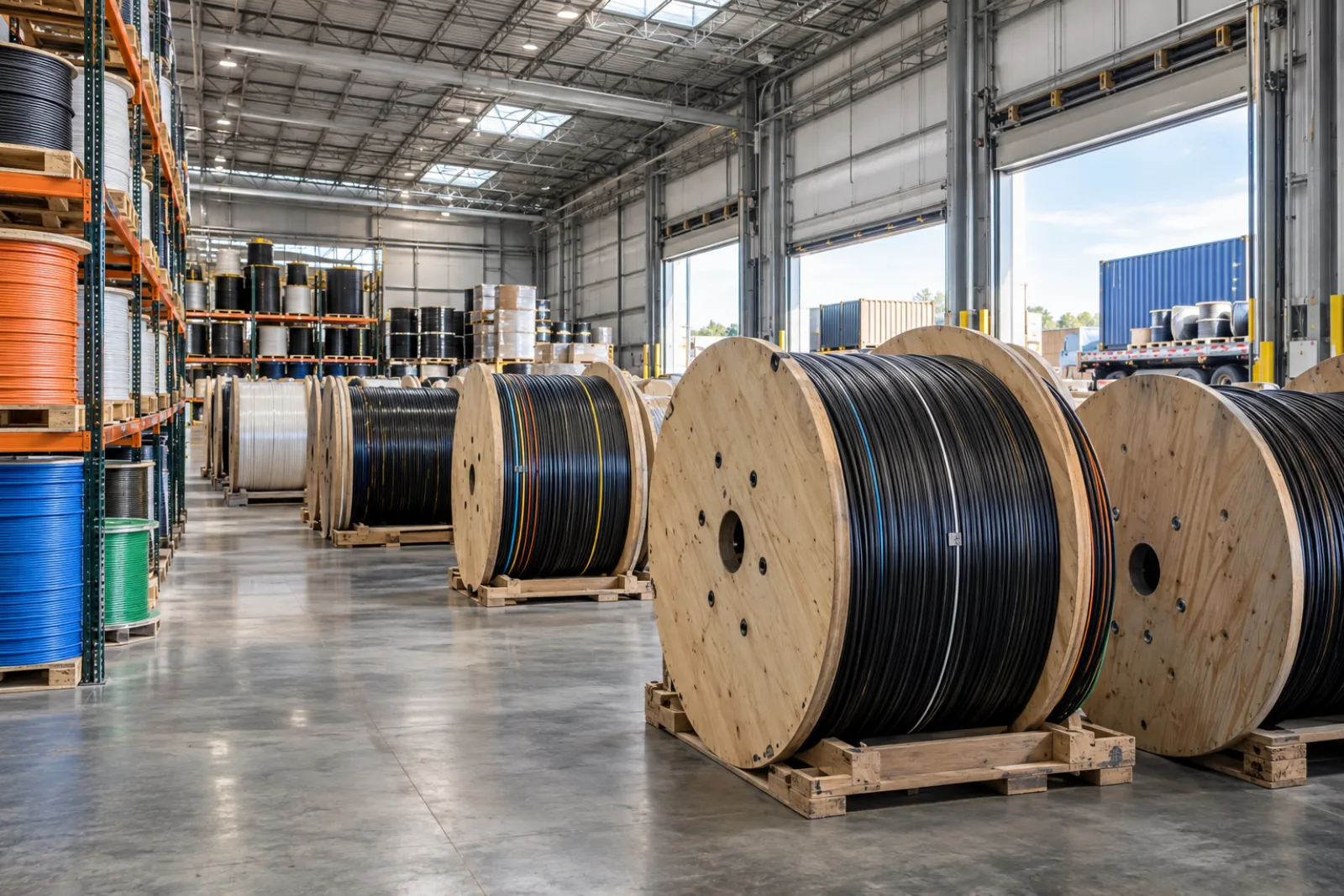
Packaging limits should include maximum gross weight, flange diameter, lifting points, rolling direction, weather protection and returnable-drum rules. Logistics teams need delivery sequence and laydown capacity. Manufacturing capacity has little value if the site cannot safely receive or store the planned release.
Qualify alternates before capacity becomes urgent
A long program should define approved alternates for fiber, sheath, armor, water blocking and packing only where engineering permits. An alternate is not merely a similar catalog description. It needs dimensional, optical, mechanical, environmental and regulatory comparison against the original requirement.
Use a deviation form that names the changed attribute, affected routes, evidence, approval owner and expiration. Emergency verbal substitutions destroy traceability and can place incompatible cable at closures or installation equipment. Prequalification makes resilience faster without lowering the acceptance threshold.
Measure supplier performance with usable indicators
Track confirmed-on-time delivery, documentation completeness, length variance, transit damage, incoming nonconformance, corrective-action closure and forecast response. Do not reward delivery speed alone if incomplete records hold material in quarantine.
Define each metric. “On time” could mean arrival at port, warehouse receipt or accepted material available to construction. The last definition often matters operationally. Review trends by product family and manufacturing lot so a high-volume program can correct systemic issues early.
Build a smaller-buyer procurement matrix
Most buyers will not negotiate at the scale in the announcement, but the planning structure still applies. Start with route takeoffs and approved alternates. Map each construction to pathway, installation method, closure and service. Then place commercial controls around that engineering map.
The commercial fiber optic cable supplier page is the appropriate place to submit fiber count, construction, length, drum, environment and documentation requirements. A request for “high-density AI cable” is not enough to quote or manufacture responsibly.
A useful sourcing review asks what is confirmed, what is forecast and what can change. It also names the acceptance owner and the evidence needed before release to the field. Those disciplines are the durable lesson from a large public agreement; the undisclosed commercial terms should remain undisclosed rather than being filled with guesses.
Frequently Asked Questions
What did Verizon and Corning announce in September 2026?
They announced a multi-year, multi-billion-dollar supply agreement covering more than 80 million fiber miles and connectivity solutions for 2027 through 2032, according to Verizon.
Does the announcement disclose cable prices or delivery schedules?
The public announcement gives overall scale and duration but does not publish project-level unit prices, monthly releases, acceptance limits or every delivery milestone.
Should smaller buyers copy the same cable design?
No. Buyers should copy the planning discipline, not assume one named design fits every route. Fiber count, duct space, access, restoration and installation equipment remain project-specific.
Does a long-term agreement remove supply-chain risk?
No. It can improve planning and capacity alignment, but contracts still need forecasts, release procedures, change control, quality evidence, logistics and remedies.
Is this article reporting a Liqiba customer project?
No. It analyzes public announcements and presents a hypothetical procurement worksheet; it does not claim that Liqiba supplies or participates in the Verizon project.