Summary: A fiber cable UV resistance test F14 report should connect a defined exposure procedure to the actual sheath material and acceptance criteria. “UV resistant,” a black jacket and a large number of laboratory hours are not interchangeable forms of evidence. This guide explains how to review the report, calculate property retention and keep accelerated exposure separate from claims about years of outdoor service.
Start with the current method and the contract
IEC 60794-1-214:2025 defines a cable UV-resistance procedure for evaluating the ability of sheath materials to maintain integrity under ultraviolet exposure. Its first edition replaces Method F14 of IEC 60794-1-22:2017 and includes a change concerning conditioning for indoor-outdoor cables. Identify the publication and edition actually required by the project before comparing a supplier’s report with the order.
A newer method number does not automatically invalidate every earlier report or retroactively change an existing contract. It does mean that a reviewer should check whether the submitted procedure is applicable and whether differences need an agreed assessment. Keep the test-method reference, product requirement and contractual acceptance decision in separate fields so the reasoning remains traceable.
The public standard description establishes scope, not every apparatus setting or pass criterion. Use the controlled full documents and the product specification when commissioning a test. This article is a purchasing review guide; it does not provide enough information to reproduce a compliant laboratory procedure or certify a material.
Match the specimen to the offered jacket
Ask which material and construction were tested. The report should identify the sheath formulation or a controlled material designation, specimen preparation and its relationship to the offered cable. A generic resin brochure may be useful background, but it is not automatically qualification evidence for every finished sheath made from a broadly similar polymer family.
Likewise, color is a description, not a test result. Do not infer a particular stabilizer package, additive concentration or weathering performance from a photograph of a black cable. If a supplier relies on a material-family qualification, request the documented scope and rationale connecting that evidence to the proposed construction. An explicit explanation is preferable to an assumed equivalence.
| Evidence field | Question for the reviewer | Reason |
|---|---|---|
| Material identity | Is the tested formulation traceable to the offer? | A shared polymer name does not establish identical performance. |
| Specimen preparation | How were exposed and baseline specimens obtained? | Results need a comparable starting condition. |
| Method and edition | Which procedure and approved deviations were used? | Different protocols cannot be compared by hours alone. |
| Exposure conditions | Are the light source, cycle and controlled conditions recorded? | The exposure history defines the result’s meaning. |
| Evaluation | Which properties and appearance criteria were assessed? | A pass statement should have identifiable supporting observations. |
Use the table as an evidence-request template, not a claim that every listed item has the same mandatory form in every standard. The governing documents determine the actual requirements. The practical goal is to reveal missing information before the cable is approved, not to invent new acceptance conditions after testing is complete.
Why test hours do not equal outdoor years
Q-Lab’s explanation of accelerated-weathering correlation rejects a universal conversion between chamber hours and outdoor service time. It describes the importance of the material, laboratory cycle and outdoor exposure conditions. Material-specific correlations can be developed from evidence, but they should not be transferred automatically to a different formulation, test setup or installation environment.
For example, a claim of “one thousand hours equals twenty years” needs more than division on a calculator. Ask for the supporting correlation, the failure criterion and the exposure conditions it represents. Without that evidence, retain the laboratory result as a result under its stated procedure. Do not relabel it as a service-life guarantee for a rooftop, aerial span or shaded wall installation.
Comparative testing can still be valuable. Two candidate formulations tested under the same justified conditions can support a controlled comparison. The conclusion should remain tied to the observed properties and test scope. A better comparative outcome does not, by itself, quantify every environmental risk or establish the calendar life of a complete cable system.
A hypothetical property-retention worksheet
Calculate each property separately
Suppose an invented evaluation records a baseline tensile strength of 18.0 MPa and a post-exposure value of 15.3 MPa. It also records baseline elongation at break of 400 percent and a post-exposure value of 300 percent. These are teaching values, not actual test data or claimed performance of a Liqiba jacket.
For this worksheet, property retention equals the post-exposure value divided by the baseline value, multiplied by one hundred. The comparison assumes that the baseline and exposed results were obtained using compatible specimen and measurement procedures. A real report must establish those conditions rather than treating any two numbers as comparable.
| Invented property | Before exposure | After exposure | Calculated retention |
|---|---|---|---|
| Tensile strength | 18.0 MPa | 15.3 MPa | 15.3 ÷ 18.0 × 100 = 85% |
| Elongation at break | 400% | 300% | 300 ÷ 400 × 100 = 75% |
If an illustrative contract required at least eighty percent retention for each property, tensile retention would satisfy that numerical threshold and elongation retention would not. The threshold is invented for this exercise and is not presented as the F14 acceptance rule. The example shows why a single average of the two retention percentages would conceal a failed individual requirement.
Do not confuse percent change with percentage points
The elongation reading decreased from 400 percent to 300 percent, a difference of 100 percentage points in the reported elongation value. Relative to its starting value, however, the reduction is 100 ÷ 400 = 25 percent, leaving seventy-five percent retention. Those are different descriptions of the same arithmetic. Clear labels prevent a report summary from exaggerating or understating the change.
A retention calculation also cannot replace any specified visual examination or other required assessment. Keep the numerical results, observations and final decision together. If the report provides only rounded averages, ask whether individual results or the prescribed statistical treatment are needed for the acceptance decision. Do not assume that an unreported criterion was checked.
Review deviations and the actual exposure record
Look for interruptions, specimen replacement, equipment deviations and changes to the intended cycle. These do not all have the same significance, but they should be visible to the responsible reviewer. A total elapsed duration can hide a different exposure sequence. Ask the laboratory to explain departures from the approved method rather than silently treating every hour on the calendar as equivalent exposure.
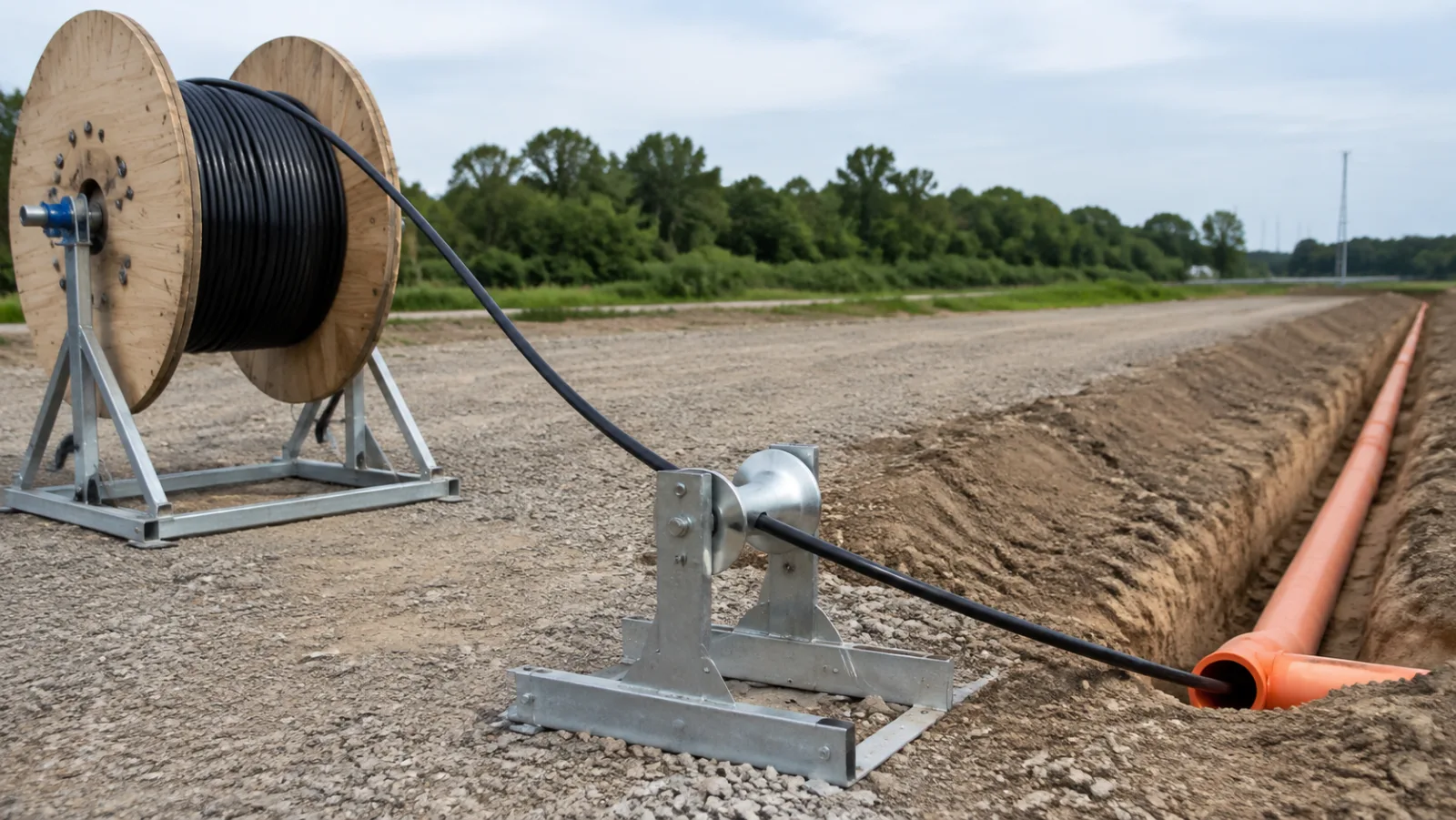
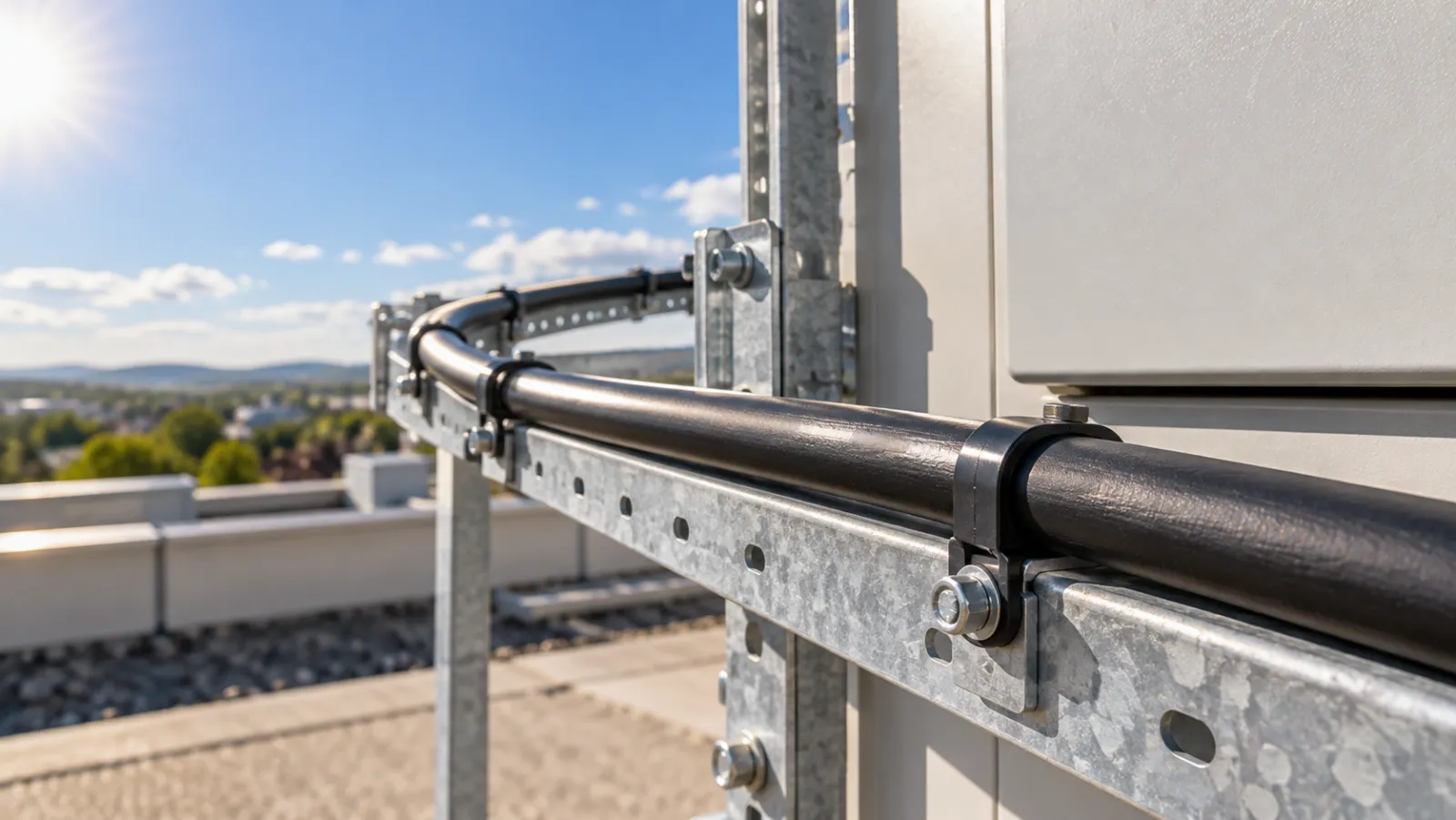
Photographs can support identification and observations when appropriately documented. They should not replace the underlying measurements or imply a certified result on their own. The image accompanying this article is an outdoor example scene, not a photograph of an F14 test specimen, a long-term installation trial or a certified product.
Keep UV resistance separate from other cable requirements
A route can require resistance to sunlight alongside acceptable temperature limits, water performance, mechanical loading and fire behavior. Passing one requirement does not establish the others. Our LSZH, OFNR and OFNP specification guide addresses fire-related distinctions, while the storage, installation and operating temperature guide separates the relevant temperature conditions.
The fiber optic cable product page is the commercial starting point for defining the sheath and exposure environment. Describe whether the cable is continuously exposed, partly protected or used across indoor and outdoor sections. Provide the required qualification documents and acceptance rules with the inquiry so the offered construction and evidence can be reviewed together.
Close the review with a written status: accepted against the identified requirement, accepted with an approved qualification, or awaiting specified evidence. Preserve the original report and the reasoning behind the decision. This produces a defensible purchasing record without turning a useful laboratory test into an unsupported lifetime promise.
Frequently Asked Questions
What does IEC 60794-1-214:2025 address?
It defines a cable sheath UV-resistance test procedure and replaces Method F14 of IEC 60794-1-22:2017. Use the full applicable documents to establish the required test conditions and acceptance criteria.
Can accelerated UV-test hours be converted directly into outdoor years?
Not with a universal factor. Any claimed correlation needs evidence for the specific material, laboratory cycle and outdoor exposure conditions.
Does a black cable jacket prove UV resistance?
No. Appearance alone does not establish the formulation, tested construction or qualification result. Request traceable evidence for the offered cable.
Is an LSZH or fire-rating declaration sufficient UV evidence?
No. Fire behavior and resistance to weathering are different performance questions and require the appropriate evidence.
What does eighty-five percent property retention mean?
In the stated arithmetic, the post-exposure property is eighty-five percent of its baseline value. Acceptance still depends on the specified property, test method and contractual limit.