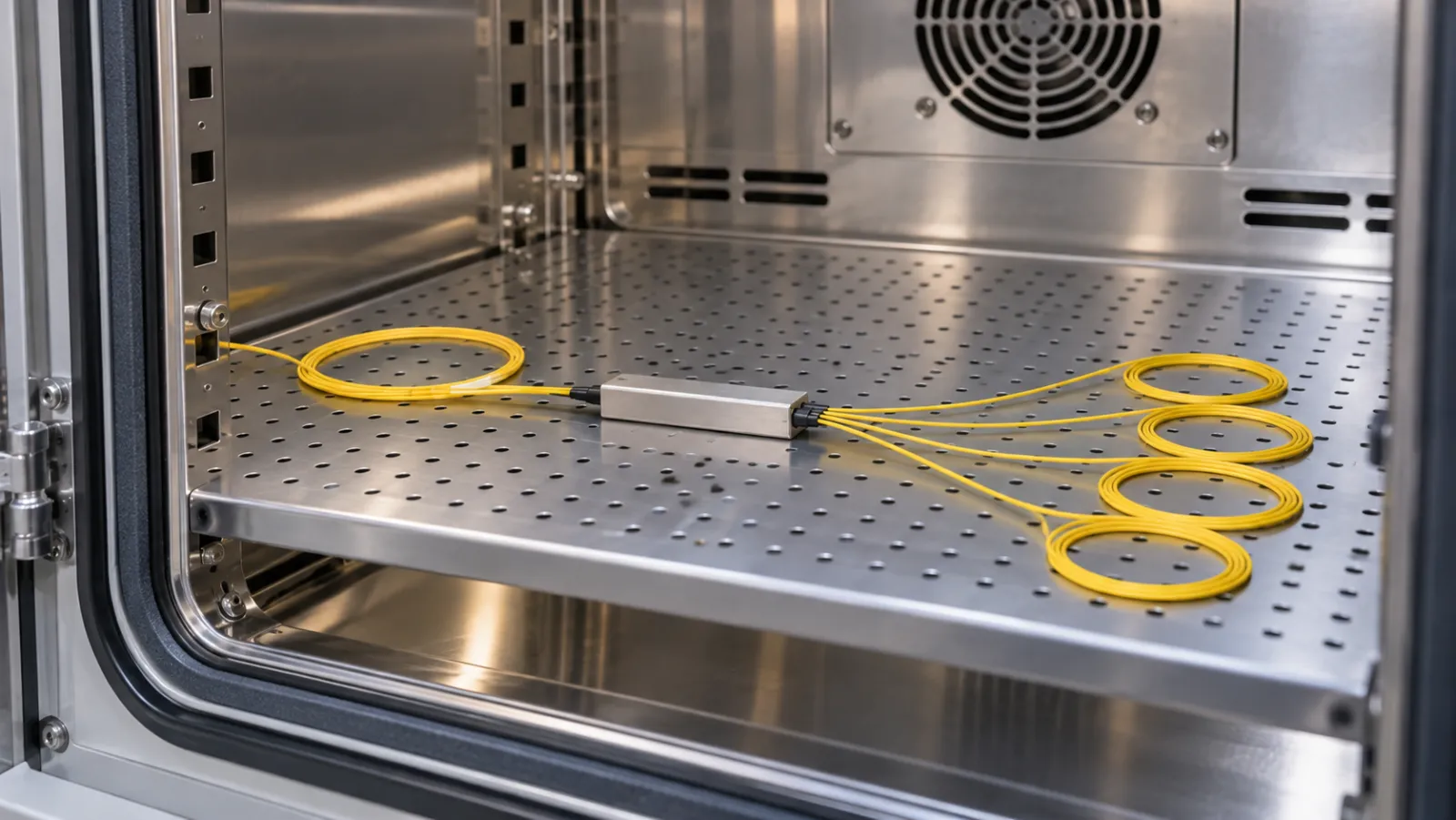
Summary: PLC splitter temperature dependent loss should be specified as an optical measurement with a defined baseline, temperature sequence and acceptance rule. An operating-temperature range alone does not explain how insertion loss changes within that range. This guide separates peak-to-peak variation, excursion from baseline and residual change after recovery, using invented readings for one optical path. It does not claim measured splitter performance or prescribe universal qualification limits.
Read the temperature range and optical footnotes together
A data sheet may list insertion loss, operating wavelength and operating temperature in neighboring rows. It is tempting to assume that every optical value is guaranteed under every combination of those conditions. That assumption needs verification. Read the notes, identify the measurement boundary and ask which figures apply at room temperature versus across the specified environmental range.
For example, SENKO’s 1xN PLC splitter specification lists an operating-temperature range and separately notes that its stated values are taken at room temperature, at identified wavelengths, without connectors. The point is the scope of the footnote, not a transfer of those ratings to another supplier’s product. Request written clarification when a quotation does not define environmental optical performance clearly.
Keep the package boundary explicit. A bare splitter component, a protected module with pigtails and a connectorized assembly can present different qualification questions. If the required performance includes connectors, external routing or enclosure hardware, state that requirement. Do not silently compare a connector-free component specification with a measurement that includes additional mating junctions.
Define the metric before applying a limit
“Loss change” can describe more than one calculation. For a selected input-to-output path and wavelength, the largest reading minus the smallest reading gives a peak-to-peak span over the sampled conditions. Comparing every reading with an initial baseline gives excursions from that baseline. Comparing the recovered reading with the starting reading gives a residual change. These values can be different even for the same data.
| Worksheet metric | Calculation | Question answered |
|---|---|---|
| Peak-to-peak span | Largest sampled loss minus smallest sampled loss | How wide was the observed loss range? |
| Maximum absolute baseline excursion | Largest absolute difference from the initial loss | How far did a sampled reading move from the baseline? |
| Residual change | Recovered loss minus initial loss | How different was the final reading after the defined recovery? |
These are explicitly defined worksheet metrics, not a claim that every manufacturer uses “TDL” for the same calculation. Ask the supplier to identify its definition, temperatures and baseline. If two quotations use different definitions, put the actual formulas beside the limits. Renaming both values “temperature loss” does not make them comparable.
A hypothetical single-path example
Keep port, wavelength and reference conditions fixed
Consider one invented splitter path measured at a single fixed wavelength. Assume that the optical reference arrangement is controlled and that readings are taken after the agreed stabilization at each listed condition. The temperatures and losses below are chosen for arithmetic illustration only. They are not test requirements, qualification data or specifications for a Liqiba splitter.
| Illustrative condition | Invented insertion loss | Change from initial 10.20 dB |
|---|---|---|
| Initial at 23°C | 10.20 dB | 0.00 dB |
| Cold condition at −40°C | 10.35 dB | +0.15 dB |
| Hot condition at +85°C | 10.05 dB | −0.15 dB |
| Recovered at 23°C | 10.22 dB | +0.02 dB |
The sampled peak-to-peak span is 10.35 − 10.05 = 0.30 dB. The maximum absolute excursion from the initial baseline is 0.15 dB. The signed residual change after the stated recovery is +0.02 dB. A report that gives only the recovered result would not reveal the larger excursions observed at the cold and hot conditions.
Suppose an illustrative acceptance limit were 0.20 dB. Applied to maximum absolute baseline excursion, the example would satisfy the numerical limit. Applied to peak-to-peak span, it would not. This is not a contradiction in the data; it is a difference in the defined metric. The acceptance rule must therefore be agreed before the results are reviewed.
Do not infer an entire curve from four readings
The example does not prove that 10.35 dB is the worst loss at every intermediate temperature or during every transition. It also does not establish long-term reliability, humidity resistance or the behavior of another output port. A handful of readings describes the sampled states. The full qualification procedure determines what additional observations, cycles and conditions are required.
Even the small +0.02 dB residual should not automatically be described as damage or permanent drift. Compare it with the measurement uncertainty, repeatability and specified decision rule. Preserve the signed result and its context instead of rounding it into “no change” or assigning a failure mechanism that the evidence does not establish.
Separate characterization from environmental qualification
IEC 61300-2-22:2024 describes a change-of-temperature procedure for optical interconnecting devices and passive components. Referencing that method identifies a test family; it does not by itself supply every product-specific severity or acceptance criterion. Use the full applicable documents and the agreed product specification when preparing the qualification plan.
A characterization exercise can explore how a sample behaves, while a qualification test evaluates it against a defined requirement. Both can be useful, but their labels should remain accurate. Do not present a development graph as a compliance certificate, or assume that a room-temperature inspection of every shipped unit replaces a required environmental qualification of the product design.
Control the measurement arrangement
Record which parts are inside the chamber and which remain outside it. The splitter package, pigtails, connectors and lead routing should have a clearly described relationship to the temperature exposure. Feedthroughs and restraints should not introduce undocumented movement or tight bends. The purpose is to keep the observed change attributable to the stated test arrangement rather than an uncontrolled alteration in the optical path.
Track source stability and the reference verification required by the procedure. If an output is reconnected at every temperature, the report needs to account for connection repeatability rather than treating every change as intrinsic splitter behavior. Likewise, identify any switching equipment used to monitor multiple ports. Instrument configuration and measurement sequence belong in the evidence package.
Record chamber conditions, stabilization criteria, dwell periods, temperature transitions, cycle count and recovery conditions as required by the approved protocol. A chamber setpoint alone does not describe the complete sample history. If a test is interrupted or modified, preserve the event and its assessment. Do not silently combine observations from incompatible sequences into one qualification table.
Keep ports, wavelength and polarization distinct
Temperature variation is not the same as output uniformity. Compare a given path with itself across conditions before comparing different outputs at a given condition. Our PLC splitter uniformity guide addresses that port-to-port comparison. Combining both effects in one unlabeled maximum-minus-minimum calculation can obscure which requirement is being evaluated.
Similarly, our wavelength-dependent loss guide changes wavelength as the independent variable. A thermal study should identify the wavelengths and polarization conditions used, not assume they are irrelevant because the device is passive. The required matrix should reflect the contract while clearly distinguishing measured combinations from untested ones.
Avoid double-counting temperature allowance in a budget
If a supplier’s maximum insertion loss already covers the specified operating-temperature range, adding the same thermal allowance again may count one effect twice. If the value applies only at a baseline condition, additional design allowance may be needed, but its amount and meaning require evidence. Ask which case applies instead of adding a generic number to every splitter quotation.
Use the PLC splitter product page to request the port configuration, package boundary, wavelengths, temperature range and optical stability definition together. Require a report that preserves individual paths and test conditions. A clear metric, a controlled setup and an appropriately scoped claim make thermal evidence useful for procurement without turning a few favorable readings into a universal reliability promise.
Frequently Asked Questions
Is operating temperature the same as temperature dependent loss?
No. A temperature range identifies environmental conditions, while an optical stability requirement states how loss is evaluated within those conditions. Read the specification footnotes and metric definition.
Is peak-to-peak loss variation equal to change from baseline?
Not necessarily. Peak-to-peak variation is the difference between the largest and smallest sampled losses; baseline change compares each reading with a selected reference condition.
Does a small loss change after recovery prove stability throughout the cycle?
No. A recovered value can be close to the starting value even when larger excursions occurred at other temperatures. Review the required in-cycle observations.
Should a thermal loss allowance always be added to maximum insertion loss?
No. First establish whether the quoted maximum already covers the specified temperature range. Adding an allowance twice can double-count the same effect.
Can a few temperature points establish performance across every condition?
No. They describe the sampled conditions. Qualification requires the agreed protocol, stabilization, wavelengths, ports and acceptance criteria.