Summary: A fiber coating strip force test is useful only when the buyer knows what was stripped, how the force was summarized and which acceptance rule applies. A low-looking number is not automatically a better result, and a typical catalog value is not a guaranteed limit. This guide explains how to review strippability evidence without confusing it with fiber strength, cable pulling tension or an instruction for field preparation.
Identify the layer being removed
An optical assembly contains several layers that can be described casually as a coating or jacket. Before comparing numbers, identify whether the report concerns the protective polymer directly around the glass, a subsequent tight buffer, or the outer jacket of a complete cable. A force result is not portable between these layers simply because the same unit, newtons, appears beside it.
The published scope of IEC 60793-1-32:2018 covers coating strippability, including fiber as manufactured and subsequently overcoated fiber. It describes longitudinal mechanical removal of protective coating and includes nominal coating diameters from 200 to 900 micrometers for the stated fiber scope. Importantly, it does not claim to prescribe the best field-stripping conditions or maximize fiber strength after stripping. Use the complete applicable procedure for a test, rather than reconstructing one from a purchasing guide.
Put the fiber product code, coating system, nominal glass and coating dimensions, color treatment where relevant, and production lot on the request. A replacement polymer or a different buffer construction should not inherit an old qualification automatically. Ask the supplier to explain the evidence linking the report specimen to the proposed shipment, especially when the commercial product name covers several variants.
Separate force metrics before comparing suppliers
The word “force” does not identify how a trace was reduced to one value. An initial peak, the largest force over a defined travel interval, an average over part of a trace, and an average across specimens describe different calculations. Request the exact metric, analysis interval and treatment of invalid tests. Do not decide that two reports agree merely because both list a result near three newtons.
| Report field | Question for the reviewer | Comparison to avoid |
|---|---|---|
| Individual peak | What interval and sampling rule define the peak? | Peak against another report’s mean |
| Trace average | Which part of the stripping travel is included? | Different analysis windows without reconciliation |
| Group average | How many valid specimens contribute? | Average used to conceal an individual exceedance |
| Conditioned result | What conditioning and recovery preceded testing? | Conditioned and dry specimens treated as identical |
A sensible review preserves both the original trace identifier and the summarized number. If a supplier submits only a screenshot with an automatic pass indication, request the settings and underlying result table. A pass indication demonstrates only that the software applied some rule; it does not establish that the rule matches the purchase specification.
Read typical values as typical values
For a concrete documentation example, the Corning SMF-28 Ultra product information sheet places coating strip force within a section explicitly described as typical performance characterizations. It distinguishes standard and reduced-diameter versions and dry versus conditioned entries. That is evidence about the named Corning product, not a Liqiba manufacturing claim or a universal pass limit for all fibers.
The purchasing lesson is to read the heading and footnotes together with the number. If the order needs a guaranteed range, ask for that range explicitly and identify its test conditions. Do not rewrite “typical” as “maximum” in a comparison spreadsheet. Conversely, do not reject a shipment solely because an individual value differs from a typical characterization unless the contract actually makes that comparison an acceptance requirement.
A hypothetical specimen-level acceptance worksheet
Assumptions and arithmetic
Assume a fictional qualification plan requests one defined peak-force result per specimen under the same approved setup. Five invented results are 2.1, 2.3, 2.4, 2.5 and 3.7 N. For this exercise only, the buyer has chosen an individual upper threshold of 3.5 N. Neither the readings nor the threshold are taken from an actual test, an IEC acceptance table or a supplier guarantee.
| Invented specimen | Peak force | Numerical comparison with 3.5 N |
|---|---|---|
| A | 2.1 N | Below |
| B | 2.3 N | Below |
| C | 2.4 N | Below |
| D | 2.5 N | Below |
| E | 3.7 N | Above by 0.2 N |
The group mean is (2.1 + 2.3 + 2.4 + 2.5 + 3.7) / 5 = 2.60 N. That mean is below 3.5 N, but specimen E exceeds the fictional individual threshold. Replacing the individual requirement with a group average would change the contract after seeing the result. The correct next action is to follow the predefined investigation and retest rule, not discard the largest reading because it is inconvenient.
This worksheet isolates one upper-limit comparison. A real specification may define a range, additional visual criteria or a different statistical decision rule. Measurement uncertainty and rounding also matter near a boundary. Record the original precision and the agreed decision rule before assigning a final conformity statement. Five invented values do not establish a production distribution or a justified sampling plan.
Keep units explicit
A force instrument may offer newtons or kilogram-force. Under the conventional conversion, 1 kgf is 9.80665 N; therefore 3.5 N is approximately 0.357 kgf. Kilogram-force is not kilogram mass, and a display marked “kg” needs clarification. This conversion is only a unit check. It is not an instruction to hang a weight from bare fiber or build an improvised test arrangement.
Control the preparation and conditioning record
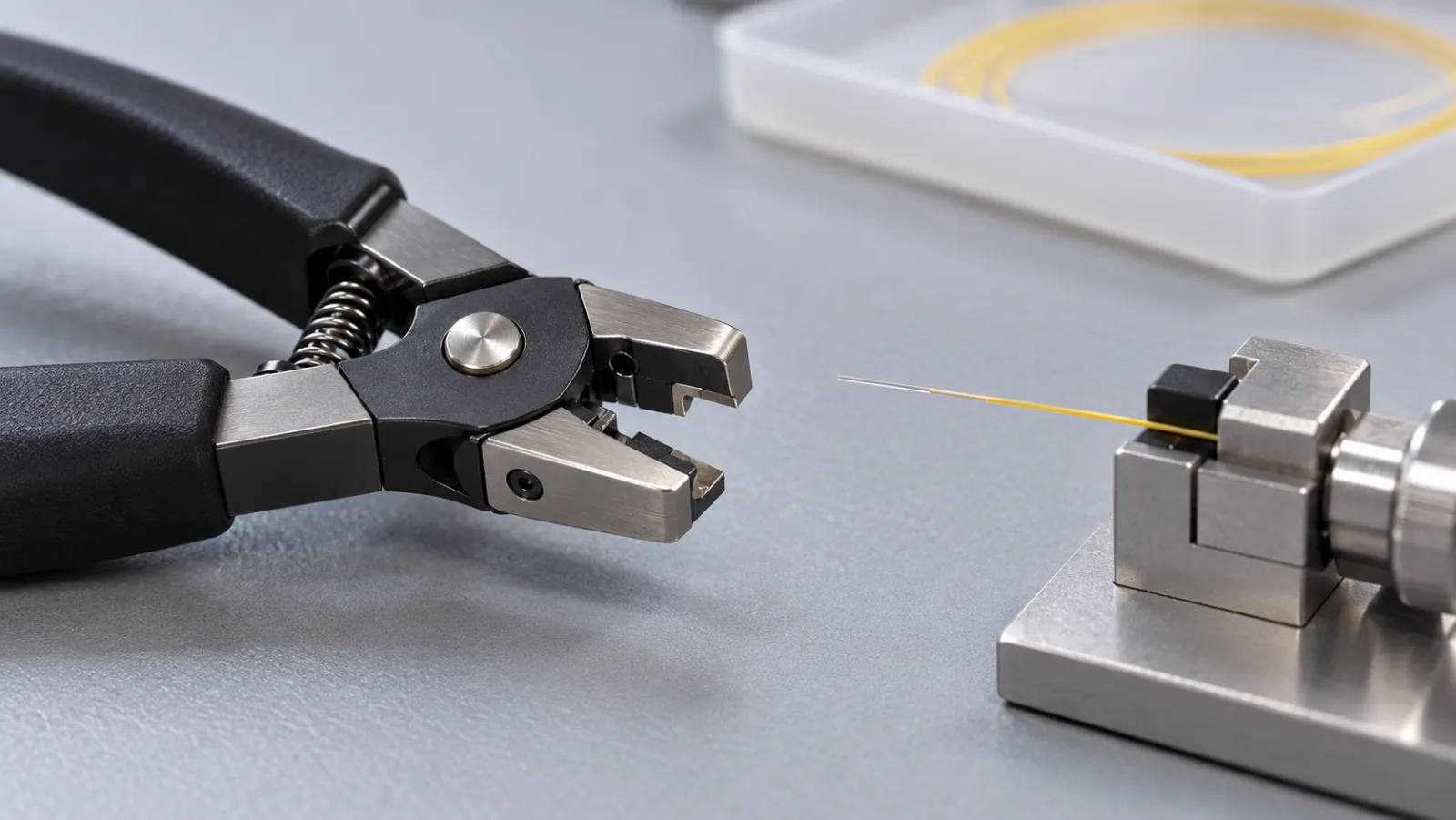
Ask the laboratory to identify the stripping tool and its relevant geometry, the specified preparation length, motion conditions, specimen conditioning and force-measurement system. These fields make results interpretable; this article does not supply substitute settings. Tool wear, contamination or an undocumented procedural deviation should be investigated through the laboratory’s controlled method rather than guessed from the final force value.
Keep failed preparation attempts and invalid-test explanations traceable. The applicable method determines which results are valid and how they are reported. If a specimen breaks or a tool slips, the reviewer needs a reasoned classification, not silent disappearance from the spreadsheet. Distinguish a method-defined exclusion from a legitimate product failure, and preserve enough information for another reviewer to understand the choice.
For environmental comparisons, identify the specimen groups and their exposure history. A dry group and a conditioned group should not be pooled into one convenient average unless the specification calls for that treatment. Establish whether measurements occur immediately after exposure or after defined recovery. Otherwise, apparent differences between suppliers may reflect different specimen states rather than different product behavior.
Do not substitute strippability for mechanical strength
A coating-removal measurement is not evidence that the glass will survive a particular installation load. Our explanation of fiber proof-test stress addresses that separate property. Keep both characteristics in their own compliance rows. A product can satisfy one specified requirement while still lacking the evidence needed for another.
Likewise, the 250 versus 900 micron pigtail selection guide concerns assembly and handling choices beyond a single force value. A preparation process must suit the actual fiber, buffer, holders and splice workflow. Avoid changing a field technique solely to reproduce a laboratory number; use the product and tool instructions and the approved work procedure.
Turn the findings into a clear inquiry
When using the optical fiber product page to prepare an inquiry, specify the fiber variant, coating dimensions, intended processing step and evidence required. Ask which results are typical characterizations and which limits are contractually guaranteed. Include the method edition, conditioning, metric, sample plan and decision rule in the technical schedule rather than scattering them across informal messages.
Finally, retain the original report alongside the purchase decision. Record any accepted exception without altering the reported result. Clear separation between measured force, typical information and contractual limits makes later lot comparisons more useful and prevents a favorable-looking average from becoming an unsupported claim about processing reliability.
Frequently Asked Questions
What does a fiber coating strip force test measure?
It measures the force involved in mechanically removing the protective coating along the fiber axis under a defined procedure. The reported force metric and specimen conditions must be identified.
Is coating strip force the same as fiber proof-test stress?
No. Strip force concerns coating removal, while proof testing applies a specified tensile stress to the fiber. A result for one does not establish compliance with the other.
Does IEC 60793-1-32 prescribe the best field-stripping technique?
No. Its published scope explicitly distinguishes the standardized strippability test from selecting optimal field-stripping conditions or maximizing strength after stripping.
Can a typical strip-force value be used as a maximum acceptance limit?
Not automatically. A typical characterization and a guaranteed maximum are different statements. Obtain the contractual limit and the exact metric to which it applies.
Can an acceptable average conceal an excessive individual result?
Yes. If the contract limits every specimen, the individual results must satisfy that rule; an acceptable group average does not override an individual exceedance.