Summary: A fiber cable abrasion test can answer two different questions: whether the outer sheath resists wear and whether identification remains readable. Those are not interchangeable results. This guide explains E2A versus E2B, how to review an older qualification report, and how to build a purchasing evidence matrix without inventing a universal cycle count or translating laboratory rubbing into guaranteed installation life.
Start with the surface that must survive
A cable can retain a sound jacket while losing its printed identification. It can also retain readable marking in one area while suffering mechanical damage elsewhere. A single statement such as “abrasion passed” does not tell the buyer which outcome was assessed. Before requesting a test, identify the practical concern: sheath protection, legibility of manufacturing identification, visibility of a continuous colored line, or several separate requirements.
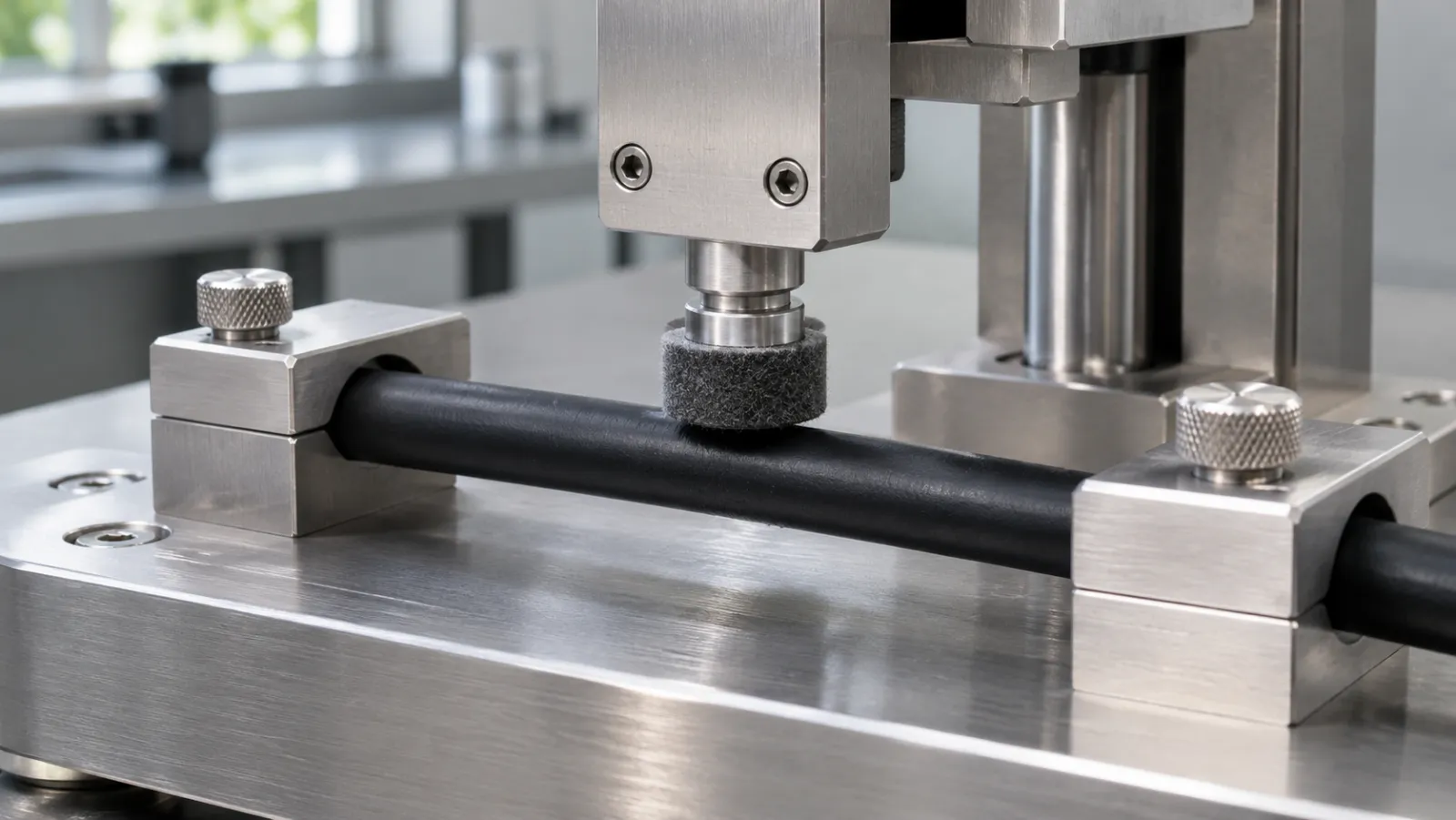
The official scope of IEC 60794-1-102:2026 separates these objectives. E2A concerns sheath abrasion resistance; E2B concerns resistance of cable markings, including text, graphics and continuous colored lines. Published on September 22, 2026, the document replaces method E2 in IEC 60794-1-21:2015. The IEC summary identifies changes concerning surface cleaning, the number of E2B tests and reporting details. This is an edition-control issue, not a reason to assume every older report is invalid.
When evaluating a proposal, record the exact cable construction and the marking process being offered. A jacket compound designation alone does not identify the complete tested product. Cable diameter, sheath thickness, surface finish, ink or marking technique, and production revision may all be relevant to the evidence comparison. Ask the supplier to explain which configuration the submitted report actually represents.
E2A and E2B belong in separate compliance rows
| Purchasing question | Evidence to identify | Unsupported substitution |
|---|---|---|
| Does the sheath resist the specified abrasion exposure? | E2A method, specimen and acceptance criteria | Readable printing used as proof of jacket integrity |
| Does identification remain usable? | E2B method and defined marking assessment | An undamaged jacket used as proof of legibility |
| Does the offered variant match the tested variant? | Construction and production traceability | A similar-looking cable photograph |
| Is the evidence acceptable for this order? | Contract edition and any approved equivalence review | A generic certificate with no report reference |
Keep optical requirements separate as well. A mechanical or visual observation cannot replace an attenuation measurement when the contract requires one. Conversely, a satisfactory optical reading does not establish that a jacket or identifying mark meets its visual requirement. The purchase schedule should state which checks are required and when each observation is made, rather than combining them into an unexplained overall pass.
Separate a test method from a product specification
A method describes how a characteristic is assessed; the applicable product specification and agreed purchase requirements determine what evidence is needed for the intended cable. For example, IEC 60794-6-10:2020 addresses universal indoor-outdoor cable construction and performance at the family level. Its public scope describes a combination of outdoor robustness and indoor suitability. That scope does not make one abrasion setting appropriate for every cable family, installation or customer.
Do not copy a force or cycle count from an unrelated tender and label it an IEC requirement. Obtain the complete applicable documents and identify the invoked clause, edition and permitted options. If two reports use different conditions, list those differences before ranking the products. A larger cycle count under a different contact geometry or load is not automatically stronger evidence of performance.
This guide intentionally does not provide an improvised laboratory procedure. A qualification setup needs controlled apparatus, preparation, conditioning and evaluation. Scraping a delivery reel with a hand tool cannot recreate a standardized test and may damage saleable cable. Use a competent laboratory and an agreed method for formal evidence; reserve incoming visual inspection for the questions it can actually answer.
Build an evidence coverage matrix before requesting quotations
A hypothetical six-cell review
Assume a buyer is comparing three fictional cable variants: A, B and C. For each variant, the project requires separate evidence for sheath abrasion and marking abrasion. The review therefore contains three variants multiplied by two evidence categories, giving six required cells. This arithmetic counts documentation coverage only. It does not determine the number of specimens or tests required by any standard.
| Fictional variant | Sheath evidence | Marking evidence | Review action |
|---|---|---|---|
| A | Matched report available | Matched report available | Review conditions and criteria |
| B | Matched report available | Not supplied | Request marking evidence |
| C | Not supplied | Report references a different marking revision | Resolve both evidence gaps |
Three of the six cells have directly matched reports. Two have no report, and one has a report that does not yet match the offered revision. Calling this “four of six passed” would be misleading: the matrix describes evidence availability, not test outcomes. Even the three matched cells still need technical review before they can support an acceptance decision.
If the supplier provides a written equivalence assessment for variant C, preserve that assessment with its justification and approval. Do not silently change the table from “different revision” to “tested” unless the new wording accurately describes what happened. A review based on similarity and a direct test of the offered construction are different forms of evidence, even when the project accepts both.
Keep sampling separate from coverage
Suppose a separate, explicitly hypothetical project plan requests two specimens for each of those six cells. That would create twelve specimen assignments before considering whether the approved procedure permits any reuse. It would not establish statistical confidence, production acceptance sampling or the correct IEC specimen count. The laboratory must resolve actual sample quantities, test sequencing and destructive effects using the applicable method.
This distinction prevents a common procurement shortcut: treating a complete spreadsheet as proof of adequate testing. Coverage asks whether each required question has evidence. Sampling asks how the evidence was obtained and how it represents a population. Both matter, but one cannot answer the other. Record the report identifier, specimen identity and method alongside each cell so that the review remains auditable.
Review older reports without erasing their history
A report referencing IEC 60794-1-21:2015 should retain that reference. Ask which E2 procedure was performed, what preparation was used and which observations were recorded. Then compare that information with the edition required by the current contract. The published changes in the newer method identify useful review questions, but they do not substitute for a clause-by-clause comparison of the complete documents.
Possible outcomes include accepting the existing evidence under the agreed contract, requesting supplementary information, or commissioning additional testing. Record the decision and its scope. Do not reissue an old report with a newer standard number merely to make the quotation look current. Likewise, do not claim that publication of a new method proves the older cable itself has become physically unsuitable.
Connect qualification to installation controls
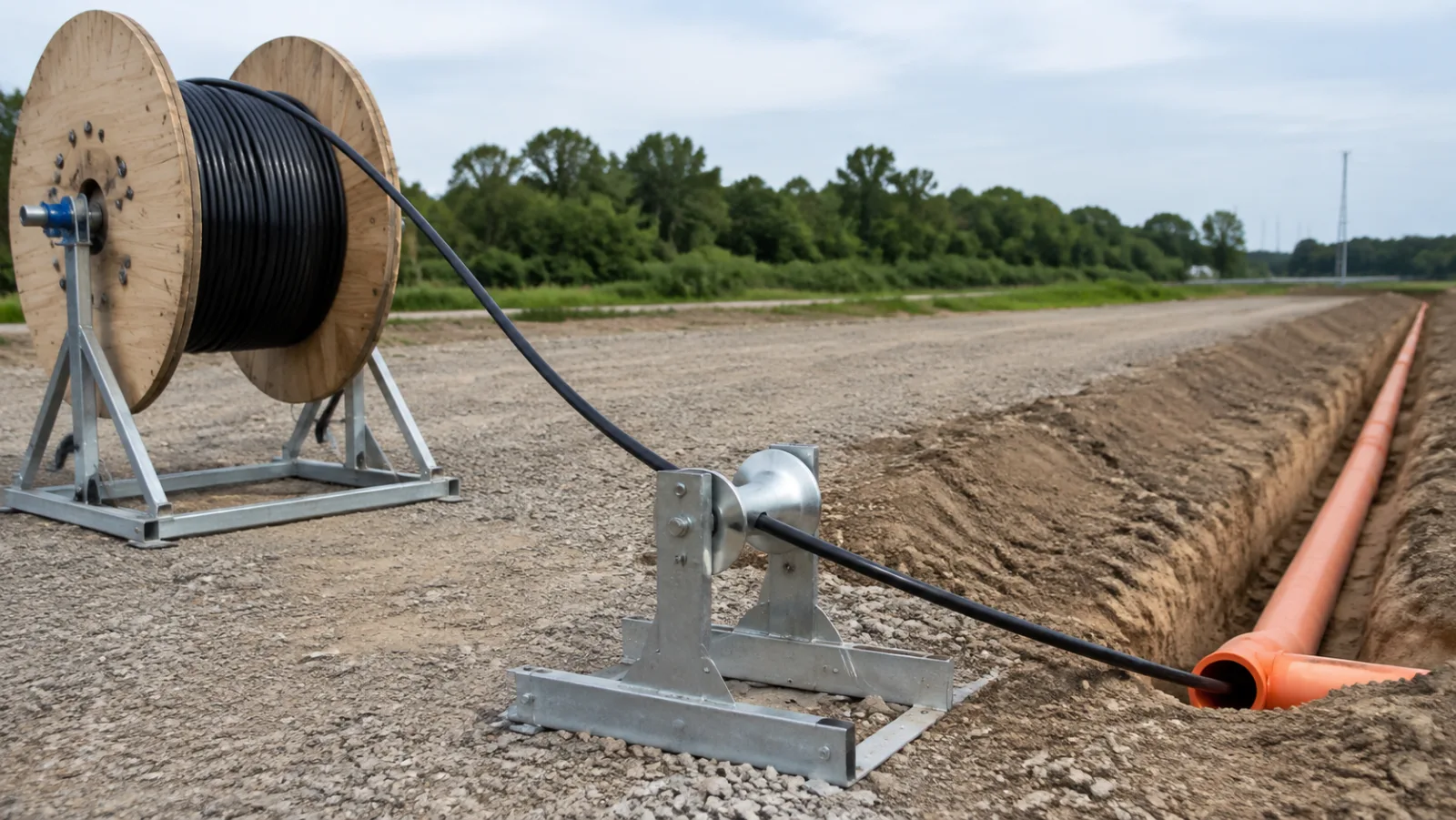
Abrasion qualification does not authorize dragging cable across sharp edges or ignoring route preparation. Site contact materials, contamination, tension and movement can differ from the laboratory exposure. The pulling tension and sidewall pressure guide addresses separate installation constraints. Those checks remain necessary even when the cable has suitable abrasion evidence.
At delivery, use the cable reel inspection checklist to confirm identity, visible condition and the documentation package. Preserve photographs of any transport damage before installation. A damaged outer wrap, unreadable delivery marking or a mismatch between reel and report should trigger a controlled clarification, not an assumption that a generic factory qualification covers the observed condition.
Write an inquiry that can receive a precise answer
For an inquiry through the fiber optic cable product page, identify the cable variant, application, required standard edition and the two abrasion questions separately. Request report traceability, preparation details, acceptance criteria and any exceptions. State whether the request concerns existing qualification evidence or a new project-specific test; these can involve different lead times and deliverables.
The useful purchasing result is a documented match between the offered construction and the required evidence. It is not the largest isolated cycle number or a photograph of an abrasion machine. Keeping sheath performance, marking durability and installation practices separate makes quotations easier to compare and prevents a narrow laboratory result from becoming an unsupported promise about service life.
Frequently Asked Questions
What is the difference between E2A and E2B?
In IEC 60794-1-102:2026, E2A addresses sheath abrasion resistance, while E2B addresses abrasion resistance of cable markings.
Does readable cable marking prove the sheath passed an abrasion test?
No. Marking durability and sheath resistance are separate characteristics and need evidence appropriate to each requirement.
Does the new standard automatically invalidate an older report?
No. Review the report against the edition and requirements invoked by the contract, preserving its original method reference and any approved equivalence assessment.
Can a higher cycle count prove that one cable is better?
Not by itself. Load, contact geometry, preparation, specimen construction and acceptance criteria must also be comparable.
Can abrasion testing guarantee a number of installation or service years?
No. A result applies to its specified exposure; a service-life claim requires separate supporting evidence and assumptions.