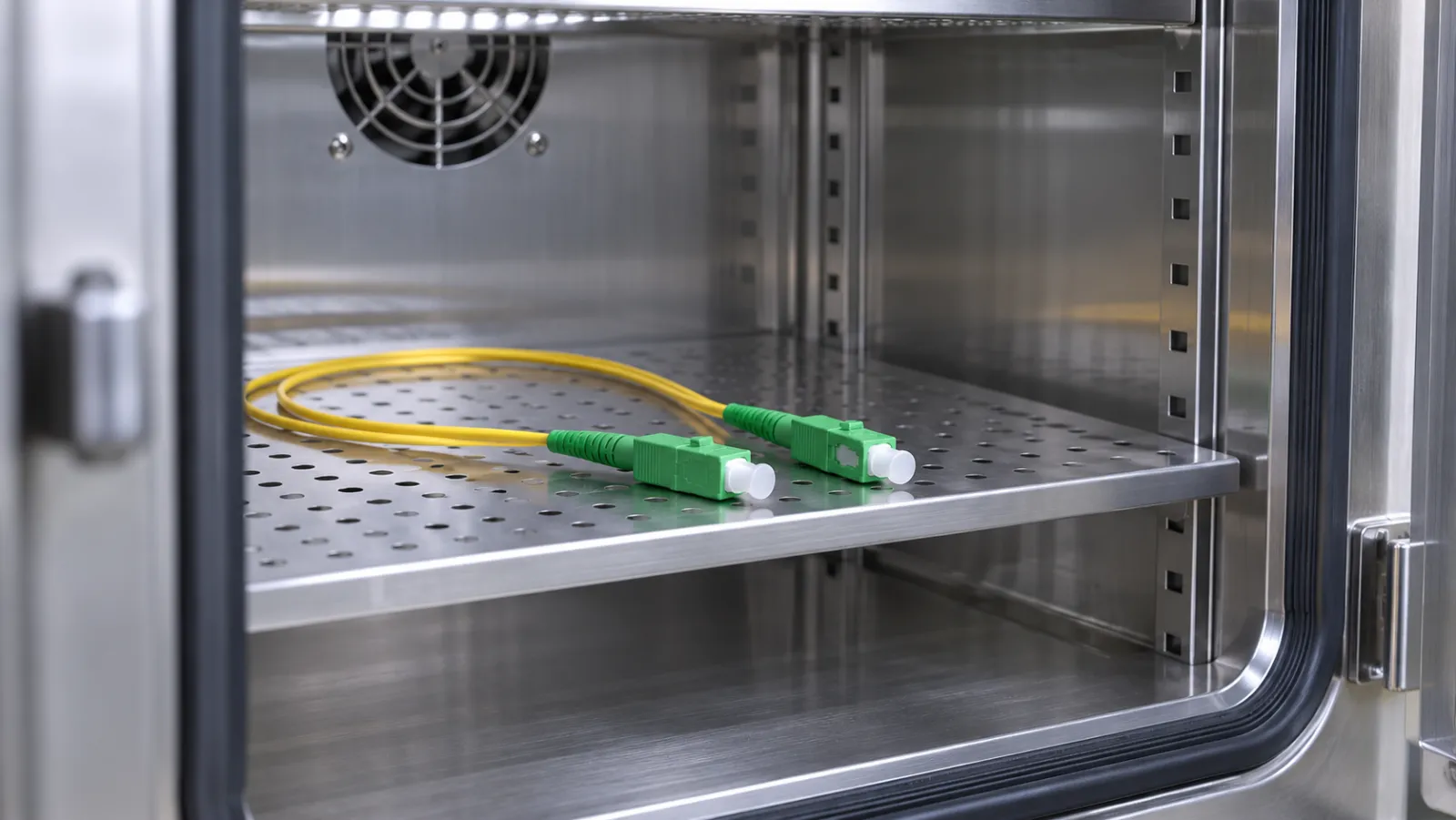
Summary: A fiber connector damp heat test report needs more than a temperature and a humidity percentage. The buyer must identify the device configuration, exposure method, measurement checkpoints and acceptance rule. This guide distinguishes steady damp heat from cyclic temperature and humidity exposure, then uses a hypothetical data-coverage worksheet to show why a final low-loss reading cannot prove that every required observation was completed.
Define the device being qualified
A connector can be supplied as a component, a terminated patch cord, a mated pair or part of a sealed assembly. These are different test articles. Before reviewing humidity evidence, establish exactly what entered the chamber and which surfaces or connections were exposed. A result for an isolated component should not be described as qualification of an entire cabinet, closure or installed network.
Record the connector type, fiber and cable construction, termination process revision, mating adapter and any protective accessories. Include whether the assembly was mated, capped or otherwise configured during exposure. These details are not administrative decoration: they define the physical arrangement represented by the report. A change in the offered assembly requires an explanation of why the earlier evidence remains applicable.
Steady damp heat and cyclic exposure answer different questions
IEC 61300-2-19:2012 addresses high humidity at constant temperature over a specified period for fiber optic devices. Its scope includes conditions relevant to use, storage or transport. The public description establishes the test’s purpose, but it does not give buyers permission to invent an exposure duration or apply one acceptance limit to every passive component.
By contrast, the published scope of IEC 61300-2-21:2009 describes composite temperature and humidity cycling, including cold conditions, condensation and effects associated with trapped water. The distinction is important: a steady exposure and a cyclic sequence are not merely two labels for the same qualification. Use the exact edition invoked by the project and confirm applicable revisions with the laboratory before testing.
| Report description | Question it can address | Claim it does not automatically establish |
|---|---|---|
| Steady damp heat | Response to the specified sustained humidity and temperature exposure | Performance under an unspecified cyclic profile |
| Composite temperature/humidity cycling | Response to the stated sequence and its conditions | Unlimited outdoor service life |
| Operating temperature range | Declared temperature limits under stated conditions | Completion of a humidity qualification |
| Enclosure protection rating | Protection assessed for the rated enclosure configuration | Humidity qualification of every component inside it |
Do not treat the words “outdoor,” “industrial” or “telecom grade” as a complete test specification. They may describe a market or intended application without defining the exposure or optical criterion. Ask for the actual evidence and its scope. If the report supplies only a summary certificate, request the underlying method reference and result schedule needed to evaluate the claim.
Specify the observation schedule before the chamber run
The technical schedule should distinguish baseline readings, any required observations during exposure, and final readings after the specified recovery. These checkpoints may answer different questions. A final result can describe the recovered state while leaving behavior during exposure unobserved. The applicable method and project requirements determine what is necessary; this article does not prescribe a universal checkpoint schedule.
Also identify the optical measurement boundary. Does a reported loss include one mated connection, a complete patch cord or additional test leads? Keep the reference arrangement and wavelength explicit. Reconnecting or cleaning interfaces can change the measurement, so the report should show when those actions occurred. An unexplained new reference can make a final number look comparable when it represents a different boundary.
Visual checks deserve their own fields. Record the defined condition assessment and any observed changes without replacing them with an optical pass. A low attenuation reading is not a complete inspection of all mechanical surfaces. Conversely, a clean-looking housing does not establish acceptable optical behavior. The decision should follow the complete agreed criteria rather than whichever observation is most favorable.
A hypothetical measurement-coverage worksheet
Count required observations, not just specimens
Assume a fictional purchasing plan covers four assemblies, two test wavelengths and three checkpoints: baseline, an agreed intermediate checkpoint and recovery. The expected table therefore has 4 × 2 × 3 = 24 observations. These numbers are invented solely to illustrate record completeness. They are not a specimen count, exposure profile or measurement schedule specified by IEC 61300-2-19.
| Checkpoint | Expected observations | Available observations | Interpretation |
|---|---|---|---|
| Baseline | 8 | 8 | Complete for the assumed plan |
| Intermediate | 8 | 7 | One required record is missing |
| Recovery | 8 | 8 | Complete for the assumed plan |
| Total | 24 | 23 | 95.8% record coverage, not a pass rate |
The coverage calculation is 23 / 24 × 100 = 95.8%, rounded to one decimal place. It says nothing about whether the 23 available values meet their limits. A reviewer should identify the missing assembly, wavelength and checkpoint, then follow the approved disposition process. It would be misleading to call the batch “95.8% compliant” or assume that a satisfactory recovery value reconstructs the missing observation.
Interpret a change without changing its meaning
For one fictional assembly at one wavelength, suppose baseline insertion loss is 0.22 dB, the recorded intermediate value is 0.41 dB and the recovered value is 0.25 dB. Relative to baseline, the recorded changes are +0.19 dB and +0.03 dB. These are invented readings, not Liqiba test results. They demonstrate why reporting only the final change would omit information present in the intermediate record.
Now assume the fictional contract allows no more than +0.15 dB at every required checkpoint. The intermediate observation exceeds that chosen criterion even though the recovered value does not. If the real contract instead defines a different criterion or observation schedule, apply that rule. Never take the example’s threshold as an IEC limit or a recommendation for all connector types.
A single intermediate reading is not necessarily the maximum change during the entire exposure. Continuous monitoring, scheduled readings and endpoint-only measurements provide different evidence. Keep the acquisition method visible in the report. Do not draw a smooth worst-case curve between sparse values or rename a sampled value as a verified peak unless the measurement process supports that statement.
Control recovery, handling and unexplained interruptions
Ask how recovery conditions were defined and recorded. The final optical state should be associated with the required recovery sequence, not simply “measured later.” If the chamber run was interrupted, preserve the time history and the laboratory’s disposition. Repeating a portion of the exposure or extending the duration may require an approved decision; neither should disappear from the final report.
Handling after exposure also needs traceability. If an interface was disconnected, cleaned or remated before a final measurement, the reviewer needs to know. That action may be required or permitted by the applicable procedure, but it still changes the interpretation of the record. The connector inspection and cleaning guide covers routine interface care; it is not authorization to alter a qualification sequence.
Do not convert chamber hours into years of service
A qualification exposure is evidence under specified conditions. Converting it into a service-life claim requires a justified model and supporting data for the relevant failure mechanism. This guide provides neither. A buyer should therefore avoid statements such as “this test guarantees twenty years outdoors” unless the supplier can substantiate the separate reliability claim and its assumptions.
Likewise, humidity qualification does not replace mechanical durability evidence. The connector mating durability guide concerns repeated mating under a defined plan. A product may need both types of qualification, but passing one does not establish the other. Keep them as distinct rows in the compliance matrix rather than creating an undifferentiated reliability score.
Turn the review into a useful patch-cord request
When requesting options through the fiber optic patch cord product page, describe the installation environment, assembly configuration and required qualification evidence. Specify the method edition, exposure conditions, optical boundaries, wavelengths, observation schedule and acceptance criteria through the project documents. Ask the supplier to identify gaps or exceptions before the order is finalized.
Preserve the original report, raw result schedule and any approved deviation with the purchasing decision. A good review makes it possible for another person to see what was exposed, what was measured and which criterion was applied. That clarity is more useful than an isolated humidity percentage, an attractive chamber photograph or a final pass label with no traceable supporting record.
Frequently Asked Questions
What does a steady damp heat test assess?
It assesses a device under a specified sustained high-humidity and constant-temperature exposure, using the applicable method and acceptance requirements.
Is steady damp heat the same as temperature and humidity cycling?
No. They use different exposure approaches and cannot be treated as interchangeable qualification evidence.
Does a satisfactory final loss reading prove every checkpoint passed?
No. It describes the measured final state and cannot reconstruct missing or excessive observations at other required checkpoints.
Does an enclosure protection rating replace connector humidity testing?
No. The enclosure rating and the component qualification have different scopes and must be reviewed separately.
Can chamber exposure hours be converted directly into years of service?
No. That conversion requires a justified reliability model and supporting data, which a qualification result alone does not provide.